In traditional project management conversations, business success is often defined by three familiar metrics: scope, schedule, and cost. But is that really helpful?
Table of Contents
Delivery Success Is Not Business Success.
If a project is delivered on time, within budget, and as per requirements, it is labeled a success.
But in reality, many such “successful” projects quietly fail.
They fail not during execution, but much earlier — and sometimes, much later.
This raises an uncomfortable but necessary question:
At what stage does a project truly fail?
The Harsh Truth: Most Projects Fail Before They Even Start
From a business perspective, the earliest and most critical point of failure is Project Selection.
1️⃣ Failure at the Project Selection Stage
A project begins to fail the moment it is approved for the wrong reasons.
At this stage, leadership decides:
- Which problems are worth solving
- Which opportunities deserve investment
- Where limited time, money, and talent should be deployed
If this decision is flawed, no amount of perfect execution can save the project.
Common selection-stage failures include:
- Solving a problem that is not strategically important
- Approving projects based on hierarchy, influence, or urgency rather than value
- Chasing trends without understanding long-term impact
- Lack of alignment with business goals such as revenue growth, cost reduction, customer experience, or risk mitigation
A well-executed wrong project is still a wrong investment.
From a business standpoint:
A project that should never have been approved is already a failed project — even before planning begins.
Planning Phase: Where Value Often Gets Lost
Even when the right project is selected, failure can still be designed into the project during the planning phase.
2️⃣ Failure During Project Planning
Planning is where business intent should translate into execution reality.
Unfortunately, this is where many projects quietly drift away from value.
Typical planning-stage issues include:
- Business objectives that are vague or unmeasurable
- Success criteria defined only in terms of deliverables
- No clarity on how and when business benefits will be realized
- Risks identified technically, but not commercially
- No clear ownership of outcomes after project closure
In many organizations, planning focuses on how to deliver rather than why the delivery matters.
The result?
Projects that are beautifully planned — but poorly aligned with outcomes.
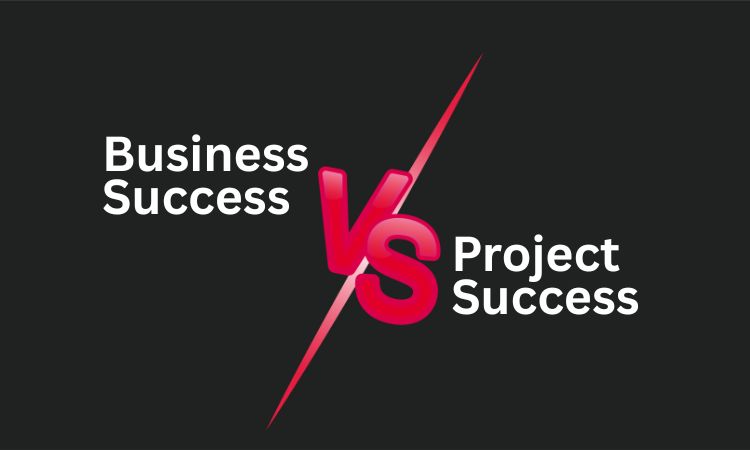
The Most Important Distinction: Delivery Success vs Business Success
This is where the conversation must mature.
Two Types of Success
| Type | Definition |
|---|---|
| Delivery Success | Project completed as per scope, time, and cost |
| Business Success | Project creates measurable value for the organization |
Many projects achieve delivery success.
Far fewer achieve business success.
From a business lens:
Outputs do not equal outcomes.
A system can be implemented.
A platform can be launched.
A feature can be delivered.
But if:
- Users don’t adopt it
- Revenue doesn’t improve
- Costs don’t reduce
- Risks don’t decline
Then the project has failed — regardless of how well it was delivered.
So, When Does a Project Actually Fail?
A project truly fails when:
- It does not create the value it was funded for
- It consumes resources without a measurable return
- It solves yesterday’s problem
- It delivers outputs without outcomes
And importantly:
Many projects are declared “successful” at closure — but fail months later in the real business environment.
This is why Benefits Realization is more important than Project Closure Reports — yet is often ignored.
The Critical Question: Is It a Project Manager’s Responsibility to Say This?
This is where your thought becomes bold — and necessary.
Can a Project Manager State That a Project May Succeed in Delivery but Fail as a Business?
Yes. And in mature organizations, they are expected to.
However, there is an important distinction.
A Project Manager:
- Is not the final decision-maker on business strategy
- Is not the sponsor or P&L owner
But a Project Manager is:
- Responsible for surfacing risks — including business risks
- Accountable for alignment between objectives and execution
- Positioned closest to early warning signals
Business value erosion is still a project risk.
Silence does not mean neutrality.
Silence means the risk goes unreported.
How a Project Manager Should Raise This Concern
This is not about opinion — it is about framing.
A mature Project Manager does not say:
“This project is a bad idea.”
Instead, they say:
“There is a risk that the project will meet delivery goals but may not achieve the intended business outcomes due to changes in assumptions, market conditions, or adoption readiness.”
This approach:
- Respects organizational hierarchy
- Protects the PM professionally
- Enables informed decision-making
- Elevates the PM from executor to business partner
Is This the Sponsor’s Job Instead?
Yes — ownership of business outcomes lies with the sponsor.
But sponsors depend on Project Managers to surface reality early.
In retrospectives, one question always appears:
“Why wasn’t this flagged earlier?”
A Project Manager who identifies value risk early:
- Protects the organization
- Builds long-term credibility
- Demonstrates leadership maturity
Low-Maturity vs High-Maturity Organizations
In low-maturity environments:
- PMs are expected to “just deliver.”
- Raising value concerns is seen as overstepping
- Projects are celebrated at closure, not in impact
In high-maturity organizations:
- PMs are expected to think beyond delivery
- Value discussions are encouraged
- PMs act as strategic execution partners
This difference defines career trajectories.
Final Thought: Redefining Project Failure
A project does not fail because it missed a deadline.
It fails because it failed to matter.
In Summary:
- Most failures originate at project selection
- Many are reinforced during planning
- Some only become visible after delivery
- True success is value realization, not task completion
A project delivered perfectly but irrelevant to the business is still a failed project.
And a Project Manager who understands this is no longer just managing projects — they are safeguarding the business and working towards business success.
Connect with me or contact me via PMPROCESSES