Project Management (PM) is often misunderstood as a role-specific skill—something only project managers need to worry about. In reality, this mindset is one of the biggest reasons projects struggle.
Successful projects are not driven by titles. They are driven by shared understanding.
When everyone involved in a project—from senior leadership to junior team members—understands the fundamentals of project management, execution becomes smoother, decisions become clearer, and collaboration becomes stronger.
Project Management Is Not Just a Role — It’s a Shared Language
Every project involves:
- Goals to be achieved
- Timelines to be respected
- Dependencies to be managed
- Risks to be identified
- Changes to be handled
These are not problems owned only by the project manager. They affect everyone working on the project.
When team members understand basic project management concepts, they begin to see how their individual work connects to the larger picture. This shared language reduces confusion, rework, and misalignment.
Why Understanding PM at All Levels Matters
1. Better Decision-Making
When people understand scope, priorities, and constraints, they make decisions that support the project instead of unknowingly working against it.
2. Clearer Communication
Teams that understand project management communicate more effectively. Discussions become objective, focused, and aligned with project goals rather than personal opinions.
3. Stronger Ownership
When team members understand how projects are planned and executed, they take greater ownership of outcomes—not just tasks.
4. Reduced Dependency on the Project Manager
A project manager should guide and enable, not act as the single point of control. A team with project management awareness becomes self-reliant and proactive.
5. Fewer Surprises
Most project surprises come from a lack of shared understanding. When everyone understands timelines, risks, and dependencies, surprises are reduced significantly.
PM Is a Life Skill, Not Just a Project Skill
Learning project management doesn’t just help during projects—it helps people:
- Plan work more effectively
- Manage time and priorities
- Collaborate better with others
- Think in terms of outcomes, not just activities
These skills are valuable regardless of role, seniority, or industry.
From Senior to Junior — Everyone Benefits
- Senior leaders make more realistic commitments and strategic decisions
- Middle managers align execution with business objectives
- Team leads coordinate work more efficiently
- Junior team members understand expectations and grow faster
Project management knowledge creates alignment across all levels.
Final Thought
Projects don’t fail because one person lacks skill. They fail because teams lack shared understanding.
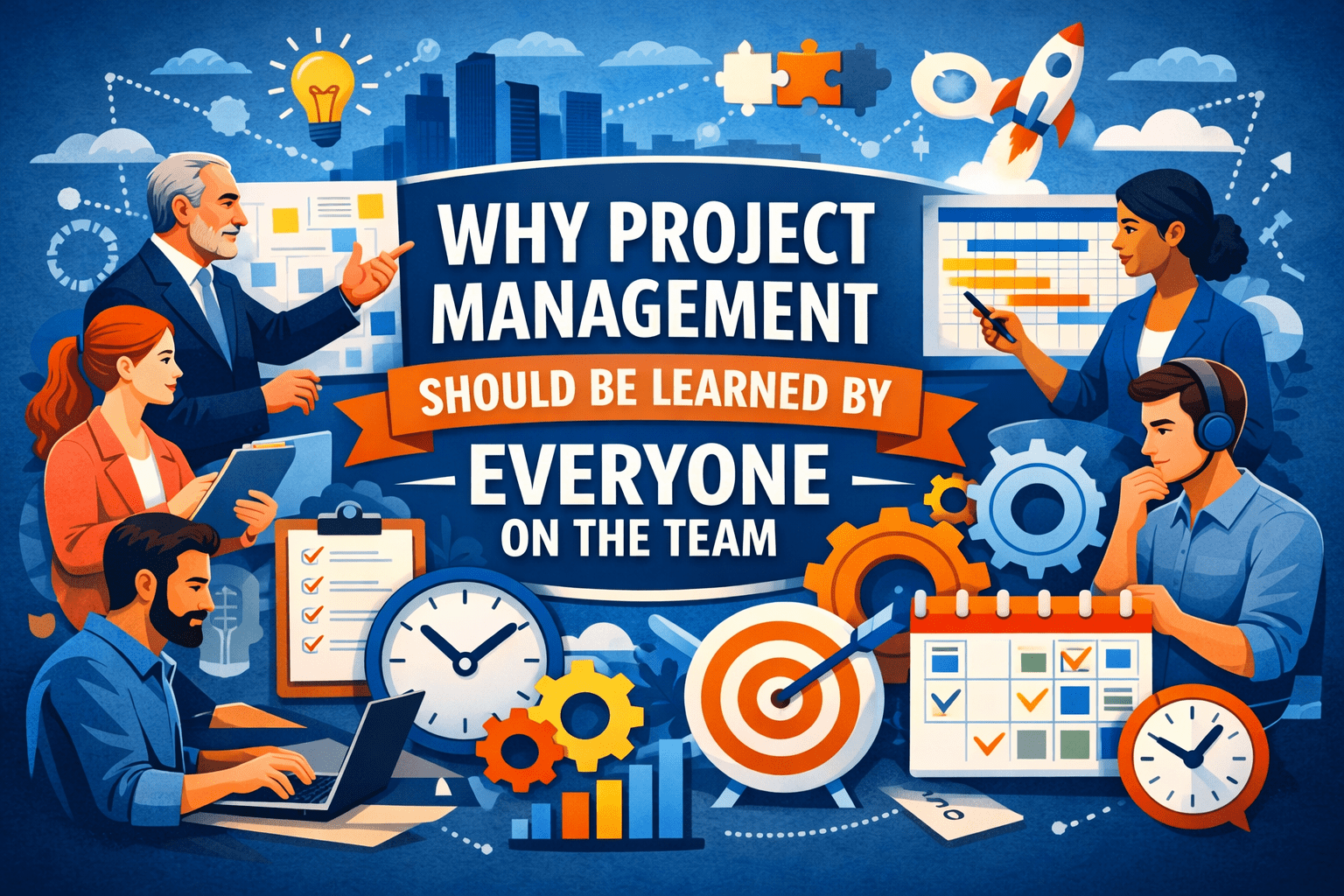
That’s why project management should not be limited to a single role. It should be learned by everyone involved in the project, regardless of title or experience level.
When project management becomes a team capability rather than an individual responsibility, projects stop being stressful—and start being successful.
References
- Project Management Institute (PMI)
A Guide to the Project Management Body of Knowledge (PMBOK® Guide)
PMI emphasizes that project success depends on stakeholder engagement, shared understanding, and collaboration across all roles—not just the project manager. - Project Management Institute
Pulse of the Profession® Reports
These reports consistently highlight that projects perform better when organizations build project management capability across teams and functions. - The Scrum Guide – Schwaber & Sutherland
Scrum clearly states that successful delivery is a team responsibility, where everyone understands goals, priorities, and delivery constraints—not just the Scrum Master. - Harvard Business Review
Articles on cross-functional teams and execution repeatedly show that shared frameworks and common operating understanding improve outcomes and reduce friction. - Google – Project Aristotle
Google’s research on high-performing teams found that clarity, shared goals, and mutual understanding matter more than individual roles or seniority. - Making Things Happen – Scott Berkun
The book reinforces that project management principles are practical thinking tools that benefit designers, engineers, leaders, and contributors alike.
Connect with our team, just write to us.