
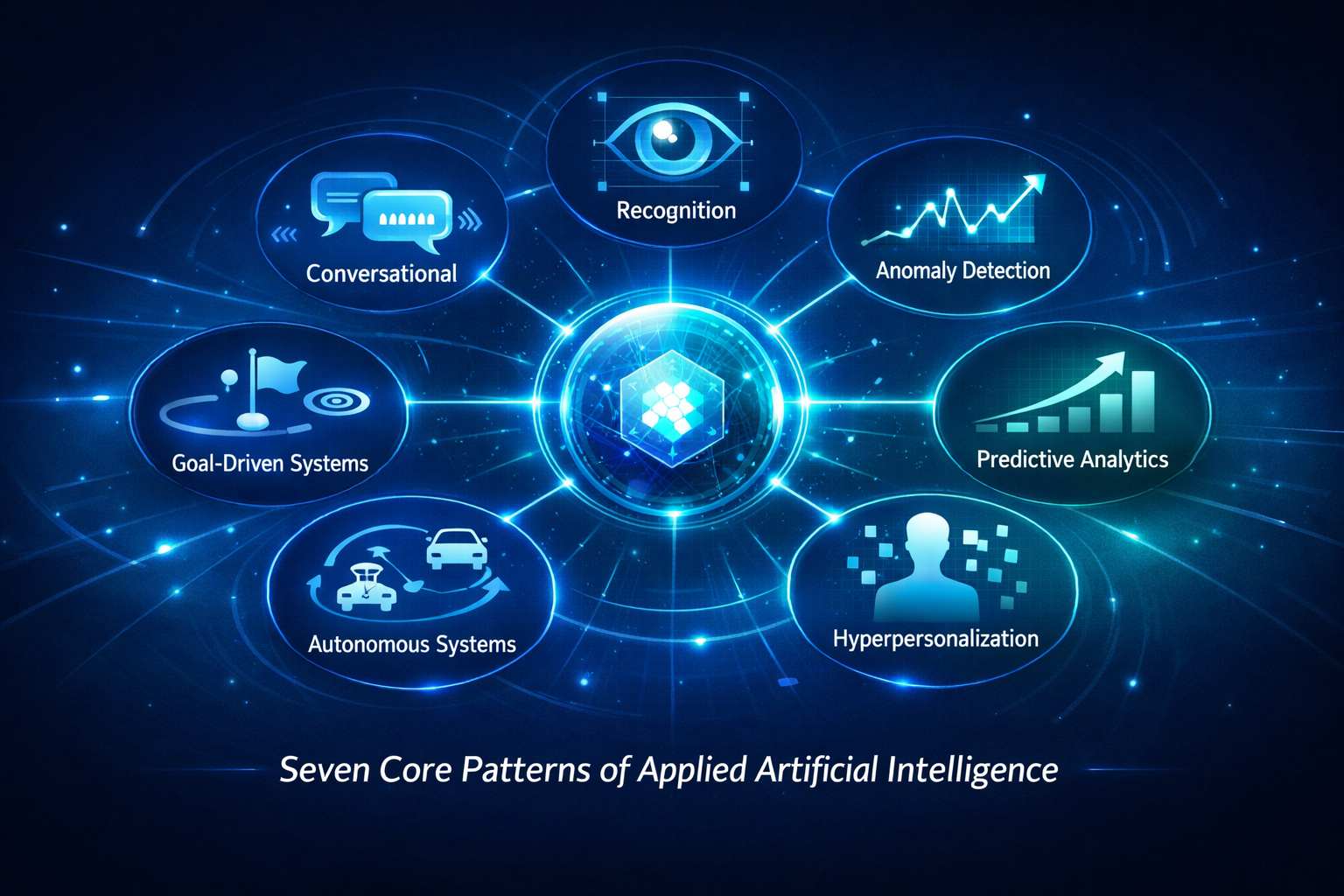
One effective way to understand AI is by organizing its use into seven fundamental application AI patterns that reflect how organizations apply AI to solve problems.
1. Conversational AI Pattern
The Conversational Pattern focuses on AI systems designed to understand and respond to human language in a natural, interactive manner. Common examples include chatbots and virtual assistants.
Unlike traditional software interfaces that depend on rigid commands and structured inputs, conversational AI leverages Natural Language Processing (NLP) to interpret spoken or written language. These systems aim to understand user intent, context, and nuance, enabling them to generate relevant responses or take appropriate actions in a more human-like way.
2. Recognition AI Patterns
The Recognition Pattern centers on AI systems that identify, classify, or extract meaning from data such as images, audio, or text. Examples include facial recognition, handwriting recognition, and text extraction from documents.
These systems are trained to detect features and match them against known patterns in real-world environments. Because real-world data is often noisy and inconsistent, recognition solutions require large volumes of training data, strong validation, and continuous refinement to ensure accuracy, reliability, and efficiency at scale.
3. Patterns and Anomaly Detection
This pattern focuses on discovering meaningful trends, regularities, or unusual deviations within complex datasets.
Typical use cases include detecting fraudulent financial transactions, identifying abnormal network activity, or spotting early warning signs of equipment failure in manufacturing. By learning what “normal” behavior looks like, these AI systems can flag anomalies or emerging patterns that require attention or further investigation.
4. Predictive Analytics and Decision Support
Predictive Analytics and Decision Support systems analyze historical and real-time data to forecast future outcomes, such as predicting sales trends, demand fluctuations, or maintenance needs.
These solutions rely on statistical techniques and machine learning models to uncover correlations and anticipate future states. The insights generated help organizations make informed decisions around planning, resource allocation, and risk management. A key challenge is ensuring the data is comprehensive and accurate, and that predictions remain aligned with real-world conditions so decision-makers can trust the results.
5. Hyperpersonalization Pattern
The Hyperpersonalization Pattern tailors content, recommendations, or experiences to individual users. Examples include product recommendations on e-commerce platforms or personalized content suggestions on streaming services.
AI systems learn from user behavior, preferences, and feedback to continuously refine their recommendations. Key challenges in this pattern include protecting user privacy, managing incomplete or sparse data, and mitigating bias while still delivering highly relevant and engaging experiences.
6. Autonomous Systems Pattern
The Autonomous Systems Pattern involves AI solutions that operate with minimal human intervention. This includes physical systems like self-driving vehicles and robots, as well as autonomous software agents and process automation tools.
These systems combine real-time data processing—often from sensors such as cameras or LiDAR—with decision-making algorithms that allow them to adapt to dynamic environments. Because autonomy carries a higher risk, these solutions demand rigorous testing, strong safety mechanisms, and often regulatory compliance. Continuous learning is essential to help autonomous systems improve performance and handle unexpected situations over time.
7. Goal-Driven Systems Pattern
Goal-Driven Systems focus on optimizing outcomes based on a clearly defined objective, such as scheduling resources, optimizing logistics, or playing strategy-based games.
By defining goals, constraints, and rules, these AI systems evaluate possible actions and determine the most effective path forward. Success depends on accurately modeling real-world constraints, handling changing requirements, and ensuring that recommended actions are practical and executable. These systems often require extensive training, tuning, and iteration to perform reliably.
Connect with US to discuss more about AI in Project Management and CPMAI.