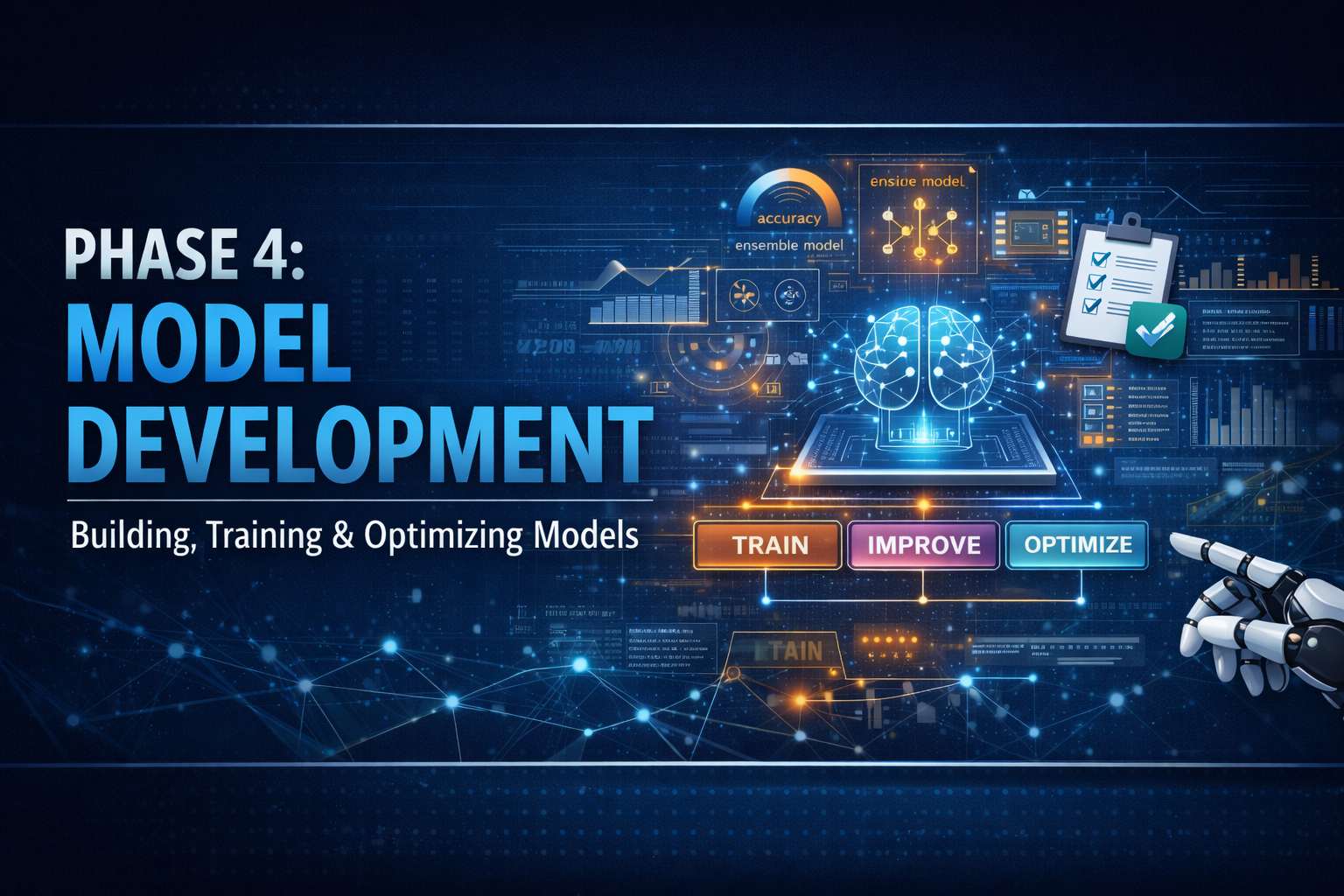
Understanding Model Development should now be an issue. If you have followed the CAPMI phased approach, you should now be well-prepared to build and train your AI models. But first, you have to choose the right tools for the job.
One of the top reasons AI projects fail is a mismatch between the vendor solution and what the organization actually needs.
You might have heard that a certain tool or platform is the latest and greatest in AI, but if it doesn’t align with your specific business problem, or if you haven’t fully defined your problem, then it’s not going to deliver real value.
This is where Model Development – Phase 4 comes in. By this stage, you have clearly defined the problem you’re solving and the data available to support it. With that foundation in place, you can now select the most appropriate AI approach.
You may not need a highly complex, agentic generative AI solution – such as a large language model with retrieval-augmented generation deeply embedded into your enterprise ecosystem.
In many cases, greater value can be achieved with simpler techniques, such as a regression model or a lightweight generative AI solution using basic prompting.
In other scenarios, your requirements may call for a more specialized approach, such as a purpose-built, fine-tuned deep neural network.
Alternatively, the best solution might already exist. An off-the-shelf model or service may meet your needs perfectly without requiring customization. Often, a simpler model can deliver the desired outcomes without the overhead of unnecessary complexity.
Starting simple can significantly reduce the effort required for data labeling, data cleaning, and investment in large-scale cloud infrastructure—especially when less data is sufficient.
And remember, CPMAI is an iterative framework. If new insights emerge or assumptions change, you can always revisit earlier phases, refine your approach, and move forward with greater confidence.
In the Data Model Development phase, the focus shifts to making key decisions about how the AI solution will be built.
- First, determine the type of approach required to solve the problem—such as classification, regression, clustering, or another modeling technique.
- Next, evaluate which algorithms, tools, or platforms best align with the characteristics of your data and your business objectives.
- You must also decide whether to leverage a third-party AI service, use a cloud-based AI platform, or develop the solution entirely in-house.
Each of these options comes with trade-offs related to cost, flexibility, control, and scalability, and should be evaluated carefully before moving forward.
Some models require significant GPU or CPU resources, while others can be trained on a standard laptop. Planning for these computational needs upfront is critical, as they can rapidly increase project costs if overlooked.
When speed and efficiency are priorities, consider using off-the-shelf or third-party solutions that provide pre-trained models. For example, if your requirement is basic image recognition, adapting an existing model can be far more efficient than building one from the ground up.
Model Considerations
One of the biggest pitfalls in this phase is building a model without considering how it will operate in production.
It’s easy to get excited about the latest AI tools or algorithms, but if a solution is too large, too slow, too costly at scale, or too complex to deploy and maintain, the project may stall before it ever delivers value.
That’s why Phase IV requires thinking ahead:
- Where will the model be deployed?
- How will end users interact with it?
- How often will the model need retraining or updates?
- What will it cost to run in real-world conditions?
The answers to these questions may lead you to simplify your approach – or, in some cases, invest in more robust infrastructure. Either way, these decisions should be made in Phase IV to avoid costly surprises later.
CPMAI is built around continuous feedback, meaning you’re never locked into a single model choice.
You might start by training a simple model on a laptop or using an off-the-shelf solution. Test it with a small dataset or a limited real-world scenario, evaluate the results, and refine your approach accordingly.
This iterative process helps uncover risks early and ensures you select the approach best suited to your data, constraints, and business goals.
And if you discover that the data is insufficient or business requirements have shifted, CPMAI allows you to return to Phase II: Data Understanding or Phase I: Business Understanding to recalibrate.
That’s far better than forcing an AI solution forward when the fundamentals aren’t right – only to watch it fail later.
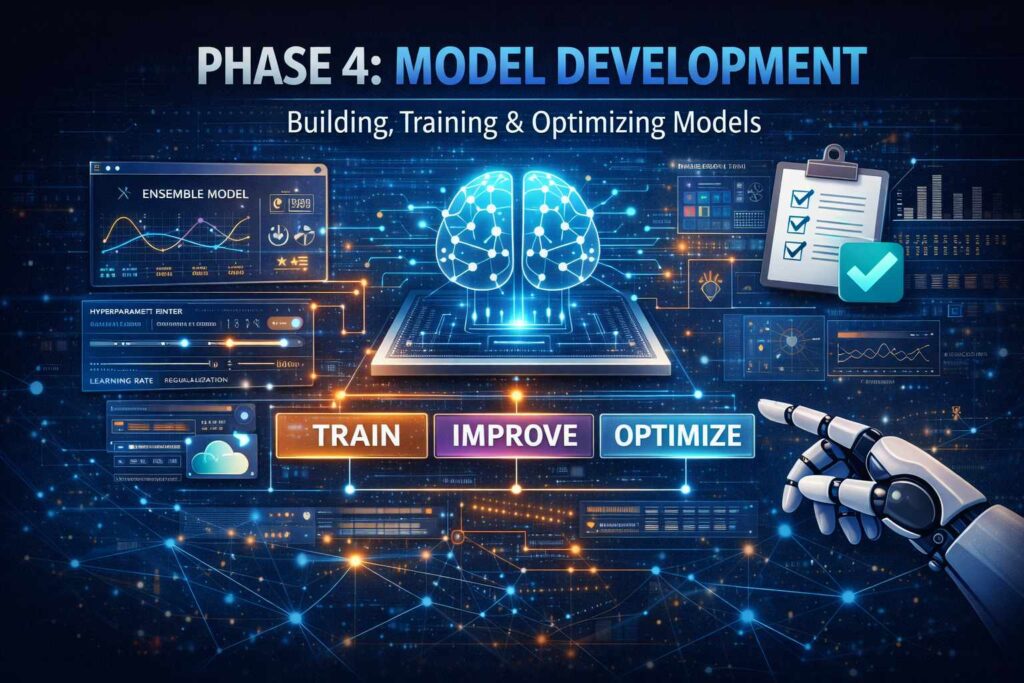
During model development, keep the following questions front and center:
- How do we transform our data into a machine learning model that meets the project’s objectives?
- How effectively is the model being trained?
- How well are we optimizing performance?
- Which algorithms, configurations, and hyperparameters best fit our data and use case?
- Should we use ensemble models, and if so, how should they be designed?
- Would third-party models or extensions add value or accelerate development?
- Are we applying the chosen machine learning techniques correctly and consistently?
Answering these questions prepares you for a smoother transition into the next CPMAI phases, where the model will be evaluated and then operationalized.
Phase IV is where the AI solution truly begins to take shape—but it does not exist in isolation. Every decision made here builds directly on the understanding gained in Phases I through III.
By aligning your model selection, tooling, and training strategy with both your data realities and business goals, you can avoid the misalignment issues that derail many AI initiatives.
Next, we’ll focus on how to test model performance, iterate effectively, and ensure the solution delivers the value originally envisioned.
Connect with us if you have any questions. In case you haven’t read about phase 3, do read. And you need to hire freelancers to help you build or manage your AI projects. Reach out to our team of freelancers.