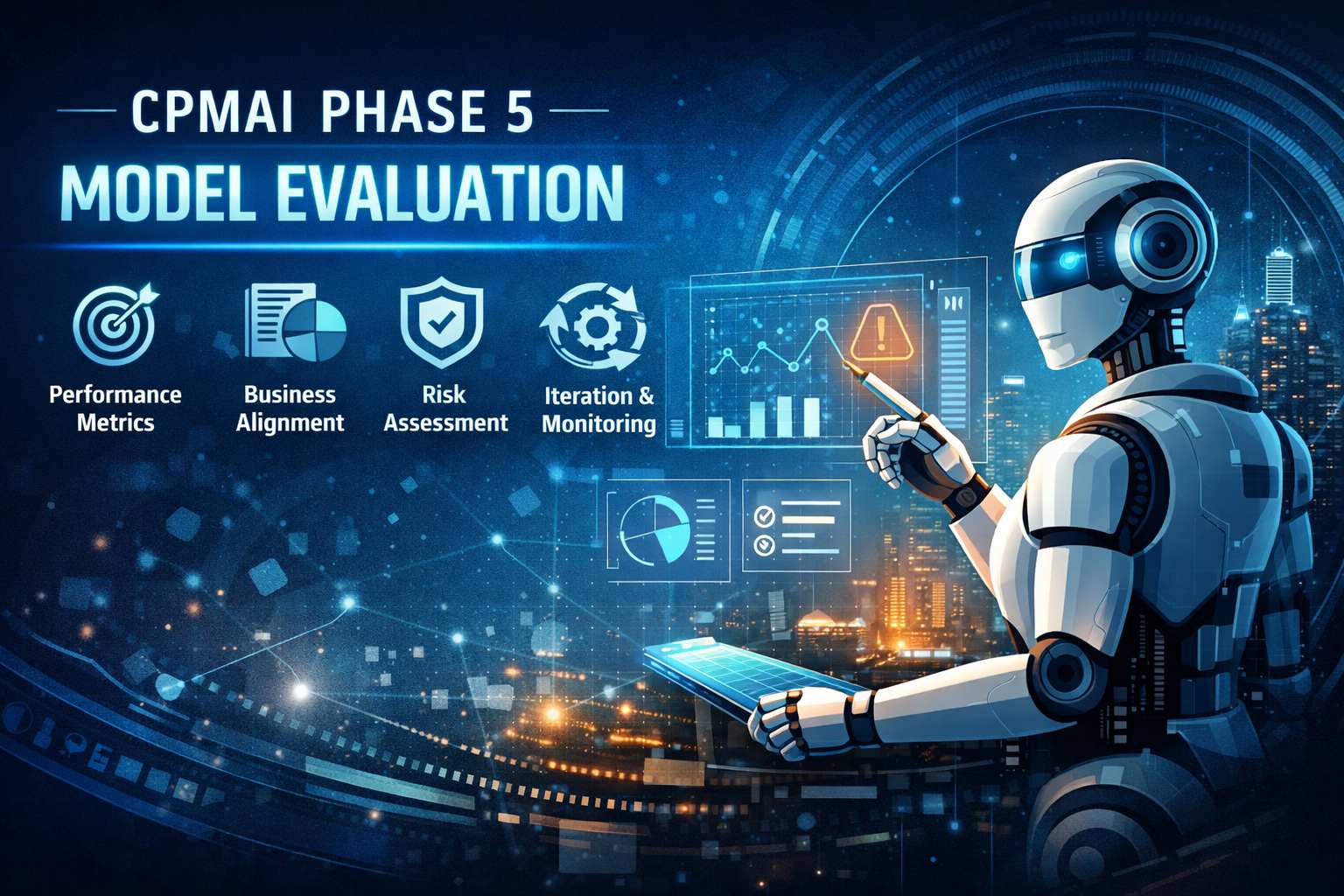
In Phase 5: Model Evaluation, we go beyond asking, “Does the AI system work?”
We ask, “Is the AI consistently delivering the value it was designed to create?”
Building a model that performs well once is not enough—you must ensure it continues to perform reliably over time.
While many teams focus primarily on technical metrics and functional requirements, this phase demands more.
Those metrics matter, but Phase 5 requires evaluating how the AI solution performs in the real world and how well it continues to meet the objectives defined in CPMAI Phase I: Business Understanding.
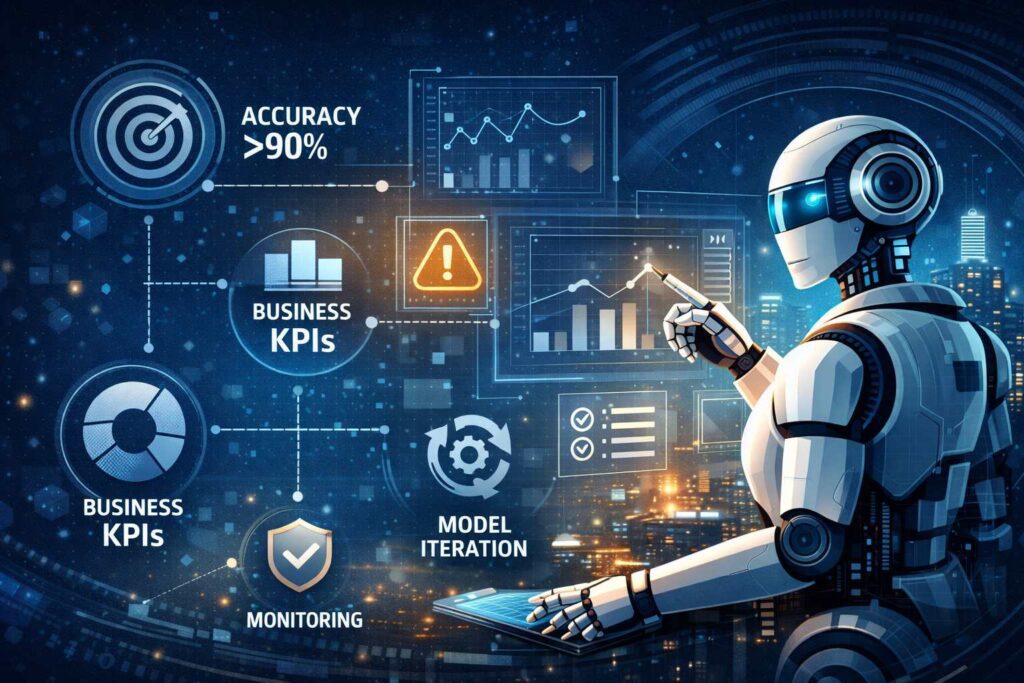
Model Evaluation – Repeatedly Questions to ask
- Are we saving the money we thought we would?
- Are we speeding up internal processes, improving compliance, or reducing risk?
If the model isn’t meeting those key performance indicators, it’s not truly successful.
An AI solution may look impressive on paper or perform well in controlled tests, yet still fail in the real world if it isn’t adopted by users or doesn’t integrate smoothly into existing workflows.
That’s why Model Evaluation – CPMAI Phase 5 focuses on a thorough evaluation of whether the model truly meets both technical expectations and real business needs.
It’s also important to recognize that AI is not a set-and-forget solution. Data evolves, user behavior changes, and operating environments shift over time. Models that perform strongly at launch can gradually drift and produce less reliable outcomes as input data changes in unexpected ways.
Moreover, AI systems are inherently probabilistic. While they may deliver accurate results most of the time, they can also generate incorrect or misleading outputs in certain situations.
For these reasons, continuous monitoring is essential—and a human-in-the-loop remains a critical part of responsible AI operation.
The Rise of MLOps
Model Evaluation requires a continuous monitoring approach, often referred to as Machine Learning Operations or MLOps.
By using these approaches, if you notice the model’s performance slipping, or if the costs start to outweigh the benefits, you can revisit earlier phases to retrain or adjust your model.
One lesson we learned in building iterative and highly reliable software systems is that we should be constantly testing our systems as we’re pushing them out to deployment.
Adopting DevOps & MLOps Practices
To sustain AI performance over time, teams must adopt core DevOps principles:
- Continuous Integration (CI) to ensure that code and model updates are frequently merged, validated, and tested.
- Continuous Deployment (CD) to automatically release new model versions into production once they pass defined quality and compliance checks.
- Continuous monitoring and version control to track which model is active, how it is performing, and to enable fast rollback if issues arise.
However, MLOps extends beyond traditional DevOps to address challenges unique to AI systems.
AI-Specific MLOps Considerations
- Data Drift
Over time, changes in incoming data can cause models to behave differently, leading to degraded performance if not detected and managed. - Model Drift
As real-world conditions evolve, a model’s predictions may become less accurate, even if the data pipeline remains unchanged. - Data Provenance
Maintaining a clear record of exactly which data sources and datasets were used to train each model version. - Model Governance
Defining who can access models, how changes are approved, and how risks such as bias, misuse, or compliance violations are handled. This may involve access controls, audit logs, and formal review processes.
Key questions include:
– Who approves model updates?
– What rules govern versioning and deployment?
– How do we ensure compliance with organizational and regulatory requirements? - Model Versioning
Supporting multiple models in parallel—such as a production model and a candidate model under evaluation—while ensuring the ability to safely roll back if performance degrades.
Developing a robust MLOps strategy ensures these technical, operational, and governance needs are addressed, enabling AI systems to remain reliable, compliant, and valuable over time.
Iterate Models
Model Evaluation Phase is also where you define a clear model iteration strategy.
This may include setting performance thresholds—such as retraining the model whenever accuracy drops below 90%—or establishing scheduled retraining cycles, like monthly or quarterly updates.
At this stage, you also need to clarify:
- Ownership: Who is responsible for monitoring model performance and triggering action
- Data strategy: How new data will be collected, validated, and used for retraining or feature refinement
- Monitoring tools: Which dashboards and metrics will be used for ongoing performance tracking
A well-defined model governance plan ensures that all stakeholders understand when, why, and how changes to the model will occur.
This structured approach helps ensure the AI system continues to deliver the business value originally defined in Phase I: Business Understanding.
Adoption
No matter how strong the model’s performance metrics are, an AI solution delivers no value if users don’t adopt it.
As part of Phase V evaluation, it’s essential to confirm that end users not only understand how to use the system but also trust the insights and recommendations it provides.
Adoption is supported by:
- Targeted training sessions that build confidence and competence
- User-friendly design that minimizes complexity
- Clear, accessible documentation that explains both usage and intent
If users are not engaging with the AI solution – perhaps because it’s too complex or poorly integrated into their daily workflows – that feedback is a strong signal to revisit the approach. This may involve adjusting the scope, simplifying the experience, or refining how the solution fits into real-world operations.
Key Questions to Address in Model Evaluation Phase
In Phase 5, you should be able to confidently answer the following questions:
- Does the model meet the required accuracy, precision, and performance thresholds?
- Are risks related to overfitting or underfitting adequately addressed?
- Do the training, validation, and test performance curves indicate stable and reliable learning?
- Does the model support and align with defined business KPIs?
- Is the model appropriate for the selected operational and deployment approach?
- How will the model’s performance be continuously monitored?
- How will model updates, iteration, and versioning be managed over time?
If these questions can be answered with confidence, the AI initiative is well-positioned for long-term success and sustainability.
With an AI solution that not only delivers value today but is designed to sustain that value over time, we are now ready to move into CPMAI Phase VI: Operationalization.
Connect with us if you have any questions. In case you haven’t read about phase 4, do read. And you need to hire freelancers to help you build or manage your AI projects. Reach out to our team of freelancers.