
I still remember the moment clearly: typing a single sentence into an AI tool.
Something like: “Build a website for a consulting business.”
I hit enter. Fifteen seconds later, there was a homepage. A navigation bar. Hero images. Call-to-action buttons. Even a blog section with placeholder posts that sounded remarkably… professional.
I leaned back in my chair and thought: everything just changed.
But then I looked closer. The site was polished. It was fast. It was technically impressive. It was also completely generic.
It could have belonged to any consulting firm on the planet. There was nothing that said who this business was for, what problem it actually solved, or why anyone should care. It was a beautiful answer to the wrong question.
That moment taught me something I have not forgotten since.
The Hard Part Was Never Writing Code
I have spent years managing digital projects. Gathering requirements. Sitting in rooms with stakeholders who each had a slightly different vision of what “success” looked like. Translating messy business problems into clear briefs that developers and designers could actually act on.
In all that time, I never once saw a project fail because someone couldn’t write the code.
Projects failed because:
- No one agreed on who the user actually was.
- The business goal kept shifting mid-build.
- Stakeholders signed off on a brief they hadn’t really read.
- “We’ll figure out the content later” became the most expensive sentence in the project.
AI has not changed any of that.
What AI has done is make execution astonishingly cheap. The part that used to take weeks now takes minutes. But the part that always mattered, understanding the problem deeply, still costs exactly what it always did: time, thought, and honest conversation.
The Architect Who Built the Wrong Building
I sometimes use this analogy with clients. Imagine walking up to an architect and saying: “Build me a building.”
The architect could absolutely build something. They have the skills, the tools, the team. Within a few months, you would have a structure.
But without knowing who would use it, how many people it needed to hold, what the budget was, what the neighborhood’s regulations required, you might end up with something that was technically a building but completely unfit for purpose.
A prompt like “Build me a website for my business” is the same thing.
AI will build you something. It will look convincing. But it is working from almost no information, filling the gaps with assumptions, and producing the most statistically average version of what you asked for.
Compare that to a prompt like:
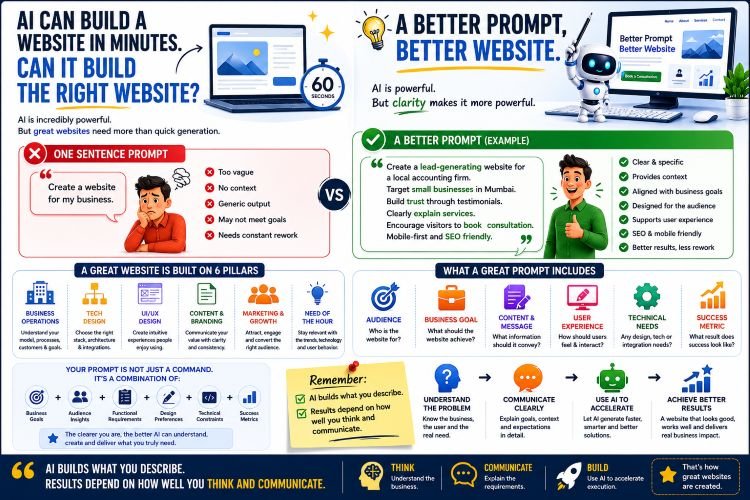
“Create a lead-generating website for my accounting firm targeting small business owners in Mumbai. The goal is to build trust quickly, clearly explain our three core services, showcase real client testimonials, address the most common objections, and drive visitors to book a free consultation. Professional tone, mobile-first, SEO-structured.”
Same tool. Same AI. Completely different output. The difference wasn’t the technology. It was the thinking that happened before anyone touched a keyboard.
A Website Is a Business Decision Wearing a Technology Costume
This is probably the belief I hold most strongly, and the one I find myself repeating most often. Websites are not technology projects. They are business projects. Technology is just the medium.
Whenever I look at a website initiative, whether I’m advising on it or building it, I think about six dimensions that no AI can figure out on its own:
What does the business actually do, and how does it make money? Who is the user, and what are they genuinely trying to accomplish? What does the content need to say to build trust and drive action? How will people find this website in the first place? What does success look like six months from now? And what are competitors doing that customers have now started to expect?
These are not technical questions. They are human ones. And until someone answers them clearly, AI is just guessing, very quickly, and very convincingly.
Prompting Is the New Requirements Gathering
Here is a reframe that I find genuinely useful. Most people think prompting is a skill for technical people. Something developers and power users do. I think that’s completely wrong.
The best prompts I have seen – the ones that produce genuinely useful outputs are written by people who understand the business deeply. Project managers. Business analysts. Founders who know their customers cold. Consultants who have done the work of clarifying what a client actually needs before a single tool is opened.
The craft of writing a great prompt is almost identical to the craft of writing a great brief.
Be specific about the goal. Define the audience. Set the constraints. Anticipate the edge cases. Describe what “good” looks like. We used to write those briefs for developers. Now we write them for AI systems too. The audience has expanded. The skill has not changed.
The Advantage Is Shifting, and Most People Haven’t Noticed
For a long time, organizations competed on their ability to execute. To ship. To build. To move fast.
AI is making execution a commodity.
If everyone can generate a website in fifteen seconds, the website itself stops being the advantage. What matters now is the clarity of thinking behind it. The sharpness of the strategy. The depth of the customer’s understanding. The quality of the decisions made before the prompt is written.
The organizations that will win are not the ones with the most AI subscriptions.
They are the ones who have done the hard, slow, unglamorous work of understanding their business, their audience, and their goals and can articulate all of that with precision.
What I Actually Believe
I use AI every day. I think it is one of the most significant shifts in how knowledge work gets done that I have seen in my career. I recommend it to almost everyone I work with.
But I also think the current conversation around it is missing something important.
We keep celebrating the speed. A website in seconds. A pitch deck in minutes. A marketing campaign before lunch.
What we talk about less is that speed without direction is just expensive noise. AI builds what we describe. If we describe something vague, we get something vague – fast.
If we describe something precise, grounded in real business thinking and genuine user understanding, we get something that actually works.
The quality of what AI produces is, in the end, a direct reflection of the quality of our thinking. That was true before AI arrived.
And the more I use these tools, the more I believe it will remain true long after the next generation of them arrives too.
Contact Us or Connect with me on LinkedIn