Business Impact: Most technology problems are blamed on the wrong thing.
The framework. The cloud provider. The team that built it five years ago. But after nearly two decades in the industry, I’ve noticed a pattern that shows up across companies of every size: the real risk isn’t technical. It’s organizational.
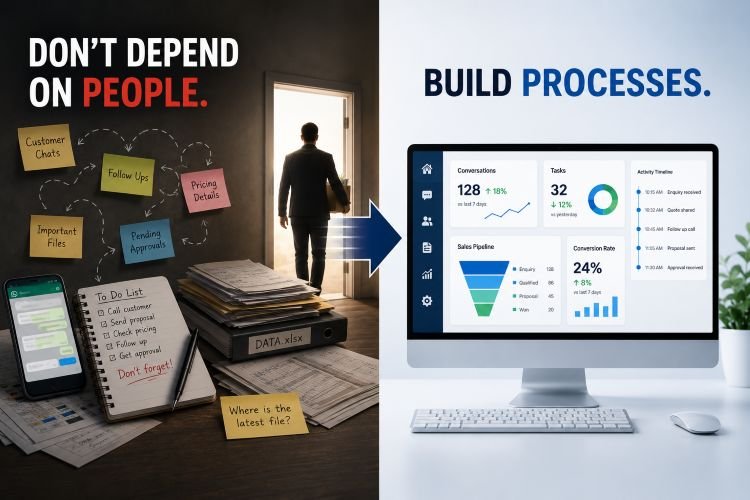
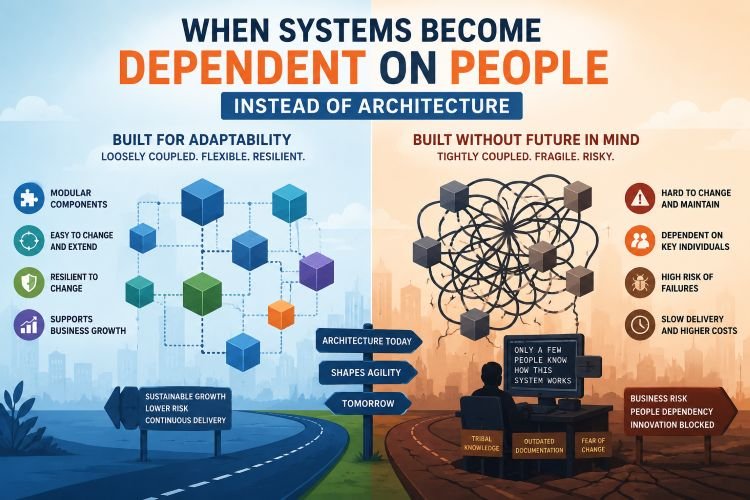
Specifically, it’s this: your system has stopped depending on architecture, and started depending on people.
Two systems walk into a board meeting
Imagine two companies. Both have been running their core platform for eight years. Both have similar team sizes, similar tech stacks, similar feature complexity.
Company A gets a request to change how their pricing model works. The engineering lead says: “Two weeks, maybe three.”
Company B gets the same request. The room goes quiet. Someone says, “We’ll need Rahul involved – he’s the only one who really knows that module.” Rahul is on sabbatical. The estimate becomes: “We’ll get back to you.”
Same size system. Same complexity. Completely different outcomes.
The difference isn’t talent. It’s what happened – or didn’t happen – every time someone made a quiet decision to move fast instead of move carefully.
The debt nobody talks about
Everyone in tech has heard of technical debt. But there’s a second kind of debt that’s far more dangerous and far less discussed: organizational debt.
Organizational debt is what accumulates when your system’s knowledge lives in people’s heads instead of in your codebase, your documentation, or your architecture.
You’ll know you have it when:
- Changing anything in a specific part of the system requires getting the same two people in a room
- A team member leaving feels riskier than a server going down
- The answer to “why does this work this way?” is “I think Dave knew, but he left in 2021”
- Every release comes with a side of anxiety
At this point, you’re not running a software platform. You’re running a knowledge dependency on human beings — and that’s a fragile thing to bet a business on.
This isn’t a developer problem. It’s a leadership problem.
Here’s the provocative part: most of the time, this situation didn’t happen because developers made bad decisions. It happened because the organization never created the conditions for good ones.
When deadlines are always urgent, documentation gets cut. When headcount is lean, knowledge-sharing gets skipped. When business leaders only measure delivery speed, teams optimize for delivery speed — and everything else quietly erodes.
If you’ve never asked your engineering team “what happens if our two most experienced people are unavailable for three months?” — you should. The answer will tell you more about your real technical risk than any audit.
What adaptable systems actually look like
The systems that stay healthy over time aren’t the ones that were built perfectly. They’re the ones that were built with change in mind.
That means:
- Clear boundaries between components, so a change in one place doesn’t detonate something else
- Decisions documented not just in code, but in plain language – why something was built the way it was
- Knowledge rotated deliberately across the team, not hoarded by default
- Architecture reviewed regularly, not only when something breaks
None of this is glamorous. It doesn’t show up on a product roadmap. But it’s the difference between a system that absorbs change and one that resists it.
The question worth asking today
Here’s a simple test of architectural maturity – one that applies equally whether you’re a developer or a business leader:
If your most knowledgeable engineer left tomorrow, would the system keep moving – or would the business slow down with it?
If the honest answer is “it would slow down,” that’s not a talent problem. That’s a design problem. And like most design problems, it can be fixed – but only if you’re willing to name it first.
This article is part of a longer exploration of software architecture, organizational risk, and building systems that outlast any individual.
Let’s connect to discuss more: Connect with me via LinkedIn. Or reach the team.