Why human reasoning becomes more important – not less – in this AI Era.
The Moment Everything Sped Up
Picture a Monday morning in 2020. A product manager spends four hours drafting a project brief: researching competitors, aligning stakeholders, structuring timelines, and wordsmithing the executive summary. She prints it, proofreads it, and hands it to her VP with quiet confidence.
Now picture the same Monday in 2026. Her counterpart opens an AI Era tool, types a two-sentence prompt, and has a polished first draft in ninety seconds.
Both documents look similar. But here is the question that matters: Is the second PM more capable – or simply faster?
That distinction is not semantic. It is the central challenge of our professional moment. And how we answer it will determine whether AI makes us sharper or, quietly, makes us weaker.
“AI should expand human capability — not replace human reasoning.”
Table of Contents
1. The Great Shift in Knowledge Work
For most of recorded professional history, thinking was inseparable from producing. A consultant wrote a strategy because writing forced her to think. An engineer designed a system because designing taught him its constraints. A project manager built a plan because building it revealed what she did not yet know.
AI has severed that link. Today, production can precede — or entirely replace — the thinking that traditionally powered it. This is genuinely remarkable. It is also genuinely risky.
The attraction is understandable. Speed is real. Quality floors are raised. Repetitive tasks evaporate. These are meaningful gains for individuals and organizations alike.
But there is a subtle difference between doing less work and doing less thinking. The first is efficiency. The second is atrophy.
When professionals delegate tasks to AI, they free up time. When they delegate understanding to AI, they erode the capacity to do their jobs well over time. The article you are reading argues one thing clearly: AI is a powerful tool for removing effort, but it must never become a substitute for thought.
2. The Hidden Risk: Delegating Thought
There is a useful distinction between delegating a task and delegating comprehension. When you ask an AI to format a spreadsheet, you delegate the task. When you ask an AI to interpret your data, and you accept its interpretation without scrutiny, you have delegated your judgment.
This is where the risk lives — not in using AI, but in trusting it without engagement.
What happens when we stop engaging?
- Loss of context: AI has no knowledge of your organization’s politics, your client’s history, or the unspoken priorities that shape every real decision. Accepting its output without adding that context produces work that looks right but fits poorly.
- Reduced problem-solving ability: Cognitive skills, like physical ones, degrade with disuse. Professionals who stop working through hard problems gradually lose the capacity to work through hard problems.
- Dependency without depth: Reliance on AI output creates a brittle competence — one that collapses when the tool is unavailable, wrong, or insufficient.
- Decline of independent judgment: When people stop forming their own views, they lose confidence in their reasoning. Over time, they become better at evaluating AI outputs than at generating independent ones.
Four examples worth examining
AI writing code: A developer who accepts generated code without understanding it cannot debug it, cannot explain it in a code review, and cannot adapt it when requirements shift. The code may work — until it does not.
AI creating project plans: A PM who accepts an AI-generated schedule without validating assumptions, dependencies, and team capacities builds on sand. The plan may look professional on slide 12 and collapse by week three.
AI generating business documents: A report produced entirely by AI and forwarded without review may contain confident assertions based on outdated, incorrect, or irrelevant data — attributed implicitly to the professional who sent it.
AI analysing data: An analyst who lets AI produce all conclusions loses the instinct to question anomalies, spot biases in datasets, or notice when a number simply does not make sense given what they know about the business.
“Dependency on AI without depth of understanding is a brittle competence — one that collapses exactly when it is most needed.”
3. Why Human Thinking Still Matters
3.1 Critical Thinking
AI is very good at producing outputs. It is structurally limited in questioning the premises of the inputs it receives. That is a human responsibility.
Critical thinking means asking: What assumptions does this output rest on? What has it missed? What would a skeptical colleague say about this? These are not tasks that can be outsourced. They require a mind that understands the problem domain, cares about the outcome, and is willing to be uncomfortable.
A product manager reviewing an AI-generated market analysis should be asking whether the sources are current, whether the competitive framing serves the organization’s actual strategy, and whether the recommendation holds up under a different set of assumptions. The AI cannot ask these questions on its own. You can.
3.2 Context Awareness
AI sees patterns across vast datasets. Humans understand environments, relationships, and consequences that do not appear in any dataset.
A project that looks straightforward on paper might be politically sensitive, technically dependent on a vendor relationship that is under strain, or culturally complicated in ways that matter enormously to its success. None of that exists in the training data. It exists in the minds of experienced professionals.
Context is not a soft or secondary input. It is frequently the difference between a decision that works and one that fails despite looking sound in a slide deck.
3.3 Decision Ownership
AI does not own outcomes. Humans do.
When a project goes wrong, the question from the board is not ‘what did the AI recommend?’ It is ‘who made that call?’ Accountability has not changed because tools have changed. Leaders, project managers, and engineers remain responsible for what they ship, approve, and sign.
Decision ownership requires that the person owning the decision actually understands it. A professional who cannot explain the reasoning behind a major decision — because AI produced it and they forwarded it — is in a fragile position professionally and ethically.
3.4 Creativity Through Direction
There is a widely repeated idea that AI will replace creative work. The more accurate observation is that AI amplifies creative direction. The quality of AI output is deeply dependent on the quality of human input.
A vague prompt produces generic output. A precise, well-structured prompt — one that reflects genuine domain knowledge, a clear understanding of the audience, and a specific creative intention — dramatically improves results.
Better prompts require better thinking. The professionals who get the most from AI are not those who use it most often. They are those who think most clearly before they use it.
4. AI Is a Co-Pilot, Not the Pilot
The co-pilot metaphor is not perfect, but it is useful. A co-pilot reduces the cognitive load on the pilot and improves safety. But the pilot remains in command, applies judgment, reads the situation, and makes decisions that cannot be pre-programmed.
Consider these professional parallels:
Navigation and Driving
AI navigation is superb. It processes live traffic data, reroutes in real time, and calculates arrival estimates with impressive accuracy. But it does not decide whether this trip is wise given the circumstances, whether a detour serves a purpose the map cannot see, or when to stop entirely because conditions have changed.
The driver decides. The AI assists.
Architecture and Design
AI tools can generate building designs, explore structural options, and run simulations faster than any human team. The architect still defines what kind of building the world needs, what it should feel like to inhabit it, and how it should serve the community around it. Those are not technical questions. They are human ones.
Project Management
AI can generate a project schedule, surface risks from pattern-matching, and draft status reports. But it cannot motivate a team under pressure, negotiate scope with a difficult stakeholder, or make the call to delay launch when the data says go but the team says no.
Leadership is not a task. It cannot be delegated to a language model.
Software Development
AI code generation has genuinely changed software engineering. It accelerates boilerplate, surfaces useful patterns, and reduces friction in well-understood domains. But the engineer still owns the architecture, the quality bar, the security posture, and the call about what should and should not be built.
The engineer who uses AI as an accelerator becomes faster. The engineer who uses AI as a replacement becomes dependent on outputs they cannot fully validate.
“A co-pilot reduces load on the pilot. But the pilot remains in command.”
5. The Mental Muscle Principle
The human brain responds to use in ways broadly analogous to muscle. Challenge it regularly and it strengthens. Remove the challenge and capability plateaus — or declines.
This is not a metaphor borrowed from pop psychology. It is a reasonably well-documented principle: skills that are not practiced are not maintained at full strength. Memory, analysis, pattern recognition, and strategic reasoning all require regular exercise to remain sharp.
The professional risks here are practical:
- Memory: Professionals who stop retaining information because ‘the AI will find it’ may find their ability to connect ideas spontaneously — a core skill for senior roles — diminishing.
- Curiosity: The habit of reading widely, questioning deeply, and exploring tangents is what builds the knowledge base from which good judgment grows. AI makes it easier not to do this.
- Analysis: Data interpretation is a skill that improves with practice. Professionals who let AI do all interpretation lose the instinct to question outputs and spot errors.
- Pattern recognition: Experienced professionals develop domain-specific intuition over years. That intuition is trained by doing hard things the hard way. Shortcuts reduce the training.
- Strategic thinking: The ability to think in systems — to see second and third-order consequences — requires exposure to complex, unstructured problems. Removing that exposure weakens the capacity.
The concern is not that AI makes people lazy in a moral sense. It is that convenience, taken too far, quietly removes the conditions under which expertise develops and is maintained.
6. How to Use AI Without Becoming Dependent
This is not a call to use AI less. It is a framework for using it in a way that keeps your thinking sharp, your judgment reliable, and your professional value high.
Rule 1 — Think first, prompt second.
Before opening an AI tool, spend five minutes forming your own view. What do you think the answer is? What approach would you take? What matters most here? Then use AI to pressure-test, expand, or execute. You will get better outputs — and you will retain ownership of the thinking.
Rule 2 — Ask AI to challenge your ideas.
Instead of asking AI to validate your direction, ask it to identify weaknesses, counterarguments, or assumptions you may have missed. Use it as a skeptic, not a cheerleader. This keeps your reasoning rigorous without removing the AI’s contribution.
Rule 3 — Verify before accepting.
Every AI output — code, analysis, plan, report — should be reviewed by someone who understands the domain. Not skimmed. Reviewed. Check the sources. Test the logic. Validate the assumptions. This is not extra work. It is your professional responsibility.
Rule 4 — Keep ownership of decisions.
You may use AI to inform a decision. But you should be able to explain the decision, defend it, and own its consequences without reference to AI output. If you cannot, the decision was not really yours.
Rule 5 — Learn from outputs, do not copy blindly.
When AI produces good work, ask yourself why it is good. What structure did it use? What reasoning underpins it? What would you have missed? Use AI outputs as learning material, not just production material.
Rule 6 — Alternate between manual and AI-assisted work.
Deliberately choose, from time to time, to do tasks the manual way. Write the first draft yourself before editing with AI. Sketch the architecture before generating it. Build the plan before asking AI to optimize it. These practices keep your baseline capabilities active.
Rule 7 — Maintain domain expertise.
The professional value of AI is multiplied by the domain expertise of its user. A skilled engineer gets more from AI code tools than a junior one — because they can direct it, validate it, and extend it effectively. Expertise is not made irrelevant by AI. It is made more leverageable. Invest in it accordingly.
7. AI and Leadership: Faster Execution Demands Stronger Thinking
Leadership has always required judgment under uncertainty. AI does not change that requirement. It intensifies it.
When execution accelerates, the cost of a wrong strategic decision amplifies. A team that could previously take weeks to produce output now produces it in hours. That speed is only valuable if the direction is right. Getting the direction right is the leader’s job.
Implications for Project Managers
PMs who rely on AI to generate plans must invest more, not less, in understanding the work being planned. Plans generated without genuine comprehension of scope, risk, and team dynamics will fail faster in an AI-accelerated environment — not slower.
Implications for Engineering Managers
The manager whose team uses AI Era tools extensively must develop stronger judgment about system quality, architectural decisions, and technical debt — because the volume and pace of AI-generated code makes it harder, not easier, to maintain oversight without strong technical grounding.
Implications for Founders and Entrepreneurs
AI can produce business plans, pitch decks, marketing copy, and product documentation faster than any team could previously. The risk for founders is the temptation to confuse production speed with strategic clarity. The businesses that succeed will be built on genuine understanding of customers, markets, and value creation — not on the quality of AI-generated documents.
“When execution accelerates, the cost of a wrong direction amplifies. Getting direction right is the leader’s job — and AI cannot do it for you.”
8. Counterargument: Why Think Deeply If AI Outperforms Me?
This is a serious question and deserves a serious answer.
On many well-defined tasks — drafting, summarising, generating options, writing code in established patterns — AI does outperform most humans on speed and often on initial quality. That is true.
But performance on a task is different from directing what tasks should be done, understanding whether the output serves the actual goal, and bearing responsibility for what follows.
A faster vehicle does not make navigation obsolete. It makes it more consequential.
The professionals who will be most valuable in an AI-saturated environment are those who can do three things AI cannot do alone: define the right problem, provide the human context that shapes the right solution, and take accountability for outcomes.
None of these are automated. All of them require thought.
Moreover, organizations do not only need production. They need judgment, trust, relationships, and adaptability. Those are human outputs, not AI outputs. The person who develops only the skills AI can replicate is investing in a rapidly depreciating asset.
Summary: The Core Principles
KEY TAKEAWAYS
1. AI reduces effort — it should not reduce thinking.
2. Delegating tasks is efficiency. Delegating understanding is risk.
3. Context, judgment, and accountability remain irreducibly human.
4. The best AI outputs come from the sharpest human inputs.
5. Mental capabilities require exercise to remain strong.
6. Leadership in an AI world demands more strategic clarity, not less.
7. The professional value of AI is multiplied by your domain expertise.
Conclusion: The Future Belongs to the Thinking Professional
We are in an unusual moment in the history of work. Tools of extraordinary capability are becoming available to ordinary professionals at low cost and with minimal friction. This is a genuine opportunity — perhaps one of the most significant capability expansions in knowledge work in a generation.
But opportunities are not self-executing. They require judgment about how to use them.
The future will not belong to those who reject AI. It will belong equally little to those who delegate their thinking to it. The professionals who will thrive are those who combine AI’s remarkable capacity for speed and scale with the human capabilities that AI cannot replicate: deep understanding, contextual wisdom, creative direction, and genuine accountability.
This is not a difficult philosophy to hold. It is, however, a discipline that requires active choice in a world designed for convenience.
Every morning, when you open an AI tool, you can choose to use it as an amplifier for your thinking or a substitute for it. That choice, made consistently over months and years, will define the kind of professional you become.
Make it deliberately.
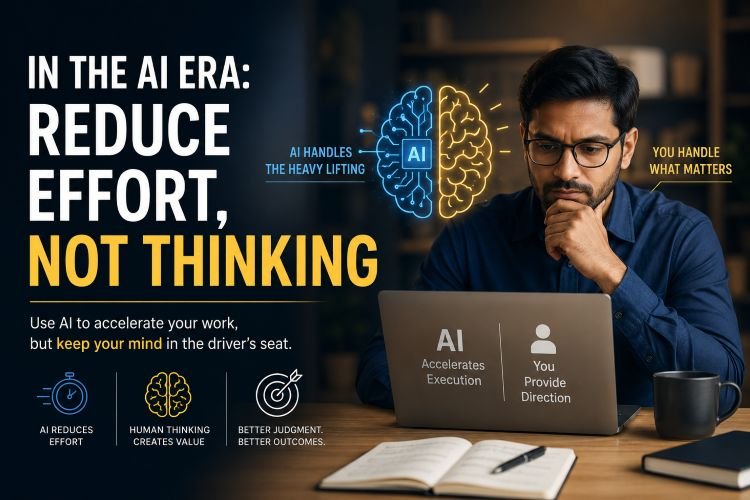
“Use AI to reduce effort — not to reduce thinking.”
Frequently Asked Questions
Q1. Will AI eventually replace roles that require deep thinking?
AI will likely change many roles significantly — automating execution-heavy tasks and raising the baseline quality of routine outputs. But roles that require judgment under uncertainty, contextual understanding, and accountability for outcomes are not on a clear path to automation. The nature of those roles may shift; their importance is not diminishing.
Q2. How do I know if I am becoming too dependent on AI?
A practical test: Can you perform your core professional function competently without AI assistance? Can you explain your reasoning on major decisions without reference to AI output? If the answer to either question has become ‘no,’ that is worth addressing. The goal is not to avoid AI, but to ensure your capability exists independent of it.
Q3. Is it not more efficient to just trust AI output?
Efficiency and reliability are both relevant metrics. AI output is often highly efficient to produce and frequently useful. It is also sometimes confidently wrong, contextually inappropriate, or subtly misaligned with the actual goal. Trusting without verification trades reliability for speed in a way that tends to produce expensive errors at scale.
Q4. How should I handle AI in team settings as a manager?
Establish norms around verification, attribution, and ownership. Make clear that AI-generated work requires human review before use, that professionals are accountable for outputs they present, and that domain knowledge remains expected regardless of AI assistance. Create time and space for the team to do meaningful work manually to maintain their baseline capabilities.
Q5. What is the most important skill to develop in an AI-augmented workplace?
Judgment. Specifically, the ability to assess quality, relevance, and appropriateness of outputs given complex, real-world context. This skill is built through experience, reflection, broad exposure, and deliberate practice. AI cannot develop it for you, and it is the skill that will most clearly differentiate high-performing professionals in the years ahead.
By Author
I wrote this article thoughtfully but with the help of AI. Here i was the Brain and AI was my Assistance to write my thoughts in the right words. If you want to discuss this topic further, do connect with me on LinkedIn or reach out to the team.