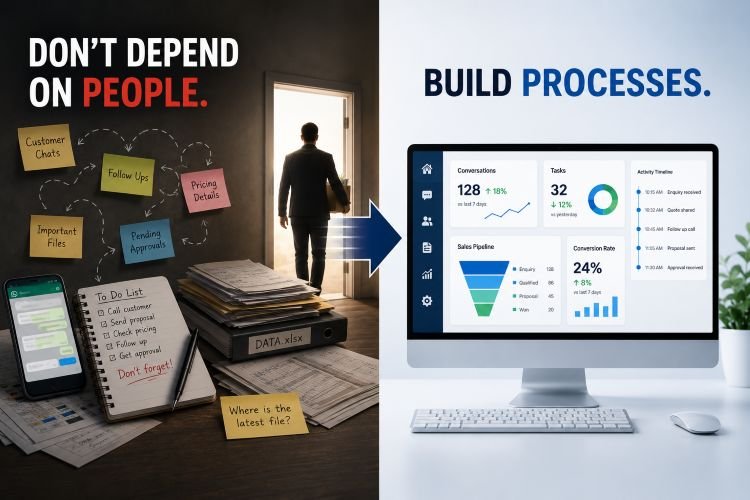
Your business should avoid Business Risk by running on Systems and Processes, Not People. If your business slows down every time someone goes on leave, resigns, or forgets to update a spreadsheet, you don’t have a scalable business – you have a dependency problem.
Every organization dreams of growth. Leaders invest in hiring talented employees, acquiring customers, improving products, and expanding into new markets. Yet many businesses unknowingly build their operations on a fragile foundation – not technology, not processes, but individual people.
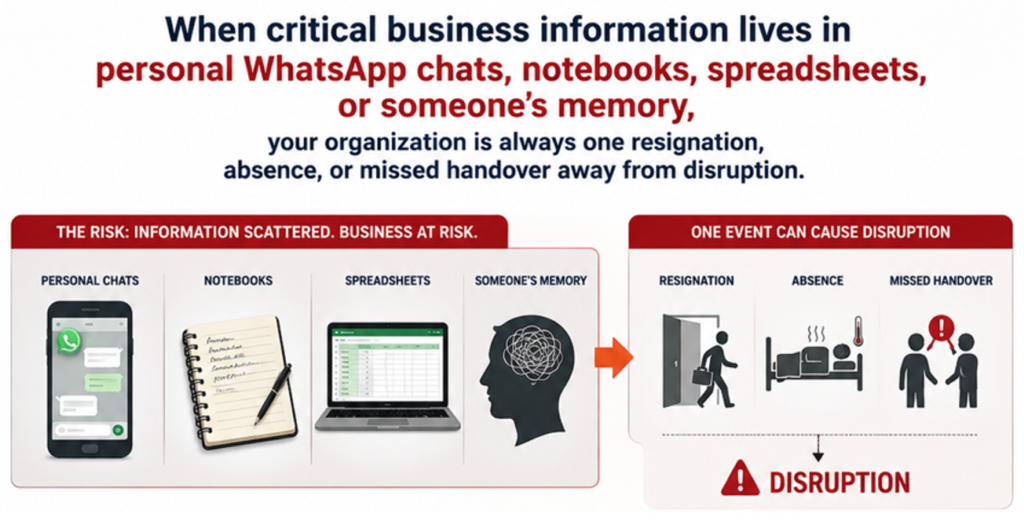
Critical customer conversations live inside personal WhatsApp accounts. Important decisions exist only in someone’s notebook. Follow-up commitments are remembered by one employee.
Operational knowledge exists only in the minds of experienced team members. Everything appears to work… until one day it doesn’t.
Then suddenly, an employee resigns. A key manager goes on leave. A salesperson changes jobs. An operations executive forgets to hand over information.
The business discovers that years of valuable information have disappeared overnight. This isn’t a technology problem. It is a process maturity problem.
The Silent Business Risk Most Ignore
Ask yourself a few simple questions.
Can another employee immediately continue work if your best salesperson resigns today?
Can leadership see every customer interaction without asking an employee?
Is every approval recorded?
Can you reconstruct the complete history of a customer conversation six months later?
Are your processes documented enough that a new employee can become productive within days instead of months?
If your answer to most of these questions is “No,” your organization depends more on individuals than on systems. That dependency becomes increasingly expensive as the organization grows.
Every Business Runs on Information
Every organization – whether it is a school, hospital, manufacturing company, software firm, consulting organization, logistics provider, or retail chain – depends on information flowing smoothly.
Information moves through countless activities every day.
Customer enquiries
Sales conversations
Vendor negotiations
Employee onboarding
Support requests
Purchase approvals
Project discussions
Financial approvals
Internal communications
The problem isn’t the amount of information. The problem is where the information lives.
Where Information Usually Gets Lost
Many organizations unknowingly create information silos.
Personal WhatsApp Chats
Sales representatives communicate with customers using personal numbers.
Service engineers coordinate through personal WhatsApp groups.
Managers approve work via personal chats.
Once an employee leaves, years of customer communication disappear.
Only one person knows where everything is written. Nobody else can access it.
Spreadsheets Everywhere
One spreadsheet for sales. Another for operations. One more for inventory. Several copies shared over email.
Nobody knows which version is the latest. Manual updates introduce errors. Eventually, trust in the data disappears.
Information Stored in People’s Memory
“We don’t need documentation.” “Ask Rahul.” “Only Anita knows that process.” “Talk to the old employee.”
These statements are warning signs. Whenever business knowledge depends on human memory, the organization is vulnerable.
The Cost of People-Dependent Processes
Organizations often underestimate the real cost of poor processes.
Customer Experience Suffers
Customers repeat the same information multiple times. Different employees provide different answers. Previous commitments are forgotten. Trust declines.
Productivity Falls
Employees spend hours searching for information. Meetings become status updates instead of decision-making sessions. Work gets duplicated. Simple tasks take longer than necessary.
Leadership Loses Visibility
Management relies on verbal updates. Reports become inconsistent. Performance becomes difficult to measure. Decision-making slows down.
Compliance Risks Increase
Without proper records:
Regulatory compliance becomes difficult.
Audits become stressful.
Customer disputes become harder to resolve.
Legal exposure increases.
Employee Onboarding Becomes Painful
New employees constantly ask: “Where is that document?” “Who handles this?” “Which spreadsheet should I update?” “What is the process?”
Instead of productive work, they spend weeks gathering information.
Systems Create Organizational Memory
One of the biggest differences between a small business and a mature organization is organizational memory.
People may leave. Processes should not. When information is stored inside systems, knowledge belongs to the organization – not to individuals.
This is how mature companies achieve consistency.
What Mature Organizations Do Differently
Instead of depending on individual effort, mature organizations build repeatable systems.
1. Centralized Communication
Every customer interaction happens through official business channels.
Whether it is:
WhatsApp Business
CRM
Helpdesk
Email
Customer Portal
Everything becomes searchable. Nothing is lost.
Benefits include:
Complete customer history
Shared visibility
Easy handovers
Consistent communication
2. Complete Activity History
Every action leaves a digital footprint.
Who updated it? Who approved it? When was it modified? Who changed the status?
This creates accountability. It also makes troubleshooting dramatically easier.
3. Audit Trails
An audit trail is much more than compliance. It creates confidence.
When every important activity is automatically recorded:
Disputes reduce.
Errors become traceable.
Accountability improves.
Compliance becomes simpler.
4. Real-Time Dashboards
Leaders should never need to ask: “Can someone send me today’s report?” Modern organizations operate using live dashboards.
Leadership should know instantly:
Sales pipeline
Project status
Pending approvals
Customer issues
Team productivity
Financial metrics
Without waiting for manual updates.
5. Standardized Workflows
Processes should not change depending on who performs them. Every important business activity should follow a defined workflow.
For example: Customer Inquiry> Qualification > Requirement Collection > Proposal > Approval > Execution > Delivery > Feedback > Support
When workflows are standardized, quality improves, errors decrease, training becomes easier, and scaling becomes possible.
Technology Alone Isn’t Enough
Many organizations believe buying software automatically solves process problems. It doesn’t.
Poor processes inside expensive software remain poor processes. Technology should automate well-designed processes – not replace them.
Before selecting tools, organizations should first ask:
What are we trying to standardize?
Who owns this process?
What approvals are required?
What data should be captured?
What reports are needed?
How should exceptions be handled?
Only then should technology be implemented.
Practical Steps to Build Process-Driven Organizations
Transformation doesn’t happen overnight. Start with these practical steps.
Step 1: Identify Single Points of Failure
Ask: “If this employee is unavailable tomorrow, what stops?” Document every dependency.
Step 2: Map Critical Processes
Identify key workflows such as Sales, Customer Support, Procurement, HR, Finance, Project Management, Operations. Document them visually.
Step 3: Centralize Information
Move conversations, files, approvals, and records into organizational systems. Avoid personal storage.
Step 4: Define Standard Operating Procedures (SOPs)
Create simple, practical documentation. Not lengthy manuals. Clear instructions that anyone can follow.
Step 5: Measure Process Performance
Track KPIs such as: Process cycle time, First response time, Resolution time, Approval turnaround time, Customer satisfaction, Rework percentage, SLA compliance. Processes improve only when measured.
Step 6: Automate Repetitive Tasks
Use technology for: Notifications, Escalations, Approvals, Workflow routing, Dashboards, Reporting. Let employees focus on solving problems instead of moving information.
The Role of Leadership
Process improvement is not an IT initiative. It is a leadership responsibility. Leaders define culture.
If leaders tolerate undocumented work, unofficial communication, and manual processes, employees will continue using them.
Instead, leaders should encourage: Documentation, Transparency, Accountability, Continuous improvement, Process ownership, and knowledge sharing.
Great organizations don’t just hire smart people. They build systems that allow ordinary people to consistently produce extraordinary results.
A Process Maturity Checklist
Use the following checklist to assess your organization.
✅ Customer communication happens through official business channels.
✅ Critical information is searchable.
✅ Every important action is recorded.
✅ Leadership has real-time visibility.
✅ Processes are documented.
✅ Workflows are standardized.
✅ New employees can learn quickly.
✅ Business continues smoothly during employee transitions.
✅ Knowledge belongs to the organization.
If several of these are unchecked, your organization has an opportunity to strengthen its operational resilience.
My Final Thoughts
Businesses often celebrate their star performers. And they should.
Talented people create innovation, build relationships, and solve complex problems. But great businesses are not built on exceptional individuals alone.
They are built on exceptional systems. People should enhance your processes – not become your processes.
When knowledge stays with the organization instead of individuals, businesses become more resilient, more scalable, and more valuable.
The organizations that thrive over the next decade will not necessarily have the largest teams or the biggest budgets. They will be the ones that create repeatable, transparent, measurable, and scalable processes that continue delivering value – regardless of who is sitting in the chair.
I would like to end this post with some example for you to asses your thoughts:
What if a sales representative resigns and takes years of customer WhatsApp conversations?
What if a finance manager is on leave during month-end close?
What if a project manager leaves without updating Jira?
What if a hospital can’t retrieve patient communication because it was stored on a doctor’s personal phone.
What if a manufacturing company can’t fulfill an order because only one planner knew the production sequence.
Your business should run on systems and processes, not people. Because people build businesses – but processes sustain them.
Key Takeaways
Information trapped in personal devices, notebooks, spreadsheets, or memory creates operational risk.
Process dependency is one of the biggest barriers to scalability and business continuity.
Centralized communication, audit trails, dashboards, and standardized workflows reduce risk and improve efficiency.
Technology supports process maturity – but cannot replace good process design.
Organizations become resilient when knowledge belongs to the business rather than to individual employees.
Organizations don’t become resilient because they hire extraordinary people. They become resilient because they build extraordinary processes that allow ordinary teams to consistently deliver extraordinary results.
About PMProcesses.com
PMProcesses.com, a blog that explores practical project management, process improvement, digital transformation, governance, and operational excellence. The goal is to help professionals and organizations build systems that are scalable, measurable, and resilient – because sustainable success is achieved through well-designed processes, not individual dependency.