Author: Team PMP

  • How to Write a Project Plan: A 10 Step Guide for Project Managers

    How to Write a Project Plan: A 10 Step Guide for Project Managers

    Introduction

    A project plan is more than a document—it is a decision-making framework. While many projects fail due to execution challenges, research consistently shows that poor or rushed planning is the root cause.

    In this article, we’ll break down how to write an effective project plan using a 10-step structure that combines classic project management principles with modern, data-driven thinking.

    1. What Is a Project Plan?

    A project plan is a formal document that defines how a project will be executed, monitored, and controlled.

    Why it matters:

    • Organizations using formal planning improve success rates by ~28%
    • Nearly 70% of failed projects lacked structured planning
    • A plan aligns scope, schedule, cost, and expectations

    At its core, a project plan transforms:

    Ideas → Structure → Execution
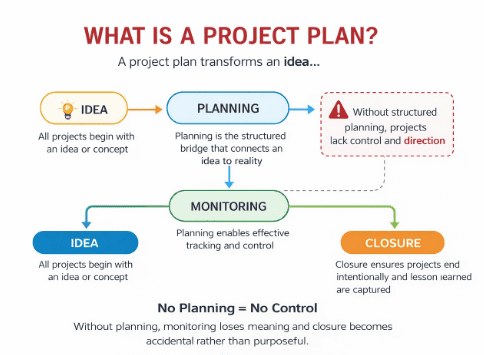
    What is a project plan

    So, a project plan is not a document created after work begins. It is the structural bridge that transforms an idea into a controlled, monitorable, and closable initiative. The flow diagram emphasizes that without planning, monitoring loses meaning, and closure becomes accidental rather than intentional.

    2. Project Plan Success Statistics

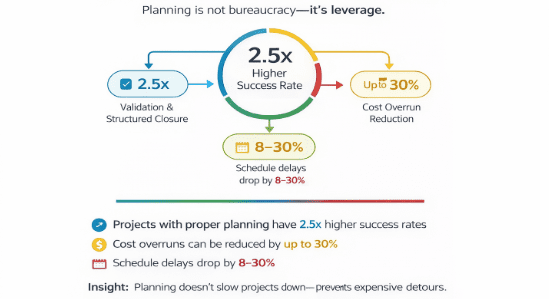
    Planning is not bureaucracy—it’s leverage.

    Key insights:

    • Projects with proper planning have 2.5× higher success rates
    • Validation and structured closure reduce rework
    • Cost overruns can be reduced by up to 30%
    • Schedule delays can drop by 8–30%
    Impact of project planning

    📌 Insight: Planning doesn’t slow projects down—it prevents expensive detours.

    3. Step-by-Step Project Plan Framework

    A solid project plan follows a logical sequence:
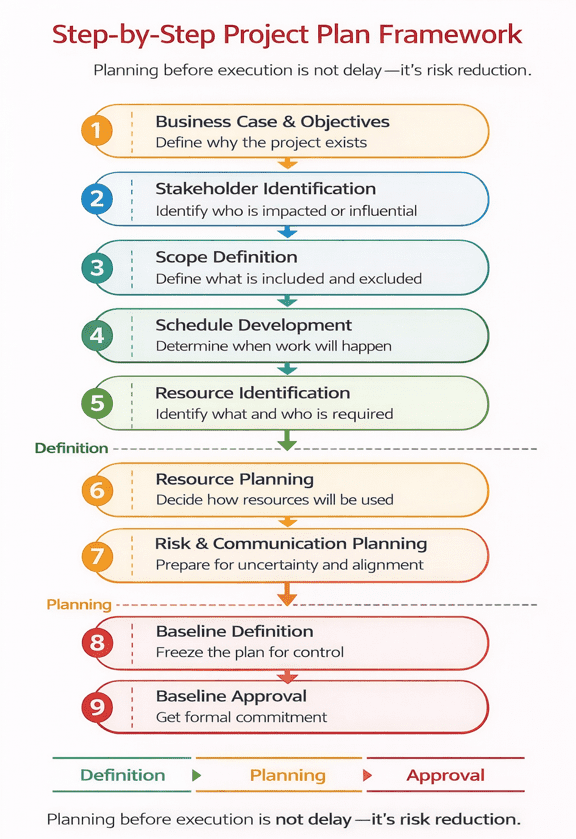
    Step-by-Step Project Plan Framework
    1. Business Case & Objectives
      • Purpose: Define why the project exists.
      • Includes:
        • Business problem or opportunity
        • Measurable objectives
        • Success criteria
        • High-level benefits
      • 📌 If this is weak, the entire plan collapses later.
    2. Stakeholder Identification
      • Purpose: Identify who is impacted or influential.
      • Includes:
        • Sponsors
        • Customers/users
        • Internal teams
        • Vendors & external partners
      • 📌 Stakeholders define requirements, risks, and approvals.
    3. Scope Identification
      • Purpose: Define what is included and excluded.
      • Includes:
        • Deliverables
        • Boundaries
        • Assumptions
        • Constraints
      • 📌 Poor scope definition causes 52%+ rework (as noted later in the image).
    4. Schedule Development
      • Purpose: Define when work will happen.
      • Includes:
        • Work Breakdown Structure (WBS)
        • Task sequencing
        • Dependencies
        • Milestones
      • 📌 A schedule without scope is guesswork. A scope without a schedule is theory.
    5. Resource Identification
      • Purpose: Identify what and who is required.
      • Includes:
        • Human resources
        • Tools & technology
        • Infrastructure
        • Budgetary inputs
      • 📌 This answers: “What do we need to execute?”
    6. Resource Planning
      • Purpose: Decide how resources will be used.
      • Includes:
        • Allocation
        • Availability
        • Utilization
        • Skill mapping
      • 📌 This prevents overloading and hidden delays.
    7. Risk and Communication Planning
      • Purpose: Prepare for uncertainty and alignment.
      • Includes:
        • Risk register
        • Mitigation strategies
        • Communication matrix
        • Reporting cadence
      • 📌 Most project failures happen here — not in execution.
    8. Baseline Definition
      • Purpose: Freeze the control plan.
      • Includes:
        • Scope baseline
        • Schedule baseline
        • Cost baseline
      • 📌 Without baselines, monitoring is meaningless.
    9. Baseline Approval
      • Purpose: Get formal commitment.
      • Includes:
        • Stakeholder sign-off
        • Sponsor approval
        • Change control activation
      • 📌 This is where planning officially ends, and execution begins.

    Each step builds clarity before commitment.

    4. Core Project Plan Components

    A project plan is not a collection of independent documents. It is an integrated system where scope, time, cost, quality, resources, risk, and stakeholders are continuously balanced through coordinated planning and control.

    An effective project plan integrates multiple management areas:
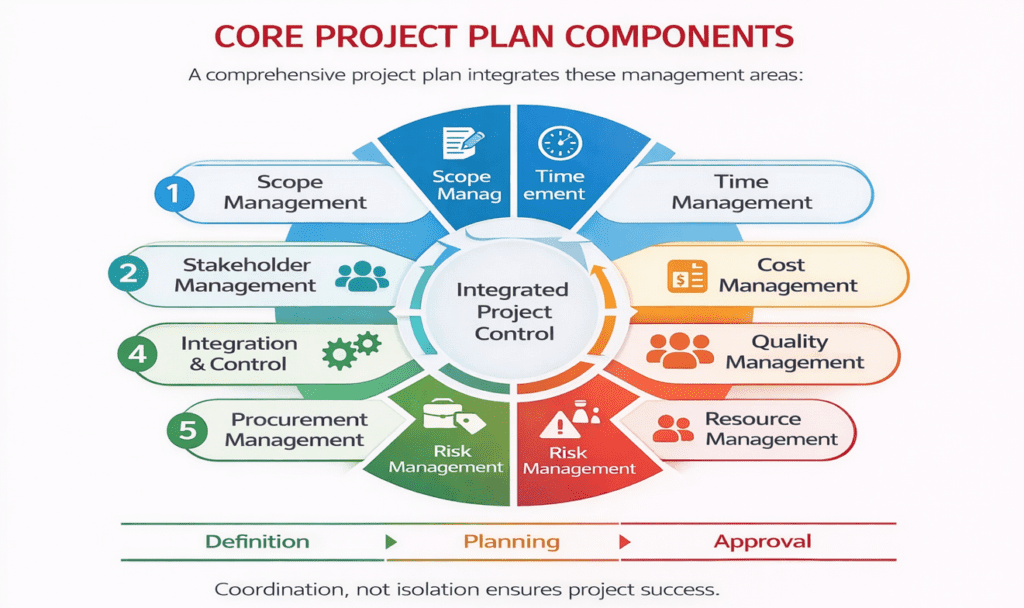
    Core Project Plan Components
    • Scope Management
      • Defines what is included and excluded in the project.
      • Weak scope leads to rework, scope creep, and stakeholder dissatisfaction.
    • Time Management
      • Converts scope into a realistic timeline with dependencies and milestones.
      • Unplanned schedules create invisible delays that surface late.
    • Cost Management
      • Ensures the project stays financially viable.
      • Without cost tracking, overruns are discovered too late to correct.
    • Quality Management
      • Quality management defines how “good” is measured, not just when work is completed.
      • It sets standards, acceptance criteria, and review mechanisms to ensure deliverables meet expectations.
      • Without quality planning, teams deliver fast — but fail acceptance.
      • Speed without quality creates rework disguised as progress.
    • Resource Management
      • Resource management ensures the right people, skills, tools, and capacity are available when needed.
      • It prevents overallocation, burnout, and dependency risks.
      • Projects often fail not due to lack of talent, but due to poor resource planning.
      • A plan that ignores capacity is a plan built on assumptions.
    • Risk Management
      • Risk management prepares the project for uncertainty.
      • It involves identifying potential risks, assessing impact, and planning responses.
      • Without risk planning, teams react emotionally under pressure instead of responding logically.
      • Risk ignored in planning becomes a crisis during execution.
    • Procurement Management
      • Procurement management governs external dependencies such as vendors, tools, licenses, and services.
      • It defines sourcing strategies, contracts, and delivery expectations.
      • Weak procurement planning often leads to delays that the project team cannot control.
      • External dependencies don’t follow your internal schedules.
    • Stakeholder Management
      • Stakeholder management identifies who has influence, interest, or impact on the project.
      • It defines engagement strategies, communication needs, and approval expectations.
      • Many project issues are not technical — they are stakeholder misalignment issues.
      • Projects fail quietly when stakeholders are not heard early.
    • Integration & Control
      • Integration is the glue that holds all components together.
      • It ensures that scope, time, cost, quality, resources, risks, and stakeholders are continuously aligned through monitoring and control.
      • This is where the project manager truly adds value — by balancing trade-offs, not just tracking tasks.
      • Coordination, not isolation, ensures project success.

    These components work together through Integrated Project Control, not in isolation.

    5. Essential Formulas & KPIs (EVM)

    Planning is only effective when progress can be measured objectively.

    Earned Value Management (EVM) provides a quantitative view of project health by combining scope, schedule, and cost into a single performance framework.

    Instead of relying on gut feeling, EVM answers one critical question:

    Are we getting the value we expected for the time and money spent?

    Earned Value Management (EVM) provides objective performance visibility.

    Key EVM Metrics Every Project Manager Should Know

    1. Earned Value (EV)

    What it means: The value of work actually completed, measured against the plan.

    📌 EV tells you how much work has truly been accomplished, not just how much time has passed.

    2. Actual Cost (AC)

    What it means: The actual cost incurred for the work completed so far.

    📌 AC reveals how much money you have spent to achieve the earned value.

    3. Planned Value (PV)

    What it means: The value of work that was planned to be completed by a specific time.

    📌 PV represents your baseline expectation.

    Core Performance Indicators

    🔹 Cost Performance Index (CPI)

    Formula: CPI = EV / AC

    What it tells you:

    • CPI > 1 → Project is under budget
    • CPI < 1 → Project is over budget

    📌 A declining CPI is an early warning of budget trouble.

    🔹 Schedule Performance Index (SPI)

    Formula: SPI = EV / PV

    What it tells you:

    • SPI > 1 → Project is ahead of schedule
    • SPI < 1 → Project is behind schedule

    📌 SPI shows schedule health based on delivered value, not time spent.

    🔹 Cost Variance (CV)

    Formula: CV = EV − AC

    📌 Shows how much budget variance exists at a given point in time.

    🔹 Schedule Variance (SV)

    Formula: SV = EV − PV

    📌 Indicates whether progress is ahead or behind the approved baseline.

    Why These KPIs Matter in Real Projects

    Organizations using EVM consistently report:

    • Better forecast accuracy (~35% improvement)
    • Earlier detection of cost and schedule risks
    • Fewer late-stage surprises

    Without EVM, problems surface late.
    With EVM, problems surface while they are still fixable.

    EVM is not about complex math.
    It is about early visibility and informed decisions.
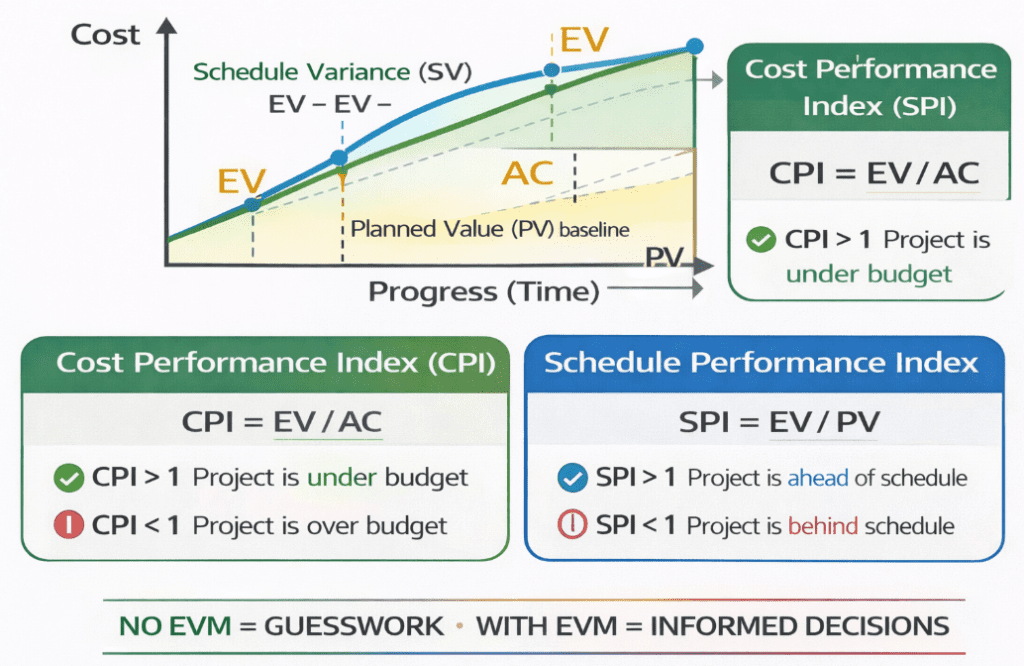
    Earned Value Management

    If a project plan does not define how performance will be measured, it is not a plan — it is a guess.

    6. Essential Project Plan Document Outputs

    A well-defined project plan does not end with ideas or calculations.
    It produces formal documents that guide execution, enable control, and support decision-making throughout the project lifecycle.
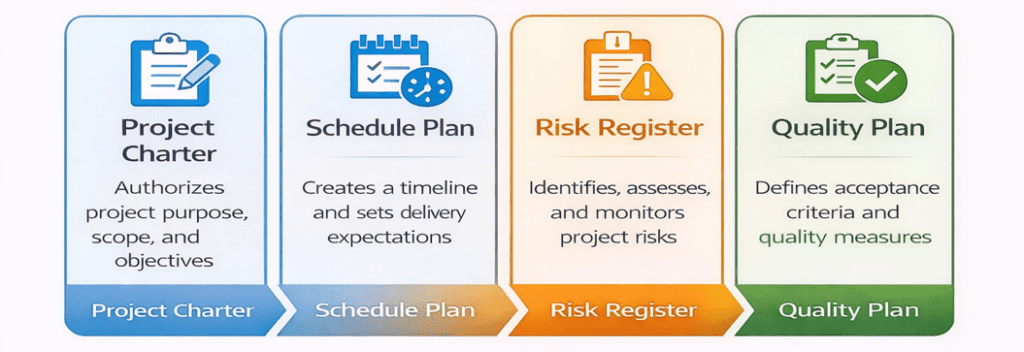
    Essential Project Plan Document

    These documents are not just deliverables — they are reference points for alignment, accountability, and governance.

    A project plan typically produces:

    • 📄 Project Charter
      • The Project Charter formally authorizes the project and gives the project manager the authority to apply resources.
      • It defines the project’s purpose, objectives, high-level scope, key stakeholders, and success criteria. Without a clear charter, projects often suffer from unclear ownership and shifting expectations.
      • The charter answers one critical question: “Why does this project exist?”
    • 📅 Schedule Plan
      • The Schedule Plan translates scope into a time-bound execution roadmap.
      • It defines activities, dependencies, milestones, and delivery timelines.
      • This document becomes the baseline against which progress, delays, and corrective actions are measured.
      • A schedule plan turns intent into commitment.
    • ⚠️ Risk Register
      • The Risk Register captures identified risks, their impact, probability, and response strategies.
      • It ensures that risks are discussed early, tracked continuously, and managed proactively rather than reactively.
      • Projects without a risk register don’t avoid risks — they simply get surprised by them.
      • Risks ignored during planning appear as crises during execution.
    • Quality Plan
      • The Quality Plan defines how quality will be measured, reviewed, and accepted.
      • It establishes standards, acceptance criteria, review processes, and responsibility for quality assurance.
      • Without a quality plan, teams may deliver on time but fail acceptance.
      • Quality is not inspected at the end — it is planned from the start.

    These are not just deliverables—they are control instruments throughout execution. These documents are not created to satisfy process requirements.

    They exist to reduce ambiguity, support informed decisions, and protect the project under pressure.

    When project documentation is treated as a control mechanism rather than paperwork, execution becomes predictable and resilient.

    7. Common Project Planning Mistakes

    The most frequent (and costly) planning mistakes include:

    • ❌ Poor scope definition (causes ~52% rework)
    • ❌ No stakeholder mapping
    • ❌ Unrealistic scheduling
    • ❌ Missing risk planning
    • ❌ Weak communication strategy

    Mistake → Impact → Cost Increase
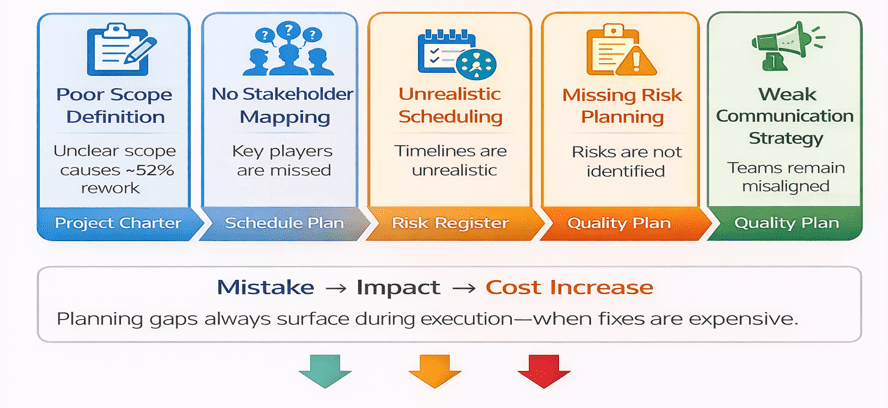
    Common Project Planning Mistakes

    Planning gaps always surface during execution—when fixes are expensive.

    8. Modern Project Planning with Data & AI

    Project planning today is no longer based solely on experience, intuition, or static documents.
    It is increasingly data-assisted, enabling project managers to make faster, more informed decisions.
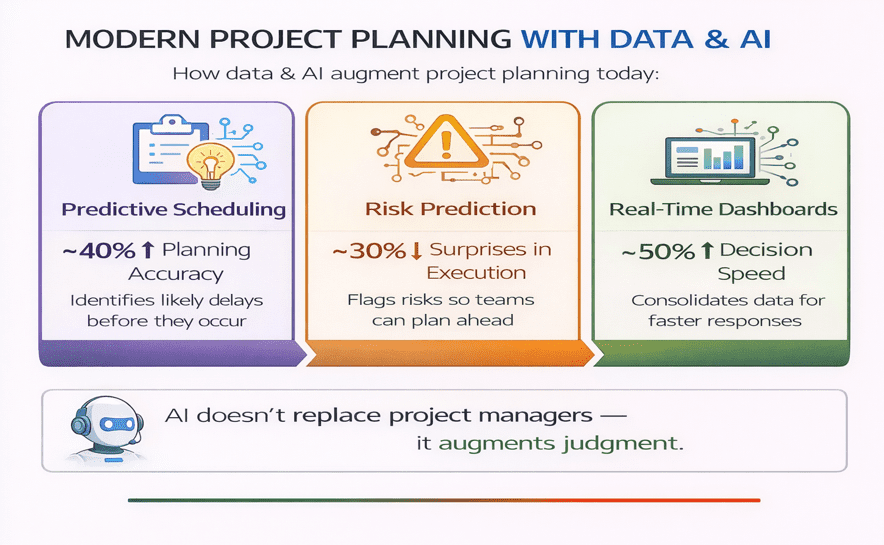
    AI Add Real Value in Project Planning

    Modern tools analyze historical project data, execution patterns, and real-time signals to surface insights that were previously invisible during planning.

    Where Data & AI Add Real Value in Project Planning

    Predictive scheduling uses historical delivery data and dependency patterns to identify likely delays before they occur.
    This improves planning accuracy by ~40%, especially in complex or multi-team projects.

    Risk prediction models analyze past issues, scope changes, and dependency failures to highlight potential risk areas early.
    This reduces execution surprises by ~30% and allows teams to plan mitigations proactively.

    Real-time dashboards consolidate schedule, cost, resource, and risk data into a single view.
    This improves decision-making speed by ~50%, particularly for senior stakeholders and sponsors.

    AI as a Planning Assistant, Not a Replacement

    AI does not replace project managers.
    It augments judgment by:

    • Highlighting patterns humans may miss
    • Flagging early warning signals
    • Simulating “what-if” scenarios
    • Supporting faster trade-off decisions

    Final decisions still require context, stakeholder awareness, and leadership — areas where human judgment remains critical.

    The Shift in the Project Manager’s Role

    As data and AI handle more analysis and prediction, the project manager’s role evolves from:

    • Task tracking → Decision facilitation
    • Status reporting → Insight communication
    • Reactive problem-solving → Proactive risk management

    Projects still succeed because of people, but people succeed faster when supported by data.

    Modern project planning is not about choosing between experience and technology.
    It is about combining human judgment with data-driven insight to reduce uncertainty and improve outcomes.

    AI accelerates planning.
    Project managers provide direction.

    AI doesn’t replace project managers — it augments judgment.

    9. Project Plan Approval Flow

    A typical approval flow looks like this:

    Draft → Stakeholder Validation → Baseline → Execution

    This ensures:

    • Shared understanding
    • Formal commitment
    • Controlled change management

    📌 Skipping validation often leads to silent misalignment, where teams believe they are aligned—until execution exposes conflicting expectations.

    Approval is not a formality.
    It is the moment where assumptions are replaced with agreement.

    10. Final Success Message

    A strong project plan transforms uncertainty into structured execution.
    Teams that invest time in planning consistently deliver faster, cheaper, and with higher quality outcomes.

    Planning is not about predicting the future — it’s about being ready for it.

    ✅ Conclusion

    Writing a project plan is not a paperwork exercise. It is a leadership act that creates clarity, alignment, and confidence.

    Whether you manage traditional, agile, or hybrid projects, these 10 steps provide a practical blueprint for planning that actually works.

    To hire a Freelance Project Manager, you can connect with Team MumbaiFreelancer.com. If you want to discuss more about this topic, connect with us.

    I came across the following, which I think can help you, too.
  • When Leadership Lacks Empathy: How Project Managers Can Respond

    When Leadership Lacks Empathy: How Project Managers Can Respond

    Handling Challenging Leadership Styles: A Practical Perspective

    Introduction: The Reality Project Managers Rarely Talk About

    Project Management is often described through frameworks, processes, and certifications. But seasoned Project Managers know that projects don’t fail because of missing templates—they struggle because of people, power dynamics, and leadership behavior.

    In many organizations, Project Managers and Team Leads operate under leaders who may be technically competent but emotionally detached, ego-driven, or inconsistent in their respect and support. Empathy may be absent, yet expectations remain high. Deadlines don’t move. Accountability doesn’t soften.

    This creates a difficult reality:
    How do you lead, deliver, and protect your team when leadership lacks empathy?

    This article explores practical strategies Project Managers can use to:

    • Lead effectively when respect is inconsistent
    • Maintain professionalism under pressure
    • Recognize subtle manipulation tactics
    • Set expectations without triggering retaliation
    • Keep teams focused, motivated, and protected

    This is not about diagnosing personalities. It’s about operating professionally and strategically in challenging leadership environments.

    1. Leading Effectively When Respect Is Inconsistent

    Inconsistent respect is one of the most destabilizing leadership patterns Project Managers face. One week your judgment is trusted; the next, your decisions are questioned publicly. One sprint review ends with appreciation; the next becomes a blame exercise.

    For Project Managers, this inconsistency creates authority erosion—especially in front of teams and stakeholders.

    How Project Managers Can Respond

    The mistake many PMs make is seeking emotional validation or approval. That approach makes leadership effectiveness dependent on someone else’s behavior.

    Instead, anchor your leadership in structure and predictability:

    • Approved scope documents
    • Clearly defined milestones
    • RAID logs
    • Decision records
    • Agreed success metrics

    When respect fluctuates, process becomes your credibility.

    Lead through:

    • Clear agendas
    • Written summaries
    • Objective reporting
    • Outcome-focused discussions

    Your team will follow consistency, even if leadership behavior is unpredictable.

    Key Insight:
    Project authority doesn’t come from personal approval—it comes from clarity and structure.

    2. Maintaining Professionalism Under Pressure

    Projects are pressure environments by default. Add emotionally reactive or ego-driven leadership, and pressure can quickly turn toxic.

    Project Managers often face:

    • Public questioning of decisions
    • Escalations without warning
    • Emotionally charged meetings
    • Unrealistic demands framed as urgency

    The instinctive reaction is to defend yourself or push back emotionally. But experienced PMs know this rarely ends well.

    The Professional Response

    Professionalism under pressure means controlling tone, not surrendering authority.

    Effective Project Managers:

    • Separate issue ownership from personal emotion
    • Respond with facts, not feelings
    • Frame conversations around impact, risk, and trade-offs
    • Avoid emotional escalation, even when provoked

    Your calm becomes a stabilizing force. Teams notice. Stakeholders notice. Even difficult leaders notice—even if they never acknowledge it.

    Key Insight:
    Professional calm is not silence—it is controlled leadership.

    3. Recognizing Subtle Manipulation in Project Environments

    Manipulation in leadership is rarely dramatic. It’s subtle, plausible, and often disguised as “business pressure.”

    In project settings, it may appear as:

    • Verbal approvals later denied
    • Scope changes introduced informally
    • Praise given privately, blame assigned publicly
    • Escalations framed without full context
    • Shifting success criteria mid-project

    Left unrecognized, these behaviors create confusion, self-doubt, and delivery risk.

    What Project Managers Should Do

    The goal is not confrontation, but protection.

    Strong PMs respond with:

    • Written confirmations after meetings
    • Documented decisions and assumptions
    • Neutral meeting minutes
    • Transparent risk communication

    This is not bureaucracy. It’s risk mitigation.

    When narratives shift, documentation provides continuity. When accountability becomes selective, records provide fairness.

    Key Insight:
    Awareness creates distance. Documentation creates safety.

    4. Setting Expectations Without Triggering Retaliation

    Project Managers must constantly set boundaries—on scope, timelines, quality, and resources. In empathy-deficient leadership environments, boundary-setting can be misinterpreted as resistance or incompetence.

    This is where many PMs struggle.

    The Framing That Works

    The secret lies in how expectations are framed.

    Avoid:

    • “I can’t do this.”
    • “My team is overloaded.”
    • “This is unreasonable.”

    Instead, focus on:

    • Delivery impact
    • Risk exposure
    • Trade-offs
    • Business consequences

    For example:

    “If we accelerate this timeline, quality risk increases here. To mitigate that, we’ll need either additional resources or reduced scope.”

    Follow verbal conversations with written summaries. Keep language neutral and professional.

    Key Insight:
    Frame boundaries as project protection, not personal limitation.

    5. Keeping the Team Focused and Protected

    Teams sense leadership instability long before it’s acknowledged. When leadership lacks empathy, the impact trickles down as:

    • Anxiety
    • Confusion
    • Fear of blame
    • Reduced psychological safety

    A Project Manager’s role expands in such environments—from coordinator to buffer.

    How Project Managers Protect Their Teams

    Effective PMs:

    • Filter unnecessary noise from leadership
    • Translate vague or emotional directives into actionable tasks
    • Maintain clarity around priorities
    • Absorb pressure so teams can focus on delivery

    This doesn’t mean hiding reality. It means containing emotional volatility and protecting focus.

    Teams don’t need every leadership emotion—they need direction, safety, and predictability.

    Key Insight:
    When leadership is unpredictable, the team relies on the Project Manager for stability.

    6. Leading Without Losing Yourself

    One overlooked cost of working under empathy-deficient leadership is burnout. Project Managers are often expected to be endlessly resilient, neutral, and composed—without acknowledgment.

    Sustainable leadership requires:

    • Emotional boundaries
    • Peer support
    • Self-awareness
    • Periodic detachment from toxic dynamics

    Strong PMs know when to push, when to document, when to escalate—and when to disengage emotionally.

    Leadership effectiveness is not measured by how much pressure you absorb, but by how well you sustain delivery over time.

    Key Insight:
    Resilience is not endurance without limits—it’s endurance with awareness.

    Conclusion: Quiet Leadership That Sustains Projects

    Project Managers don’t always have the power to change leadership behavior. But they do have the responsibility to:

    • Protect delivery
    • Preserve team health
    • Maintain professionalism
    • Lead with clarity and restraint

    Handling leadership that lacks empathy is not about confrontation or ego battles. It’s about structure over emotion, facts over narratives, and consistency over approval.

    The Project Managers who master this skill become anchors in difficult organizations. Their leadership is not always loud—but it is lasting.

    Learn more about Project Managementconnect with us

  • Project Management Business Value: Unlock Stunning Strategic Results

    Project Management Business Value: Unlock Stunning Strategic Results

    In today’s fast-paced and competitive business environment, project management business value is more critical than ever. Organizations are no longer focused solely on completing projects on time and within budget; they want to unlock tangible benefits that drive growth, innovation, and competitive advantage. This shift highlights the importance of strategic project management—a discipline that aligns project goals with business objectives to create measurable value. Understanding how to leverage project management for business advantage enables companies to run value-driven projects that yield impressive strategic results.

    What is Project Management Business Value?

    At its core, project management business value refers to the tangible and intangible benefits an organization gains by effectively managing projects. These benefits extend beyond simple deliverables and timelines, encompassing enhanced customer satisfaction, improved operational efficiency, market expansion, increased profitability, and stronger stakeholder relationships.

    Unlike traditional project management, which often emphasizes processes and deliverables, focusing on business value encourages project managers and executives to prioritize outcomes that align with strategic goals. This perspective transforms projects from isolated tasks into powerful tools for organizational growth and competitive positioning.

    The Rise of Strategic Project Management

    Aligning Projects with Business Strategy

    Strategic project management is the practice of ensuring that every project undertaken serves a specific business objective or supports a broader strategic initiative. Instead of treating projects as standalone efforts, this approach views them as building blocks of a larger organizational plan.

    By embedding strategy into project selection, planning, and execution, companies can allocate resources efficiently, minimize wasted effort, and focus on initiatives that promise the highest return on investment. This alignment ensures that all projects contribute meaningfully to long-term success, not just short-term wins.

    Benefits of Strategic Project Management

    Prioritized Initiatives: Projects with the greatest potential business impact get prioritized.
    Resource Optimization: Aligning projects with strategy helps allocate funds, talent, and time more effectively.
    Better Risk Management: Understanding strategic context helps identify and mitigate risks proactively.
    Enhanced Communication: Clear links between projects and strategy make it easier to communicate value to stakeholders.
    Improved Decision-Making: Project decisions are guided by overarching business goals, increasing relevance and value.

    Driving Value with Value-Driven Projects

    One of the most effective ways to realize project management business value is through value-driven projects. These initiatives are purposefully designed to deliver measurable benefits aligned with client, customer, or stakeholder expectations.

    Characteristics of Value-Driven Projects

    Clear Value Proposition: Each project defines what value it aims to deliver and how it will be measured.
    Customer-Centric: Outcomes focus on meeting or exceeding customer needs.
    Measurable Goals: Key performance indicators (KPIs) are established to quantify success.
    Continuous Feedback: Regular checkpoints ensure the project stays aligned with evolving requirements and expectations.
    Outcome-Oriented: Success is defined by results, not just compliance with timelines or budget.

    Implementing Value-Driven Projects

    1. Stakeholder Engagement: Early and ongoing involvement of stakeholders to clarify priorities and expectations.
    2. Value Mapping: Identifying how project outcomes contribute to business goals and objectives.
    3. Agile Practices: Using iterative development and feedback loops to enhance flexibility.
    4. Performance Metrics: Establishing and tracking KPIs tied directly to business value.
    5. Benefit Realization: Ensuring value is captured and embedded into business operations post-project completion.

    Measuring and Communicating Project Management Business Value

    It’s not enough to deliver projects; organizations must also be able to measure and communicate the value generated. Demonstrating clear project management business value boosts stakeholder confidence and builds support for future initiatives.

    Key Metrics to Track

    Return on Investment (ROI): Financial gains compared to project costs.
    Customer Satisfaction: Surveys, Net Promoter Scores (NPS), or feedback indicating project impact.
    Operational Efficiency: Improvements in speed, quality, or cost savings.
    Market Impact: New customers, increased market share, or competitive differentiation.
    Employee Engagement: How initiatives improve workforce productivity or morale.

    Effective Communication Strategies

    Storytelling: Use narrative techniques to explain how projects solve problems and create value.
    Dashboards and Reports: Visual tools to present data clearly and succinctly.
    Executive Summaries: Focused overviews that highlight strategic impact.
    Success Stories: Case studies showcasing tangible outcomes and benefits.
    Regular Updates: Consistent communication to keep stakeholders informed and engaged.

    Overcoming Challenges to Realize Business Value in Projects

    Despite the clear benefits, many organizations struggle to fully capture project management business value. Common obstacles include insufficient strategic alignment, poor communication, resistance to change, and a focus on output rather than outcomes.

    Solutions to Unlock Value

    Leadership Commitment: Senior leaders must champion strategic project alignment.
    Training and Development: Equip project managers with the skills to focus on value realization.
    Cultural Shift: Foster a culture that values innovation, customer-centricity, and continuous improvement.
    Integrated Tools: Utilize project management platforms that support strategic planning and value tracking.
    Feedback Loops: Promote transparency and learning from successes and failures.

    Real-World Examples of Project Management Business Value

    Case Study 1: Technology Company Scaling Innovation

    A global technology firm implemented strategic project management by establishing a portfolio review process that prioritized projects aligned with long-term R&D goals. They adopted value-driven initiatives focused on speed to market and customer adoption, resulting in a 30% increase in product launches reaching profitability within the first year.

    Case Study 2: Manufacturing Operational Efficiency

    A manufacturing company targeted value-driven projects to improve production processes. By aligning projects with operational KPIs and engaging frontline employees, they reduced downtime by 25% and improved product quality, resulting in significant cost savings and higher customer satisfaction.

    Case Study 3: Healthcare Provider Enhancing Patient Care

    A healthcare provider utilized strategic project management to design and implement new patient service workflows. The focus on outcome metrics such as patient wait times and satisfaction enabled continuous improvement, improving quality of care while lowering operational costs.

    Best Practices to Maximize Project Management Business Value

    Define Clear Strategic Objectives: Understand what the business aims to achieve.
    Establish a Robust Governance Framework: Ensure accountability and oversight.
    Focus on Outcome Delivery: Shift attention from outputs to impacts.
    Engage Cross-Functional Teams: Leverage diverse expertise to enhance project outcomes.
    Leverage Technology and Data: Use analytics to track progress and forecast benefits.
    Adopt Agile and Adaptive Approaches: Allow flexibility to respond to changing business environments.

    Conclusion

    Unlocking stunning strategic results through project management business value requires a deliberate approach that blends strategy, execution, and measurement. Through strategic project management and value-driven projects, organizations can transcend traditional project constraints, turning initiatives into powerful engines of growth and innovation. By embracing these principles, companies not only improve project success rates but also create lasting business advantages that drive competitive differentiation in a complex marketplace.

    Incorporating a strong focus on delivering measurable value through every project ensures that resources are invested wisely and outcomes clearly demonstrate business impact. As more organizations adopt this mindset, project management continues to evolve from a tactical discipline into a strategic driver of business success.

    Learn more about Project Managementconnect with us

  • Project Failure Reasons: Uncover Stunning Business Outcome Wins

    Project Failure Reasons: Uncover Stunning Business Outcome Wins

    Project failure reasons continue to challenge organizations across industries, often leading to wasted resources, missed deadlines, and lost opportunities. Yet, understanding these reasons is pivotal for turning potential failures into stunning business outcome wins. By delving into the root causes of why projects fail, companies can reshape their approaches, enhance project success metrics, and ultimately bridge the gap between business outcome vs delivery.

    In this comprehensive article, we will explore key project failure reasons, shed light on how business outcome versus delivery often differ, and outline effective project success metrics to guide your initiatives toward success. Whether you are a project manager, stakeholder, or business leader, the insights here will be invaluable for transforming your project performance.

    Common Project Failure Reasons: What Causes Projects to Falter?

    Projects, regardless of size or complexity, can stumble for a variety of reasons. Recognizing these pitfalls early allows teams to course-correct before failure is inevitable. Below are some of the most prevalent project failure reasons:

    1. Poorly Defined Objectives and Scope Creep

    At the heart of many failed projects lies an unclear or constantly changing project scope. When objectives are not clearly defined or well understood across the team and stakeholders, confusion and misalignment ensue. This vagueness often leads to scope creep—where additional features and requirements get tacked on without corresponding adjustments in time, budget, or resources.

    Managing expectations from the outset, utilizing clear project charters, and implementing strict change management protocols can combat this problem.

    2. Inadequate Stakeholder Engagement

    Projects rely heavily on stakeholder input and support. Lack of engagement or collaboration from key stakeholders can result in missed requirements, conflicting interests, and insufficient buy-in. Without continuous communication, the project team may develop solutions that do not align with business needs, leading to failure.

    Regular check-ins, transparent communication channels, and involving stakeholders in decision-making are essential strategies.

    3. Ineffective Communication

    Communication breakdowns are a classic reason for project failure. When teams do not share information efficiently or misunderstandings happen frequently, alignment suffers. Poor communication between departments, across remote teams, or between management and frontline staff hinders progress and creates risks.

    Adopting robust project management tools, fostering a culture of openness, and establishing clear communication protocols help maintain clarity.

    4. Lack of Experienced Project Management

    Not all projects have the benefit of seasoned project managers who understand how to navigate complex challenges. A lack of experience or insufficient training in managing resources, risks, timelines, and budgets can doom a project before it gains momentum.

    Empowering project managers through education, mentorship, and leadership support will greatly improve outcomes.

    5. Insufficient Resource Allocation

    Many project teams suffer from constraints on time, money, or manpower. When projects are underfunded or understaffed, there is little room to absorb delays or overcome unexpected obstacles. This scarcity often leads to cutting corners or rushed deliveries, sacrificing quality and increasing failure risk.

    Proper forecasting, realistic budgeting, and prioritizing projects based on strategic value are necessary actions.

    6. Ignoring Risk Management

    Project environments are unpredictable. Ignoring potential risks or failing to prepare mitigation strategies can leave teams vulnerable to setbacks such as technical failures, supplier delays, or regulatory changes. Without active risk management, minor issues can cascade into full project derailment.

    Incorporating risk identification, assessment, and contingency planning early in the project cycle is vital.

    Business Outcome vs Delivery: Why Meeting Deadlines Isn’t Enough

    A common misconception in project management is equating project delivery — completing tasks on time and within budget — with project success. The reality is more nuanced and centers on business outcomes rather than just outputs.

    Understanding Business Outcome vs Delivery

    Delivery focuses on the completion of project deliverables: milestones hit, features coded, reports submitted, and products launched.
    Business Outcome centers on the value generated post-delivery, such as increased revenue, enhanced customer satisfaction, improved market share, or internal efficiency gains.

    The reality is that a project can be perfectly delivered — on schedule and within budget — but still fail if it does not achieve the strategic business outcomes it was meant to produce. This disconnect is one of the key reasons why many projects ultimately fail in the broader sense.

    Real-World Examples of the Gap

    – A software development project releases a new app on time, but users find it difficult to navigate, leading to poor adoption and no increase in sales.
    – An infrastructure upgrade completes under budget, but due to misaligned requirements, it does not solve operational bottlenecks, leaving productivity unchanged.

    By focusing solely on delivery, organizations may miss the mark on delivering real value.

    Aligning Delivery with Business Outcomes

    To align your project execution with desired business outcomes, initiatives must be framed with strategic goals in mind. This requires:

    – Clear definition of business success criteria before the project begins.
    – Continuous validation of whether the work being done contributes to those outcomes.
    – Flexibility to pivot or adjust scope if interim results indicate misalignment.

    This outcome-oriented mindset transforms projects from being checklists of tasks into strategic enablers of organizational growth.

    Project Success Metrics: Measuring What Truly Matters

    Measuring project success requires moving beyond conventional metrics like timelines and budgets. Incorporating success metrics that emphasize business outcomes provides a holistic view of project performance.

    Traditional Project Success Metrics

    Traditionally, project success has been based on the “Iron Triangle”:

    Time: Did the project finish on schedule?
    Cost: Was the project completed within budget?
    Scope: Were all agreed-upon features or deliverables completed?

    While these remain important, they are insufficient by themselves.

    Enhanced Project Success Metrics Focused on Outcomes

    To capture true success, consider integrating:

    1. Customer Satisfaction and Adoption Rate

    How satisfied are customers or end-users with the project deliverable? High adoption rates and positive feedback indicate the project’s deliverables meet user needs.

    2. Return on Investment (ROI)

    Did the project generate financial benefits exceeding its cost? Measuring ROI ties the project directly to business value and profitability.

    3. Business Process Improvements

    For internal projects, success can be gauged by improvements in process efficiency, reduced error rates, or increased throughput.

    4. Strategic Goal Achievement

    Did the project advance strategic initiatives such as market expansion, innovation, or regulatory compliance? Alignment with strategic goals is a key marker of success.

    5. Quality and Reliability

    Metrics like defect rates, downtime, and maintainability reflect the quality and sustainability of deliverables.

    6. Employee Engagement and Skill Development

    Projects can be measured by their impact on internal teams, including improved skills, morale, and collaboration.

    Continuous Monitoring of Project Success Metrics

    The best practice is to track these metrics continuously—not just at project completion—to enable early detection of issues and ensure course correction is possible.

    Leveraging Insights from Project Failure Reasons to Achieve Business Outcome Wins

    Identifying project failure reasons is only beneficial if the lessons lead to improved practices.

    1. Define Clear Business Outcomes Upfront

    Before starting any project, ensure that clear, measurable, and attainable business outcomes are agreed upon by all stakeholders. This provides a target to guide all work and decisions.

    2. Implement Strong Project Governance

    Governance structures help maintain alignment between project activities and business objectives, overseeing scope, budget, and risks to prevent failure.

    3. Foster Effective Communication and Stakeholder Collaboration

    Encourage open dialogue and collaboration across all levels of the project to identify challenges early and ensure support.

    4. Embrace Agile and Adaptive Methodologies

    Agile approaches promote iterative delivery, frequent validation against business outcomes, and flexibility in responding to change, helping avoid large-scale failures.

    5. Invest in Project Management Expertise and Tools

    Skilled project managers supported by modern tools can better navigate complexity, optimize resources, and provide transparency.

    6. Use Project Success Metrics as a Feedback Loop

    Regularly review success metrics with stakeholders to evaluate progress toward business outcomes and adjust course as needed.

    Conclusion: From Awareness of Project Failure Reasons to Stunning Outcome Wins

    The journey to successful projects lies not simply in completing tasks but in delivering measurable business value. Understanding the common project failure reasons is the first essential step. These reasons—ranging from unclear scope and poor communication to inadequate risk management—provide a roadmap of what to avoid and improve.

    Simultaneously, shifting focus from mere delivery to tangible business outcomes transforms how projects are managed and evaluated. By adopting comprehensive project success metrics that prioritize value creation, organizations can ensure their efforts produce lasting benefits beyond just finishing on time and within budget.

    Ultimately, organizations that internalize these lessons and integrate them into their project management DNA will unlock stunning business outcome wins, turning past failures into future successes.

    Additional Resources – Project Failure Reasons

    – The Standish Group’s CHAOS Report on project success and failure statistics
    – PMI’s Project Management Body of Knowledge (PMBOK)
    – Agile frameworks such as Scrum and Kanban for adaptive project management
    – Tools like Microsoft Project, Jira, and Trello for tracking progress and communication

    By emphasizing the relationship between project failure reasons, business outcome vs delivery, and project success metrics, your organization will not only reduce failure rates but also create projects that truly advance strategic goals and deliver real-world impact.

    Learn more about Project ManagementConnect with us to discuss more about Project Failure Reasons.

  • Project Management Leadership: Must-Have Skills Senior Management Trusts

    Project Management Leadership: Must-Have Skills Senior Management Trusts

    Project management leadership is a critical component of successful project execution and organizational growth, for project managers stepping into leadership roles or those already leading complex projects, understanding and embodying the skills that senior management trusts can make the difference between project success and failure. These skills affect how projects are prioritized, resources allocated, and how PM decision-making influences overall company objectives. This article dives deep into the must-have skills that distinguish project management leaders trusted by senior management, and how embracing these abilities can elevate project outcomes and foster organizational confidence.

    Understanding Senior Management Expectations in Project Management Leadership

    Senior management expectations often shape and define the parameters within which project managers operate. Project management leadership isn’t just about managing timelines and budgets; it’s about aligning project goals with strategic business objectives, managing risks proactively, communicating effectively, and leading diverse teams toward shared success.

    Strategic Alignment and Business Acumen

    One of the foremost expectations senior management holds is that project managers think beyond the confines of project plans and schedules. They expect leaders to maintain a clear line of sight into how the project supports broader business goals. Project management leadership requires a strong grasp of business acumen. Leaders must understand market dynamics, customer needs, and competitive pressures to make informed decisions that prioritize initiatives bringing maximum business value.

    By demonstrating strategic alignment, project managers earn the confidence of senior executives, showing that their projects are not isolated technical endeavors but vital components of business growth.

    Transparent and Effective Communication

    Communication lies at the heart of project management leadership. Senior management expects regular updates that are clear, concise, and free from jargon, enabling them to make timely and informed decisions. This includes not only success reports but also transparent risk assessments, budget concerns, and potential delays.

    Effective communication is a two-way street; trusted project leaders know how to listen actively to stakeholder concerns and feedback, ensuring that issues are addressed early and solutions are collaboratively developed. This skill fosters trust and openness, essential for executive support.

    pm Decision Making: A Core Competency of Trusted Project Leaders

    Decision-making in project management is often complex due to competing priorities, limited resources, and uncertain circumstances. Senior management entrusts project leaders who exhibit sound judgment, swift action, and a balanced approach to risk and opportunity.

    Making Data-Driven Decisions

    Project management leadership today heavily relies on data-driven insights. Leaders trusted by senior executives use metrics, KPIs, and predictive analytics to underpin their decisions. This reduces bias and emotional reactions, allowing project managers to choose paths that optimize outcomes.

    For example, if a risk register indicates a high probability of supplier delays, a project leader proactively adjusts schedules or sources alternative vendors rather than waiting for problems to materialize. This proactive mindset, rooted in data awareness, is highly valued by senior management.

    Balancing Risk and Reward

    Senior management does not expect project managers to avoid all risks—that would be unrealistic. Instead, they look for leaders who can thoughtfully weigh risks against potential rewards and make informed decisions on how much risk is acceptable.

    Trusted leaders develop contingency plans, negotiate risk-sharing agreements, and invest in risk mitigation strategies. This calculated approach to risk management helps minimize surprises and keeps projects on track, reinforcing executive confidence.

    Encouraging Collaborative Decision-Making

    While pm decision-making requires authority, the best project leaders balance their own judgment with inputs from their teams and stakeholders. Senior management appreciates leaders who foster a culture of collaboration, tapping into the collective expertise to improve outcomes.

    For instance, facilitating regular brainstorming sessions during critical project phases not only yields innovative ideas but also strengthens team commitment. Leaders who can harmonize diverse perspectives while maintaining decisive control earn respect and trust.

    Essential Skills in Project Management Leadership Trusted by Senior Management

    Beyond decision making and understanding expectations, certain competencies consistently set apart project management leaders who command senior management’s trust. Here are essential skills to develop and refine:

    1. Emotional Intelligence (EQ)

    Emotional intelligence—the ability to recognize, understand, and manage emotions—plays a pivotal role in project leadership. Leaders with high EQ demonstrate empathy, self-awareness, and social skills that help resolve conflicts, motivate teams, and foster productive relationships.

    Senior managers trust leaders who can remain composed under pressure, empathize with stakeholders, and maintain morale during challenges.

    2. Influencing and Negotiation Skills

    Projects often involve diverse stakeholder interests and competing agendas. Trusted project leaders excel at influencing decisions without direct authority and negotiating compromises that serve the project’s best interests.

    For example, persuading a resource manager to allocate additional staff or negotiating a deadline extension with clients requires tact, diplomacy, and a clear articulation of the benefits.

    3. Adaptability and Resilience

    The project landscape is rarely static. Market shifts, sudden scope changes, or unforeseen challenges demand flexibility. Senior management relies on leaders who can pivot quickly, reassess plans, and maintain momentum despite setbacks.

    Resilience—the capacity to recover from difficulties—and adaptability demonstrate leadership maturity, easing senior management concerns amid uncertainty.

    4. Time Management and Prioritization

    Effective prioritization ensures that project teams focus on high-impact tasks and deliverables aligned with critical deadlines. Senior management expects project leaders to manage their time and the team’s efforts efficiently, avoiding unnecessary delays or scope creep.

    Proficiency in time management tools, delegation, and prioritization frameworks showcases leadership capability and respect for organizational resources.

    5. Technical Competence and Continuous Learning

    While leadership focuses on people and strategy, technical competence remains important for credibility. Senior management trusts project leaders who understand the technical nuances of their projects and can engage knowledgeably with subject matter experts.

    Furthermore, a commitment to continuous learning signals adaptability and a forward-thinking mindset, strengthening leadership appeal.

    Building Trust Through Accountability and Results

    Ultimately, senior management trust is earned through a consistent track record of delivering results while owning accountability. Project management leadership is about stepping up to challenges, taking responsibility for outcomes, and learning from mistakes to improve.

    Measurement and Reporting: Demonstrating Accountability

    Trusted project leaders establish clear success criteria and monitor progress closely. Transparent reporting mechanisms that highlight achievements and expose risks early create a culture of accountability and trust.

    By using dashboards and regular status meetings, leaders keep senior management informed and engaged without overwhelming them with unnecessary detail.

    Leading by Example

    Senior management respects leaders who model the behaviors and standards they expect from their teams—whether it’s commitment, integrity, or open communication. Leading by example fosters a positive team culture that supports project success.

    Building Strong Relationships with Stakeholders

    Relationship management is a cornerstone of project leadership. Leaders who cultivate strong, respectful, and collaborative relationships with internal and external stakeholders facilitate smoother project execution and quicker issue resolution.

    Senior executives trust leaders who understand stakeholder needs and expectations, promoting alignment and partnership.

    Leveraging Technology to Enhance Project Management Leadership

    In an increasingly digital world, project management leadership also involves leveraging technology to improve decision making and project execution.

    Project Management Software and Tools

    Modern tools provide project leaders with real-time visibility into project status, resource allocation, and risk factors. Leaders trusted by senior management harness these systems for accurate data and streamlined workflows.

    Communication Platforms

    Effective leadership demands seamless communication. Utilizing platforms that support collaboration, instant updates, and documentation ensures that teams remain connected and informed.

    Data Analytics for Predictive Insights

    Advanced analytics empower leaders to forecast trends, identify bottlenecks, and optimize resource use. Senior management appreciates leaders who utilize these technologies to anticipate issues before they become critical.

    Conclusion: Elevating Project Management Leadership to Meet Senior Management Expectations

    Project management leadership involves multifaceted competencies that go beyond managing tasks—they embody strategic thinking, exceptional communication, wise pm decision making, and emotional intelligence. Senior management trusts project leaders who demonstrate these skills consistently and deliver measurable results that align with corporate objectives.

    By cultivating strategic alignment, mastering decision making, fostering collaboration, embracing adaptability, and leveraging technology, project managers can elevate their leadership impact. This builds a bridge of trust with senior management, paving the way for greater support, visibility, and successful project outcomes.

    For project leaders aiming to advance their careers, investing in these must-have skills is not just beneficial—it is essential for gaining senior management’s trust and driving projects that truly make a difference.

    Learn more about Project Managementconnect with us

  • Business and Technology Best Alignment: The Essential Project Manager Role

    Business and Technology Best Alignment: The Essential Project Manager Role

    Business and technology alignment is a critical challenge and opportunity for organizations striving to stay competitive in today’s fast-paced digital economy. As companies increasingly rely on technology to support and drive their strategic objectives, the ability to seamlessly integrate business goals with technological capabilities can distinguish market leaders from laggards. At the heart of this alignment process lies the project manager role, which acts as a pivotal bridge connecting diverse teams, managing expectations, and ensuring that projects deliver value aligned with business strategy. This article explores the intricacies of business and technology alignment and highlights why the project manager’s role is indispensable in achieving stakeholder alignment and successful project outcomes.

    Understanding Business and Technology Alignment

    Before delving into the project manager’s role, it is important to clarify what we mean by business and technology alignment. At its core, this concept involves ensuring that technology initiatives, investments, and operations are closely tied to the organization’s business objectives and overall strategic direction. Alignment is not merely about deploying the latest technology, but about leveraging IT in ways that optimize operational effectiveness, enhance customer experiences, support innovation, and ultimately drive business growth.

    Organizations frequently struggle with misalignment for various reasons: siloed departments that operate independently, communication gaps between technical and business teams, evolving market demands, and shifting priorities. When alignment is poor, projects may fail to deliver intended business benefits, cost overruns can occur, and morale decreases as stakeholders become frustrated by disconnects and unmet expectations.

    Achieving and maintaining alignment requires ongoing dialogue, shared understanding, and coordinated efforts across organizational boundaries. This is where the project manager role becomes particularly crucial.

    The Project Manager Role in Driving Business and Technology Alignment

    The project manager plays a multi-dimensional role that goes far beyond traditional task tracking and deadline management. In modern organizations focused on innovation and digital transformation, project managers are strategic enablers who facilitate collaboration, foster stakeholder engagement, and translate business needs into actionable technical plans.

    1. Acting as the Bridge Between Business and Technology Teams

    One of the biggest challenges is the conventional divide between business units — often driven by customer needs, market trends, and revenue targets — and technology teams, who concentrate on systems, infrastructure, and technical solutions. The project manager serves as a crucial interface, leveraging strong communication skills to ensure mutual understanding. They articulate business goals clearly to technical experts and explain technical constraints or possibilities in terms familiar to business stakeholders. This “translation” function helps prevent misunderstandings and promotes mutual respect.

    For example, during a software development project, the project manager might work with marketing to understand the key customer value propositions that need enhancement, then collaborate with developers to ensure these features are prioritized correctly in the product backlog. Without this mediation, the business might push for flashy features while the technology team struggles with underlying architectural issues.

    2. Facilitating Stakeholder Alignment to Mitigate Conflicts and Build Consensus

    Stakeholder alignment is a key subcomponent of overall business and technology alignment. Given that projects often involve multiple stakeholders with varying priorities and expectations, the project manager must engage proactively with all parties to establish a shared vision and agreed-upon success criteria.

    Regular stakeholder meetings, transparent reporting, and active listening help surface and address concerns early. The project manager uses negotiation and conflict resolution skills to balance competing demands. By maintaining alignment among executives, business users, technical teams, vendors, and sometimes customers, the project manager ensures project efforts remain focused, resources are appropriately allocated, and surprises are minimized.

    A practical example might be a system upgrade affecting both customer service operations and backend IT infrastructure. The project manager coordinates planning so service disruptions are minimized during peak hours, achieving stakeholder buy-in from both departments.

    3. Aligning Projects With Business Strategy Through Rigorous Planning and Adaptation

    A strong project plan is the foundation for aligning technology activities with business goals. The project manager must have a deep understanding of the organization’s strategic priorities and translate these into project scope, objectives, timelines, and deliverables.

    Beyond the initial planning, continuous monitoring and adaptation are critical to maintaining alignment in dynamic environments. Emerging risks, market changes, or evolving customer feedback might require project adjustments. The project manager’s ability to make informed decisions, supported by data and stakeholder inputs, ensures projects stay relevant and contribute real value.

    Tools such as balanced scorecards, benefits realization frameworks, and project portfolio management techniques are often deployed by project managers to link tactical activities to strategic outcomes transparently.

    Skills and Competencies that Empower Project Managers in Alignment Roles

    Given the complexity and importance of their activities, project managers involved in business and technology alignment must hone specific skills and competencies:

    Strong Communication and Interpersonal Skills: Clear, empathetic communication builds trust and understanding across diverse groups.
    Business Acumen: Understanding market dynamics, financial metrics, and business models enables better decision-making.
    Technical Literacy: While not required to be experts, project managers must grasp enough technology to identify risks, opportunities, and constraints.
    Leadership and Influence: Leading without authority in matrix environments demands influencing skills and diplomatic collaboration.
    Change Management Expertise: Driving alignment often means guiding teams through organizational change and overcoming resistance.
    Stakeholder Management: Prioritizing and engaging stakeholders appropriately to build consensus and commitment.
    Problem-Solving and Critical Thinking: Navigating complex challenges to find solutions that satisfy both business needs and technical feasibility.

    Organizations investing in training and developing project managers with these competencies tend to see significantly better alignment outcomes and project success rates.

    Real-World Examples Highlighting the Project Manager’s Impact

    Case Study 1: Digital Transformation in a Financial Services Firm

    A large financial institution embarked on a digital transformation initiative to improve customer engagement via a revamped mobile app and integrated backend systems. Initially, the project faced delays because requirements from marketing were unclear, and IT teams were focused on infrastructure upgrades unrelated to customer-facing features.

    Bringing in a seasoned project manager with expertise in cross-functional collaboration helped the company realign priorities. The project manager facilitated workshops between customer service, compliance, IT, and product teams to clarify business goals and technical constraints. Through regular stakeholder alignment meetings and transparent progress tracking, the project regained momentum and was delivered on time, increasing app usage by 30% within six months.

    Case Study 2: Manufacturing IoT Deployment

    A manufacturing company sought to deploy IoT sensors on production lines to improve operational efficiency. The technology team proposed a phased rollout based on technical feasibility, but the business side pushed for an accelerated timeline to meet competitive pressures.

    The project manager navigated this tension by conducting a risk-benefit analysis with both sides and proposing a pilot program to validate assumptions quickly. They kept leadership informed, aligned expectations about scope, and managed vendor coordination. The pilot’s success led to a scaled implementation aligned with business goals without risking plant downtime.

    Best Practices for Project Managers to Enhance Business and Technology Alignment

    Based on industry insights, the following best practices can empower project managers to excel in their alignment roles:

    Cultivate Early Involvement: Engage business stakeholders early in the project lifecycle to understand their vision and avoid scope creep.
    Develop a Clear Communication Plan: Tailor messages to different audiences and keep communication channels open.
    Use Collaborative Tools: Leverage project management platforms and dashboards that provide real-time visibility for all stakeholders.
    Prioritize Continuous Learning: Stay abreast of industry trends, emerging technologies, and organizational strategies.
    Promote Agile and Flexible Methodologies: These allow iterative feedback and adjustment, fostering better alignment.
    Champion Benefits Realization: Track and measure business outcomes post-implementation to validate project value.
    Encourage Cross-Functional Teams: Facilitate diverse team collaboration to enhance creativity and mutual understanding.

    Conclusion

    Business and technology alignment is not a one-time effort but a continuous journey requiring commitment, collaboration, and clarity. The project manager role is essential in steering this journey by acting as a trusted intermediary who connects strategic intent with operational delivery. Through effective stakeholder alignment, communication, and adaptive planning, project managers help organizations realize the full potential of technology investments in driving business success. Investing in skilled project managers and empowering them with the right tools and authority can transform alignment from an aspirational concept into a competitive advantage.

    Learn more about Project Managementconnect with us more about business and technology.

  • Project Governance Basics: Must-Have Agile Frameworks for Success

    Project Governance Basics: Must-Have Agile Frameworks for Success

    In the dynamic world of project management, understanding project governance basics is essential for ensuring projects are delivered efficiently, on time, and within budget. Governance serves as the backbone of any successful project, providing the structure, accountability, and decision-making pathways necessary to steer projects through complexity and change. When combined with agile methodologies, project governance becomes a powerful tool that balances flexibility with oversight, enabling organizations to respond to evolving requirements without losing sight of their strategic goals.

    This article will explore the fundamental concepts of project governance, delve into the role of agile governance, and outline some of the most effective governance frameworks that can transform your project outcomes.

    What Are Project Governance Basics?

    At its core, project governance refers to the framework of policies, regulations, roles, responsibilities, and processes that guide a project from initiation through to completion. It ensures that decision-making is transparent, risk is managed, and resources are used productively. The integrity of project governance influences how well stakeholders are engaged, how conflicts are resolved, and how project objectives align with broader organizational goals.

    Understanding the basics of project governance means recognizing several key components:

    Clear Definition of Roles and Responsibilities: Who is accountable for what? Effective governance demands clarity to avoid overlaps or gaps.
    Decision-Making Structures: Establishing committees or boards that have defined authority levels to approve budgets, scope changes, and timelines.
    Risk and Issue Management: Proactively identifying and addressing vulnerabilities and challenges before they jeopardize the project.
    Performance Monitoring: Setting measurable success criteria and regularly reviewing progress through reporting.
    Stakeholder Engagement: Ensuring the interests and inputs of all parties are incorporated and managed appropriately.

    In traditional project management, governance relies on rigid processes and heavy documentation. While effective in certain contexts, this can often slow progress and inhibit flexibility. This is where the integration of agile governance comes into play.

    The Role of Agile Governance in Modern Projects

    Agile methodology has reshaped the way projects, particularly in software development and product innovation, are executed. Unlike traditional waterfall approaches, agile emphasizes iterative development, customer collaboration, and adaptability.

    Agile governance seeks to marry the structured oversight of project governance with agility’s responsiveness and collaborative spirit. This integration ensures that while teams have the freedom to iterate and adapt, they still operate within a clearly defined framework that reduces ambiguity and mitigates risks.

    Key Principles of Agile Governance

    Agile governance is not about discarding controls but making them fit for a changing environment. It typically embraces the following principles:

    Empowered Teams: While governance offers a guiding structure, the team members are trusted and empowered to make decisions within their domain.
    Lightweight Processes: Documentation and reporting focus only on what adds value, avoiding bureaucracy.
    Continuous Feedback Loops: Regular reviews and retrospectives for continuous improvement.
    Risk Management Embedded in Iterations: Rather than waiting for project phases to end, risks are addressed proactively at every sprint or iteration.
    Alignment with Organizational Strategy: Agile governance ensures that flexible delivery models are aligned with the organization’s strategic imperatives.

    By embedding these principles into governance frameworks, organizations can better handle uncertainty and deliver higher-quality projects faster.

    Essential Governance Frameworks in Agile Environments

    Adopting an effective governance framework tailored for agile can feel daunting given the variety of options. However, certain frameworks have gained traction for their ability to integrate governance and agility.

    1. Scrum Governance Framework

    Though Scrum is primarily a delivery framework, many organizations extend it with governance layers to ensure compliance and oversight.

    Roles: Scrum defines roles such as Product Owner, Scrum Master, and Development Team, which collectively ensure accountability and transparency.
    Artifacts: Sprint Backlogs, Product Backlogs, and Burndown charts create a visible audit trail.
    Ceremonies: Sprint Reviews and Retrospectives offer governance boards insight into progress and quality.
    Governance Extensions: Some companies appoint an agile coach or a governance officer to oversee Scrum adoption and adherence to organizational policies.

    Scrum governance encourages empowering teams while maintaining accountability through frequent inspection points.

    2. SAFe (Scaled Agile Framework)

    Large enterprises need governance models that can manage multiple agile teams working in concert. SAFe provides a comprehensive governance framework that aligns portfolio management, program execution, and team-level agility.

    Portfolio Level: Governance committees prioritize epics and allocate budgets based on strategic objectives.
    Program Level: Agile Release Trains (ARTs) synchronize multiple teams with cadence-based planning.
    Lean Budgeting: SAFe replaces traditional project budgets with lean budgeting to ensure faster decision-making without sacrificing control.
    Compliance and Reporting: SAFe includes built-in governance practices such as compliance audits and architectural oversight.

    SAFe’s multi-layered governance structure enables flexibility while preserving stringent oversight mechanisms in complex environments.

    3. Disciplined Agile Delivery (DAD)

    DAD is a people-first, learning-oriented agile framework that incorporates governance explicitly as part of the process.

    Governance Practice Area: DAD highlights governance as one of its process blades, emphasizing the need for pragmatic governance tailored to the team and enterprise.
    Risk-Value Delivery Lifecycle: Teams deliver work in manageable increments with risk review gates.
    Guidance on Decision Frameworks: DAD supports teams in choosing and adjusting lightweight governance approaches.

    DAD’s contextual approach ensures governance frameworks evolve with the team rather than being imposed rigidly.

    4. PRINCE2 Agile

    PRINCE2 Agile combines the established PRINCE2 governance framework with agile delivery mechanisms.

    Robust Governance: PRINCE2’s focus on business justification, defined roles, and stage reviews remains intact.
    Agile Flexibility: Teams use Scrum, Kanban, or other agile methods within PRINCE2’s governance structure.
    Tailored Controls: It offers guidance on tailoring governance to avoid unnecessary overhead.
    Focus on Benefits Realization: Governance emphasizes ensuring deliverables create business value continuously.

    Organizations seeking to preserve strong governance while adopting agility find PRINCE2 Agile a practical solution.

    Implementing Agile Governance Frameworks: Best Practices

    While selecting the right governance framework is crucial, successful implementation is equally important.

    Establish Clear Accountability

    Define governance roles and responsibilities explicitly. Clarity prevents confusion about decision authority and escalation paths. For instance, product owners should have decision-making power over scope changes within sprint limits, while steering committees handle budget approvals.

    Foster Transparency and Communication

    Make project status, risks, and issues visible across all levels. Utilize dashboards, dashboards, and regular review meetings that engage both delivery teams and governance bodies. Open communication reduces surprises and builds trust.

    Embed Governance in Agile Ceremonies

    Use sprint reviews, retrospectives, and planning sessions as natural governance checkpoints. These ceremonies provide timely insights into progress and obstacles without burdening teams with excessive reporting.

    Tailor Governance to Context

    Recognize that governance is not one-size-fits-all. Smaller teams may require lighter governance processes, while regulated industries may need tighter controls. Assess project size, complexity, risk, and corporate culture to customize governance frameworks accordingly.

    Promote Continuous Improvement

    Treat governance as a continuous journey, evolving with feedback from teams and stakeholders. Regularly assess the effectiveness of governance processes and refine them to improve efficiency and relevance.

    Common Challenges in Agile Governance and How to Overcome Them

    Despite the benefits, integrating governance with agile can be challenging.

    Resistance to Change

    Teams accustomed to traditional command-and-control may resist governance perceived as bureaucratic. Address this by involving teams early in governance design and highlighting how it supports rather than restricts them.

    Balancing Control and Autonomy

    Too much governance stifles agility; too little invites chaos. Use pilot programs to find the right balance before scaling governance practices.

    Measuring Success

    Governance often emphasizes metrics that don’t align with agile values (e.g., focusing solely on deadlines). Adopt performance indicators that reflect value delivery, customer satisfaction, and team health.

    Conclusion

    Mastering project governance basics while incorporating agile governance principles is a critical step for organizations striving to excel in today’s competitive environment. The right governance frameworks provide the scaffolding that supports innovation, risk mitigation, and strategic alignment. Frameworks such as Scrum governance, SAFe, Disciplined Agile Delivery, and PRINCE2 Agile demonstrate how project oversight and agility can coexist to produce remarkable outcomes.

    By fostering accountability, promoting transparency, and embracing continuous improvement, organizations can harness governance not as a bureaucratic burden but as a catalyst for project and business success. The journey to effective agile governance is ongoing, but with the right foundation, it becomes a cornerstone of sustainable project excellence.

    Are you ready to refine your project governance approach and accelerate your agile transformation? Start by assessing your current governance practices, select the framework that aligns with your unique needs, and commit to fostering a culture of transparent, value-driven delivery.

    Learn more about Project Managementconnect with us to discuss about project governance basics.

  • Project Selection Process: The Must-Have Guide for Best Results

    Project Selection Process: The Must-Have Guide for Best Results

    The project selection process is a critical component in ensuring that organizations invest their time, resources, and efforts into the right projects that align with their strategic goals. Whether you’re managing a startup or a multinational corporation, selecting the right projects determines not only the success of your initiatives but also the overall growth and competitive edge of your business. This guide will walk you through the essential steps in the project selection process, highlight the importance of portfolio management, and explain how business case analysis can help make informed decisions.

    Understanding the Project Selection Process

    At its core, the project selection process involves evaluating potential projects to decide which ones to pursue. Not every idea or proposal contributes value equally; some projects deliver high returns or strategic benefits, while others may drain resources without significant payoff. An effective selection process helps ensure that organizational efforts are focused on projects that generate the highest possible value.

    The process typically includes identifying potential projects, assessing their feasibility, analyzing potential risks and benefits, and finally prioritizing and approving projects aligned with business objectives.

    Why the Project Selection Process Matters

    Investing in projects is inherently risky. Without a structured approach to selecting projects, companies risk wasting resources, delaying timelines, and failing initiatives that can lead to lost opportunities and revenue.

    Some of the key benefits of a strong project selection process include:

    Optimized resource allocation: Choosing projects that provide the best return on investment ensures efficient use of time, capital, and human resources.
    Strategic alignment: Projects that align with the company’s mission and vision support long-term goals.
    Risk mitigation: Early assessment helps identify and avoid high-risk projects.
    Enhanced portfolio performance: Selecting the right mix of projects improves overall business performance.
    Stakeholder buy-in: A transparent and objective selection process fosters trust and collaboration.

    Key Components of the Project Selection Process

    1. Idea Generation and Project Proposal

    The process begins with collecting ideas from various sources, such as internal teams, customer feedback, market research, or competitive analysis. Each idea is then developed into a project proposal or concept document that outlines the project’s goals, benefits, estimated costs, potential risks, and resource requirements.

    2. Preliminary Screening

    At this stage, proposals undergo a preliminary review to filter out projects that don’t meet basic criteria. Criteria might include alignment with strategic objectives, regulatory compliance, or feasibility considerations. The goal is to narrow down the list to projects worth detailed analysis.

    3. Business Case Analysis

    One of the most critical steps in the project selection process is performing a business case analysis. This involves a comprehensive evaluation of the project’s benefits, costs, risks, and overall value. The business case provides a structured framework to quantify expected financial returns, non-financial benefits, and potential impacts.

    Key elements of business case analysis include:

    Cost-benefit analysis: Estimating all costs versus expected gains from the project.
    Risk assessment: Identifying uncertainties and potential problems that could affect project success.
    Return on investment (ROI): Calculating the expected profitability.
    Impact assessment: Evaluating the project’s effect on stakeholders, customers, and the environment.

    A well-prepared business case ensures decisions are backed by data and sound reasoning rather than intuition.

    Portfolio Management: The Bigger Picture

    While selecting individual projects is important, managing the entire collection of projects within an organization—known as portfolio management—is equally vital. Portfolio management oversees all projects to optimize resource allocation, balance risks, and align with corporate strategy on a broader scale.

    Project Selection Process within Portfolio Management

    Portfolio managers use the project selection process as a tool for continually evaluating and prioritizing projects based on their strategic fit, expected benefits, and resource demands. This ensures a balanced portfolio containing a mix of short-term wins and long-term investments.

    Portfolio management helps organizations:

    – Avoid resource conflicts by scheduling and prioritizing projects efficiently.
    – Monitor portfolio performance and make adjustments based on changing business conditions.
    – Foster innovation by incorporating new project ideas while maintaining core activities.
    – Improve stakeholder communication through transparent reporting on project status and benefits.

    Criteria for Effective Project Selection

    Choosing the right projects depends on various criteria that reflect an organization’s priorities. Some common criteria include:

    Strategic alignment: Will the project help achieve the company’s vision and objectives?
    Financial viability: Does the project offer a good return on investment?
    Resource availability: Are the necessary human, financial, and technical resources available?
    Risk level: What are the potential risks, and how manageable are they?
    Market demand: Does the project respond to customer needs or market trends?
    Technical feasibility: Can the project be completed with existing technologies and capabilities?
    Timeframe: Is the project timeline aligned with business needs?

    Organizations may weigh these criteria differently based on their specific goals, risk tolerance, and industry dynamics.

    Tools and Techniques in the Project Selection Process

    Scoring Models

    Scoring models assign numerical values to different criteria, enabling comparison of projects based on weighted scores. This quantitative approach simplifies decision-making and adds objectivity.

    Benefit-Cost Ratio (BCR)

    This ratio compares the expected benefits to the cost, helping prioritize projects with better economic returns.

    Net Present Value (NPV)

    Calculating the present value of future cash flows allows managers to assess the profitability of a project.

    SWOT Analysis

    Evaluating strengths, weaknesses, opportunities, and threats provides qualitative insights into a project’s potential.

    Decision Trees

    These visualize possible outcomes and risks, facilitating decisions under uncertainty.

    Steps to Implement an Effective Project Selection Process

    1. Define clear objectives: Start with a comprehensive understanding of strategic goals to guide project selection.
    2. Establish criteria and weights: Develop criteria and assign importance based on organizational priorities.
    3. Solicit project proposals: Encourage input from across the organization to identify viable projects.
    4. Screen proposals: Use preliminary filters to remove non-viable projects.
    5. Conduct business case analysis: Deep dive into the financial and strategic merits of each candidate.
    6. Prioritize projects: Employ tools like scoring models or financial metrics to rank projects.
    7. Review and approve: Use governance structures such as steering committees or portfolio boards to make final decisions.
    8. Monitor and adjust: Continuously track project performance and adjust the portfolio as needed.

    Common Challenges in Project Selection and How to Overcome Them

    Challenge 1: Lack of Clear Strategic Focus

    Without a clear business direction, project selection becomes inconsistent. Organizations must define and communicate strategic priorities to guide decision-making.

    Challenge 2: Biased Decision Making

    Personal preferences or internal politics can skew choices. Establishing objective criteria and transparent processes reduces bias.

    Challenge 3: Poor Data or Incomplete Information

    Incomplete data can lead to faulty business case analyses. Collect accurate and comprehensive information before making decisions.

    Challenge 4: Resource Constraints

    Limited resources force tough choices. Portfolio management can help by balancing projects and optimizing resource usage.

    Conclusion: Achieving the Best Results through a Structured Project Selection Process

    The project selection process serves as the foundation for successful project execution and overall business growth. By integrating thorough business case analysis and effective portfolio management, organizations can make well-informed decisions that optimize resources, manage risk, and align with strategic goals.

    Embracing a structured, transparent, and objective approach not only maximizes the return on investment but also cultivates a culture of discipline and accountability. For companies striving to thrive in competitive and dynamic markets, mastering the project selection process isn’t just a best practice – it’s an imperative.

    Additional Resources

    Project Management Institute (PMI) – Guide to Project Portfolio Management

    Harvard Business Review – How to Prioritize Your Company’s Projects

    MindTools – Business Case Analysis: Know Whether to Move Ahead

    By making the project selection process a central part of your organizational strategy, you position your business for sustained success and innovation.

    Learn more about Project Managementconnect with us

  • Value Focused Project Management: Must-Have Modern PM Practices

    Value Focused Project Management: Must-Have Modern PM Practices

    In today’s fast-paced and complex business environment, value focused project management has become an essential approach to delivering successful projects. Traditional project management often emphasized completing tasks within budget and schedule constraints, but modern organizations demand more—they want projects that deliver real, meaningful outcomes and create significant value for stakeholders. This shift is driving a new wave of modern PM practices that center around maximizing value and ensuring projects contribute to strategic objectives.

    In this article, we will explore what value-focused project management entails, why it is critical for the success of today’s projects, and which key modern project management practices can help organizations transition to an outcome-driven approach.

    Understanding Value Focused Project Management

    At its core, value-focused project management shifts the attention away from merely completing deliverables to ensuring those deliverables generate tangible benefits. It involves defining, measuring, and maximizing value throughout the project lifecycle. The focus is on benefits realization rather than just deliverable production.

    Value can take many forms depending on the project’s context—financial return, improved customer satisfaction, enhanced operational efficiency, or strategic advantage. What unites all these is the commitment to ensuring that every project activity and decision contributes to outcomes that matter.

    One of the most important aspects of value-focused management is the continuous engagement with stakeholders to identify what value means to them. This collaborative approach helps to prioritize project objectives around those desired outcomes, creating a clear line of sight between project efforts and business impact.

    Why Value Focused Project Management Matters

    The traditional project management triangle of scope, time, and cost is necessary but not sufficient. A project completed on time and on budget may still fail if it doesn’t deliver what the business or customer really needs. Value focused project management addresses this gap by prioritizing outcomes through:

    Strategic Alignment: Ensuring projects support broader organizational goals and strategies.
    Customer-Centricity: Designing projects around customer requirements and real-world usage.
    Agile Adaptability: Responding quickly to changing needs and market conditions.
    Benefits Realization: Tracking and measuring benefits post-delivery to validate success.

    In today’s disruptive business landscape, organizations that adopt value-centered approaches tend to innovate faster, reduce waste, and improve satisfaction among stakeholders.

    Key Components of Value Focused Project Management

    There are several foundational components that enable effective value-focused project management:

    1. Clear Value Definition and Metrics

    Before a project begins, stakeholders must agree on what “value” means. This involves identifying measurable key performance indicators (KPIs) linked to outcomes rather than outputs. For example, instead of focusing on delivering a software feature, the emphasis might be on increasing user engagement or reducing processing time.

    2. Prioritization Based on Value

    Not all tasks or features contribute equally to value. Prioritization techniques such as MoSCoW (Must, Should, Could, Won’t) or value versus complexity matrices help teams focus efforts on high-impact activities.

    3. Continuous Stakeholder Engagement

    Ongoing dialogue throughout the project helps to validate assumptions, uncover changing needs, and keep everyone aligned on the desired outcomes.

    4. Incremental Delivery and Feedback Loops

    Frequent delivery of value increments allows for early validation, course correction, and risk reduction. Practices from Agile and Lean methodologies support this iterative approach.

    5. Benefits Tracking and Realization Management

    Post-project activities are crucial to ensure that intended benefits are realized and sustained. This often involves ongoing measurement and reporting after delivery.

    Modern PM Practices that Support Value Focused Project Management

    Several modern PM practices have emerged or evolved, enabling project teams to adopt an outcome-driven mindset efficiently:

    Agile and Lean Methodologies

    Agile project management prioritizes working deliverables and embraces change as a pathway to better outcomes. Lean project management focuses on reducing waste and improving flow. Both methodologies support delivering value incrementally and adapting based on real feedback.

    Scrum, Kanban, and Lean Startup are popular frameworks that empower teams to deliver customer-centric solutions and maximize value continuously.

    Outcome Driven Planning

    This planning approach moves beyond outputs and emphasizes end benefits. Rather than task lists, plans revolve around achieving defined outcomes or capabilities. This mindset drives better decision-making and resource allocation.

    Design Thinking

    Design thinking is a user-centric approach that incorporates empathy, experimentation, and iteration to develop solutions that solve real problems and add value. Integrating design thinking into project management ensures projects address user needs effectively.

    Benefits Realization Management

    This practice involves establishing a benefits realization plan at the start of the project and continuously measuring, tracking, and optimizing benefits. It closes the loop between project delivery and business value.

    Data-Driven Decision Making

    Modern project managers leverage data analytics tools to monitor project health, measure value metrics, predict risks, and make informed decisions that focus on maximizing outcomes rather than just completing tasks.

    Collaborative Technologies

    Remote work and distributed teams are now commonplace. Collaborative platforms enable transparent communication, real-time feedback, and stakeholder engagement crucial for maintaining alignment on value throughout the lifecycle.

    Risk and Change Management

    Proactively managing risks and embracing change ensures that projects remain aligned with value goals, even in evolving environments.

    How to Implement Value-Focused Project Management in Your Organization

    Transitioning to a value-focused approach requires both mindset and process changes across teams and leadership. Here are some practical steps to begin:

    1. Establish Clear Value Goals Aligned to Business Strategy

    Start project planning by defining specific value goals and success criteria that align with organizational priorities. Engage stakeholders early to understand their expectations.

    2. Train Project Teams in Modern PM Practices

    Provide training on Agile, Lean, Design Thinking, and benefits realization to equip teams with the right tools and frameworks.

    3. Adopt Agile Frameworks for Incremental Delivery

    Shift from waterfall to Agile or hybrid methodologies that deliver value incrementally and enable feedback.

    4. Integrate Benefits Realization into Project Lifecycle

    Include benefits identification, measurement, and post-project tracking as standard parts of your project process.

    5. Use Value-Based Prioritization Techniques

    Implement techniques like Weighted Shortest Job First (WSJF) to prioritize work that offers the highest value relative to effort and risk.

    6. Emphasize Stakeholder Collaboration and Transparency

    Leverage collaborative technologies and regular communications to maintain alignment on value delivery goals.

    7. Embed Data Analytics into Project Governance

    Use data dashboards, KPIs, and metrics to monitor performance and value realization continuously.

    8. Encourage a Culture of Continuous Improvement

    Promote learning, reflection, and agility to refine processes and improve value delivery over time.

    Challenges and Solutions in Value Focused Project Management

    While highly beneficial, value-focused project management does present challenges:

    Defining Intangible Value

    Some value elements, like customer satisfaction or brand reputation, are difficult to quantify. Solution: Use proxy metrics and qualitative feedback combined with quantitative data.

    Resistance to Change

    Teams accustomed to traditional practices may resist adopting new approaches. Solution: Encourage change champions and demonstrate value through quick wins.

    Complexity in Benefits Tracking

    Measuring benefits after project completion stretches beyond typical project timelines. Solution: Establish benefits owners and integrate benefits realization into program or portfolio management.

    Balancing Value with Constraints

    Sometimes delivering maximum value conflicts with strict deadlines or budgets. Solution: Negotiate and communicate trade-offs clearly, focusing on prioritized outcomes.

    Conclusion: Embracing Value Focused Project Management for Future Success

    In the evolving landscape of project delivery, the traditional focus on tasks, deadlines, and budgets alone is no longer sufficient. Value focused project management combines strategic thinking, continuous stakeholder engagement, modern methodologies, and outcome driven planning to ensure that projects deliver meaningful and measurable benefits.

    By adopting modern PM practices such as Agile, Lean, design thinking, and benefits realization management, organizations position themselves to deliver better products and services that truly meet stakeholder needs. The shift toward outcome driven projects not only maximizes ROI but also builds greater trust, innovation, and competitive advantage.

    Organizations ready to embrace this shift will find themselves better equipped to navigate complexity and uncertainty while consistently driving business growth and customer satisfaction. In an era where change is constant, focusing on value is no longer optional—it is essential for successful project management.

    Keywords: value focused project management, outcome driven projects, modern pm practices

    Learn more about Project Managementconnect with us

  • Project Management Processes: Must-Have Guide for Effortless PM BA Alignment

    Project Management Processes: Must-Have Guide for Effortless PM BA Alignment

    In the realm of complex projects, project management processes form the backbone of successful delivery, ensuring every phase—from initiation to closure—is methodically executed. Yet, even with the best frameworks in place, achieving seamless collaboration remains a common challenge, particularly between the project manager (PM) and business analyst (BA). This is where PM BA alignment becomes crucial—a harmonious partnership that drives clarity, efficiency, and stakeholder satisfaction throughout the project lifecycle.

    This comprehensive guide dives into the essential project management processes and highlights strategies for fostering effective business analyst collaboration. Whether you’re a seasoned PM, a diligent BA, or part of a leadership team seeking to streamline your project workflows, this resource equips you with key insights to overcome typical hurdles and optimize your project execution.

    Understanding Project Management Processes

    Project management processes encompass a set of standardized activities that guide a project from start to finish. According to the Project Management Institute (PMI), these processes are organized into five major groups:

    1. Initiating – Defining the project and securing authorization.
    2. Planning – Establishing scope, objectives, activities, and schedules.
    3. Executing – Coordinating resources to accomplish project plans.
    4. Monitoring and Controlling – Tracking progress and making necessary adjustments.
    5. Closing – Finalizing deliverables and formally closing the project.

    Each process group contains specific activities and deliverables aimed at ensuring the project meets its objectives on time, within budget, and to the desired quality standards.

    Why Project Management Processes Matter

    Structured project management processes reduce uncertainty, manage risks, and create predictability in workflows. They provide a common language and framework for team members, stakeholders, and customers alike. However, the success of these processes often hinges on how effectively the core project roles collaborate—particularly the project manager and business analyst.

    The Role of the Business Analyst in Project Management

    The business analyst acts as a bridge between business stakeholders and the technical team, translating business needs into functional requirements. Their job includes:

    – Eliciting and defining requirements clearly.
    – Analyzing business processes and identifying improvement opportunities.
    – Facilitating communication among stakeholders.
    – Verifying that delivered solutions meet business expectations.

    A BA’s ability to accurately define scope and objectives directly influences project planning and execution phases. Without solid BA input, projects risk scope creep, unclear deliverables, and misaligned stakeholder expectations.

    The Importance of PM BA Alignment

    PM BA alignment refers to the strategic synchronization of roles, responsibilities, communication, and workflows between the project manager and business analyst. It is not just about working together but integrating their efforts so they complement each other’s strengths throughout the project.

    Benefits of Strong PM BA Alignment

    Improved Requirements Management: Clear, well-documented requirements guide project planning.
    Enhanced Risk Mitigation: Early detection and resolution of ambiguities or conflicts.
    Greater Stakeholder Satisfaction: Unified messaging and consistent feedback loops.
    Efficient Resource Utilization: Minimizing redundant work and optimizing scheduling.
    Higher Quality Deliverables: Alignment ensures that the product meets both business needs and project constraints.

    Despite these advantages, many projects falter due to miscommunication or role confusion between PMs and BAs.

    Common Challenges in Project Management Processes Affecting PM BA Alignment

    To foster effortless collaboration, it’s vital to identify typical barriers:

    1. Undefined Roles and Responsibilities: Overlapping or unclear duties can cause duplicated efforts or gaps.
    2. Lack of Communication Channels: Without structured updates, misunderstandings and misinterpretations thrive.
    3. Inadequate Requirements Documentation: Poorly documented business needs lead to scope creep.
    4. Limited Stakeholder Engagement: Both PMs and BAs need direct access to stakeholders to validate assumptions.
    5. Resistance to Collaboration: Organizational silos or personality clashes can derail unified efforts.

    Recognizing these pitfalls allows project teams to implement targeted solutions within their project management processes.

    Enhancing PM BA Alignment Through Streamlined Project Management Processes

    Initiating Phase: Collaborate on Project Charter and Business Case

    From the outset, both PMs and BAs should partner to draft and verify the project charter and business case. The BA provides detailed business context and high-level requirements, while the PM ensures project feasibility, risk identification, and alignment with strategic goals.

    Best Practice: Host joint stakeholder workshops to gather unified input and establish a shared vision.

    Planning Phase: Jointly Develop Detailed Plans

    In this critical phase, the project plan comes to life. The BA’s requirements analysis informs scope definition while the PM coordinates scheduling, budgeting, and resource allocation.

    Best Practice: Adopt integrated planning sessions where PMs and BAs co-create the Work Breakdown Structure (WBS), requirements traceability matrix, and communication plans.

    Executing Phase: Continuous Collaboration and Issue Resolution

    Execution requires active involvement from both roles. The BA supports the project team by clarifying requirements and managing scope controls, while the PM oversees task execution and risk management.

    Best Practice: Establish regular check-ins, issue logs, and alignment meetings to promptly address discrepancies or change requests.

    Monitoring and Controlling Phase: Joint Progress Tracking and Reporting

    PMs and BAs must collaborate in monitoring project progress versus requirements. They analyze variances and adjust plans to keep the project on track.

    Best Practice: Use shared dashboards and status reports that reflect both project performance metrics and requirements status.

    Closing Phase: Validate Deliverables and Capture Lessons Learned

    Before project closure, the BA ensures final outputs meet business requirements, while the PM organizes formal acceptance and documents lessons for future projects.

    Best Practice: Conduct a joint review session with stakeholders to validate deliverables and gather feedback.

    Leveraging Tools and Techniques to Support PM BA Alignment

    Today’s project environments are supported by a wide array of digital tools designed to enhance collaboration and transparency.

    Requirements Management Software

    Platforms like Jira, Confluence, or IBM DOORS enable BAs to document, track, and communicate requirements efficiently, providing PMs with real-time insight into scope changes and impacts.

    Collaboration Platforms

    Tools like Microsoft Teams, Slack, or Asana facilitate daily communication and task management, breaking down silos and encouraging swift issue resolution.

    Agile Methodologies

    In Agile settings, the BA often assumes the role of Product Owner or Proxy PO, collaborating closely with the Scrum Master (akin to PM) for sprint planning and backlog grooming. This level of interaction exemplifies PM BA alignment by design.

    Cultivating Soft Skills for Effective PM BA Collaboration

    While processes and tools are critical, interpersonal skills dramatically influence collaboration success. Both PMs and BAs should develop:

    Active Listening: To truly understand concerns and ideas.
    Conflict Resolution: To address disagreements constructively.
    Empathy: To appreciate each other’s challenges and perspectives.
    Adaptability: To pivot plans based on evolving requirements or constraints.
    Transparency: To openly share progress, setbacks, and priorities.

    Investing in joint workshops or team-building exercises focused on these skills strengthens the partnership beyond formal meetings.

    Real-World Example: Successful PM BA Alignment in Action

    Consider a multinational software rollout project where the PM and BA employed a tightly integrated approach:

    – Initiated with a joint discovery phase involving all stakeholders.
    – Co-developed a detailed roadmap incorporating both technical and business perspectives.
    – Held bi-weekly alignment meetings to discuss risks and scope updates.
    – Utilized collaborative software for real-time document sharing.
    – Delivered the project on time, within budget, and exceeded user adoption expectations.

    This case demonstrates how aligning efforts according to tailored project management processes enhances outcomes and stakeholder trust.

    Conclusion

    Mastering project management processes is fundamental for project success, but the real multiplier effect comes from achieving smooth PM BA alignment. When project managers and business analysts synchronize their efforts—clarifying requirements, sharing responsibility for planning and monitoring, and maintaining open communication—projects become more manageable, adaptive, and successful.

    By understanding their distinct yet complementary roles, adopting structured collaboration practices, leveraging supportive tools, and cultivating effective interpersonal skills, teams can turn project challenges into opportunities for innovation and excellence.

    Embrace this must-have guide as your roadmap to refining project workflows and fostering enduring success through powerful project management processes and business analyst collaboration. Your next project delivery will thank you for it!

    Learn more about Project Managementconnect with us