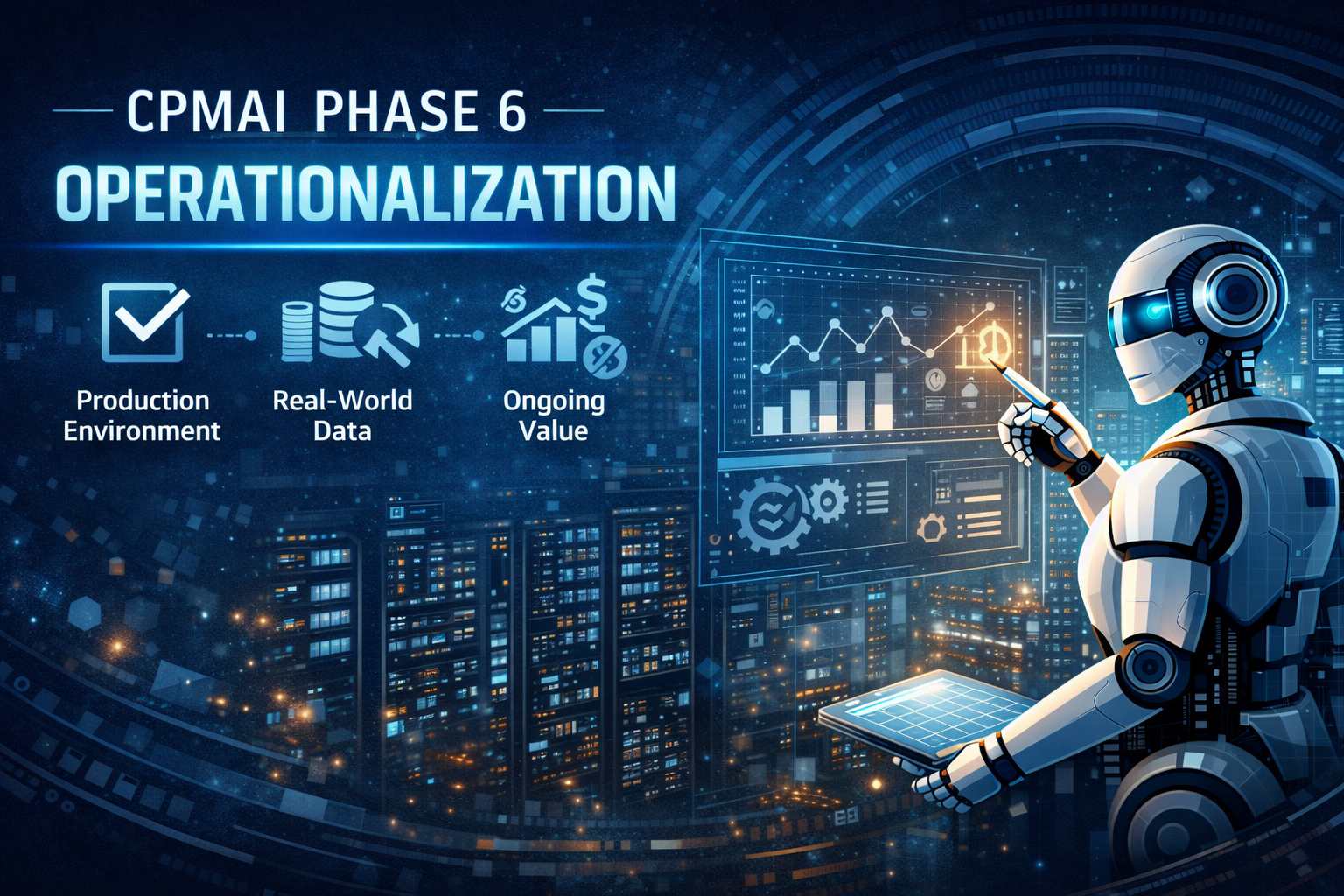
In Phase 6: Operationalization, the AI solution is ready to move from design and validation into real-world use. This is where the model transitions from the lab into live business environments and starts delivering tangible value.
By the end of this phase, the AI system will be:
- Running in a production environment
- Integrated with live, real-world data
- Delivering ongoing, measurable value to the organization
Operationalization is the process of embedding a trained model or AI system into real operational workflows—where it supports users, customers, and business decisions at scale.
Key Questions in CPMAI Phase 6
Phase 6 requires answering critical operational and business questions, including:
- How will the model be used in real-world scenarios?
- What data is required for the model to operate effectively?
- What performance standards must the model consistently meet?
- How will the model be deployed across different environments?
- How will performance be monitored and measured over time?
- How will model versions, updates, and rollbacks be managed?
- How will the model’s impact on business goals be tracked?
- How is success defined, and when should improvements be triggered?
From Evaluation to Execution
In Phase 5, you validated that the AI system met its technical benchmarks and business KPIs.
In Phase 6, that validated model is embedded into internal workflows or customer-facing processes, where real-world constraints and expectations apply.
Key Operational Considerations
Performance
Performance is one of the most critical factors during operationalization:
- How quickly does the model respond to requests?
- How many concurrent users can it support without degradation?
Latency, throughput, and reliability directly affect user trust and adoption.
Resource Usage and Costs
Operational AI systems incur ongoing costs – not just at launch, but over time.
For example, models that require frequent retraining on large datasets can significantly increase infrastructure and operational expenses. These recurring costs must be anticipated and included in the project budget to avoid surprises.
Model Versioning and Governance
Clear governance is essential once the AI system is live:
- Who decides when a model should be upgraded?
- How do you roll back if a new version underperforms?
- What approval and compliance checks are required before deployment?
Phase 6 formalizes decision ownership, updates guidelines, access controls, and review processes—because this is where AI begins to create real-world impact.
Reporting and Visibility
Operational success depends on transparency.
Dashboards and reporting mechanisms should track the metrics defined earlier in the project, answering questions such as:
- Are we achieving the expected ROI?
- Are costs decreasing, efficiency improving, or response times accelerating?
- Are business outcomes aligned with what was promised?
Clear, measurable reporting makes it easier to demonstrate value, maintain executive buy-in, and justify future investment.
Final Operationalization Checklist
As you finalize operationalization, ensure that you:
- Select the appropriate deployment model (on-premise, cloud, or edge) based on performance, data, and cost requirements
- Monitor system usage, latency, and resource consumption continuously
- Budget for training, retraining, scaling, and ongoing system management
- Establish clear update and rollback procedures with defined accountability
- Use dashboards and analytics to confirm delivery of the business outcomes defined in Phase 1: Business Understanding
Closing the CPMAI Lifecycle
Once operationalization is complete, you’ve successfully navigated all six phases of CPMAI – from business understanding and data preparation to a live AI solution operating in the real world.
That said, this is not the end of the journey. It simply marks the beginning of the next iteration.
AI is never set-and-forget. To remain relevant, accurate, and valuable, AI systems require continuous monitoring, refinement, and care.
Think Big. Start Small. Iterate Often.
Have a bold vision for what AI can achieve for your organization – but begin with focus and discipline. Start small by solving a well-defined, tangible problem, and iterate frequently.

Once you achieve an initial success, expand the scope or introduce additional capabilities in future cycles. This incremental approach helps avoid overpromising and underdelivering—one of the most common reasons AI initiatives fail.
A frequent pitfall is attempting to build an all-encompassing AI solution from the outset. When the technology, data, or organizational readiness isn’t there yet, this often leads to disappointing outcomes. Instead, focus on solving the right problem with AI and delivering measurable value step by step.
By producing value in smaller increments, you build trust, gain stakeholder confidence, and create the momentum needed to scale. An iterative mindset also allows you to adapt to evolving requirements, changing data landscapes, and emerging technological opportunities.
Why CPMAI Works
CPMAI is not just another project framework—it is a vendor-neutral best-practice methodology designed specifically for the realities of data-centric AI initiatives.
By applying CPMAI, you can:
- Clearly identify what to work on and when
- Understand why each phase matters
- Keep AI initiatives aligned with real business objectives
- Increase the likelihood of sustainable AI success
I hope this introduction has sparked your interest in CPMAI and provided a strong foundation as you continue your AI journey.
Stay curious and keep learning. AI and data science evolve rapidly, and continuous learning is essential to staying ahead.
And remember: think big, start small, and iterate often.
Connect with us if you have any questions. And if you need to hire freelancers to help you build or manage your AI projects. Reach out to our team of freelancers.