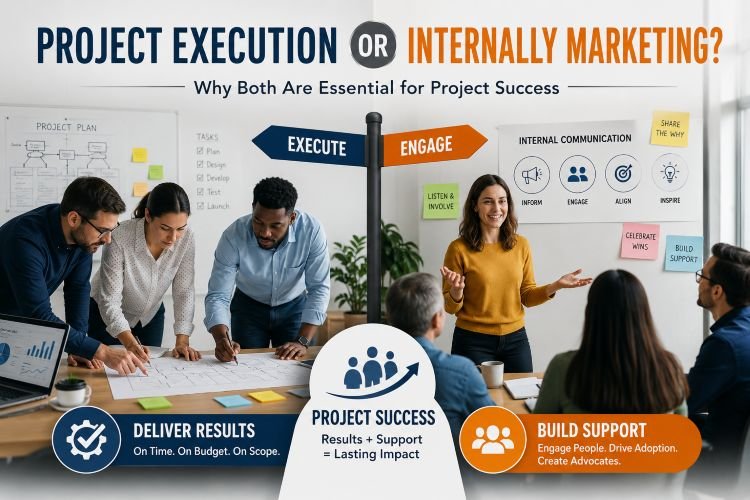
Months of project planning. Careful budgeting. Cross-functional teams. Weekly status calls. A launch event with a slide deck and maybe even branded swag.
And then — silence.
Not because the project was bad. Not because the team underdelivered. But because nobody ever made the organization want it. This is the quiet killer of corporate initiatives: the absence of internal marketing.
The Assumption That Kills Good Work
There’s a belief that runs deep in most organizations: if something is genuinely valuable, people will figure that out on their own. It’s a reasonable assumption. It’s also almost always wrong.
Think about what employees are navigating at any given moment: competing deadlines, shifting priorities, back-to-back meetings, and inbox overload. A new system, process, or platform doesn’t arrive in a vacuum. It lands in the middle of that chaos and asks people to change how they work.
Quality alone is not enough to cut through that noise. Value has to be communicated clearly, consistently, and early.
Even exceptional products need marketing. Apple doesn’t release an iPhone and assume people will discover why it matters. Neither should your project team.
Delivery Is Not the Same as Success
Most organizations measure project success through a familiar checklist:
- Delivered on time?
- Within budget?
- Scope completed?
- Stakeholders signed off?
Check, check, check, check. Project closed.
But these metrics only confirm that something was built. They say nothing about whether it was used — or whether it actually changed anything.
Consider a company that spends eight months implementing a new CRM platform. The rollout goes smoothly. Training sessions are held. The system goes live. Six months later, half the sales team is still logging deals in spreadsheets because “the old way is faster.” By every traditional measure, the project succeeded. By any meaningful measure, it failed.
A completed initiative that nobody uses isn’t a success. It’s an expensive artifact.
What Internal Marketing Actually Is
Let’s be clear about what internal marketing is not. It’s not a motivational poster in the break room. It’s not a CEO video message about “exciting changes ahead.” It’s not a launch email that gets skimmed and deleted.
Internal marketing is the deliberate, ongoing process of helping people understand:
- Why this change is happening — the problem, the urgency, the opportunity
- What’s in it for them — specifically, not generically
- How their day-to-day work improves — with concrete examples, not abstract promises
- What success looks like — and how they’ll know when it’s been reached
When those questions go unanswered, employees don’t rebel. They just… don’t change. They revert. They work around the new system. They wait for the initiative to quietly fade — and in most organizations, they don’t have to wait long.
Five Ways Projects Lose the Room
1. Executive Buy-In Gets Mistaken for Organizational Buy-In
Securing a signature from leadership is not the same as securing hearts and minds across the business. The VP approved it — great. But the operations manager whose workflow is about to change? The customer service team that wasn’t consulted? They didn’t sign anything, and they’re the ones who determine whether the project actually lands.
Top-level approval funds the work. Adoption from the middle and frontline defines its impact.
2. Communication Starts Too Late
The most common mistake is treating communication as a launch activity rather than a project-long discipline. By the time an organization announces a new tool or process, people have already formed opinions — based on rumors, assumptions, or experience with previous initiatives that didn’t deliver.
Awareness shouldn’t begin at go-live. It should begin during development, when people still have the chance to feel heard, to ask questions, and to become genuinely curious rather than defensively skeptical.
A simple “here’s what we’re building and why” update shared mid-project does more for adoption than a polished launch campaign delivered too late.
3. Teams Explain Features When People Care About Outcomes
Project teams are proud of what they’ve built, and understandably so. But employees don’t care about features — they care about their experience.
“We’ve implemented an automated approval workflow with role-based permissions and real-time notifications” means very little to someone who just wants to know: does this mean I stop chasing my manager for sign-offs?
That’s the message. Lead with the human outcome, not the technical achievement.
4. Resistance Is Dismissed Instead of Decoded
When employees push back on a new initiative, the instinct is often to label it as negativity or obstruction. In reality, resistance is almost always a signal worth decoding.
“This is too complicated” — means: I haven’t been trained properly. “We tried something like this before” — means: I need to understand what’s different this time. “I don’t see why this matters” — means: nobody has connected this to my actual work.
Projects that treat resistance as feedback rather than friction move faster in the long run. The people asking the hardest questions are often the ones who, once convinced, become the strongest advocates.
5. Adoption Metrics Are Absent from the Success Report
If a project’s final report celebrates on-time delivery and budget adherence but says nothing about usage rates, behavioral change, or employee sentiment — that report is measuring the wrong things.
Real success metrics look like: What percentage of the target population actively uses the new system? What behaviors changed? What did employees say three months post-launch?
When adoption goes unmeasured, organizations celebrate completion and miss the quiet failure happening just beneath the surface.
What High-Performing Organizations Do Differently
The organizations that consistently turn projects into lasting change treat internal adoption as its own workstream — not something that gets figured out at the end.
Before development begins, they identify every team that will be affected and invite them into the conversation early. They surface concerns before they become entrenched objections. They define what “success” means in human terms, not just technical ones.
During execution, they communicate progress openly — sharing prototypes, running feedback sessions, and being honest about trade-offs. People support things they’ve had a hand in shaping.
Before launch, they build a coalition of internal champions: respected people in key teams who understand the change and can translate it for their peers in language that resonates. No corporate campaign beats a trusted colleague saying “I’ve seen this — it actually works.”
After launch, they sustain the momentum. They track adoption, acknowledge friction, celebrate early wins, and keep educating. Because change doesn’t happen at launch — it happens in the weeks and months that follow.
The Real Competition Every Project Faces
Here’s the uncomfortable truth: your new initiative isn’t competing against market conditions or technical complexity.
It’s competing against habit.
Habits are powerful. They’re efficient, familiar, and low-risk. Asking someone to abandon a habit — even a bad one — requires more than a mandate. It requires belief: belief that the new way is better, that the disruption is worth it, and that the organization is committed to making the transition work.
That belief doesn’t appear automatically. It’s built — through consistent communication, genuine engagement, and the steady work of internal marketing.
The Question Worth Asking
When a project underperforms, organizations tend to ask: What went wrong with execution?
It’s the right instinct, but often the wrong question.
The more revealing question is: Did enough people truly understand what we were trying to do — and did they believe it was worth doing?
Because many projects aren’t rejected. They’re simply never properly introduced. They arrive without context, without champions, and without a compelling answer to the most human question of all: Why should I care?
The difference between a transformation that sticks and one that quietly fades isn’t always better planning or better technology. Sometimes, it’s just better internal marketing.
I would love to discuss more if you have questions or want to share your experience. You can also reach the team in case you have any other questions.