
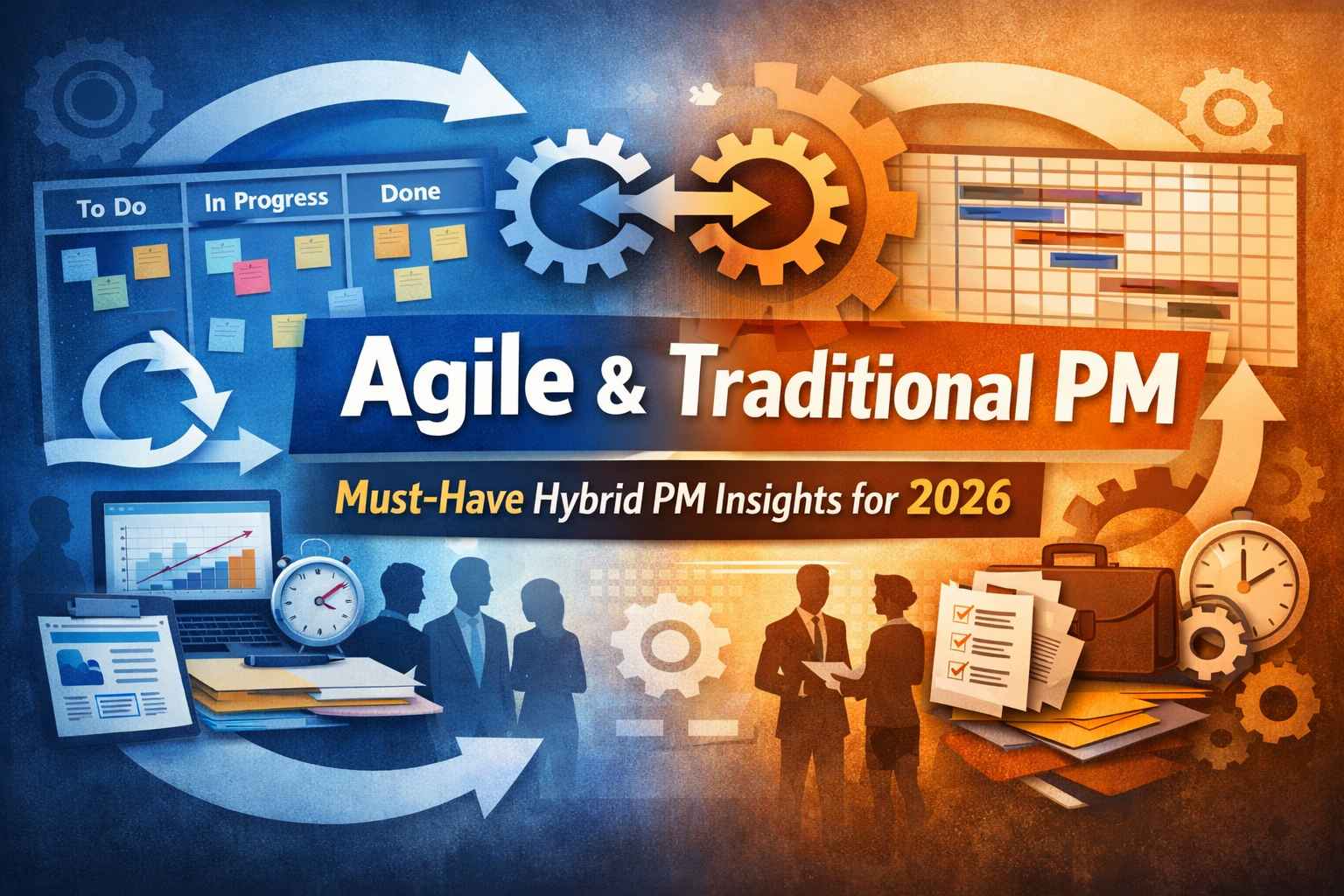
In today’s dynamic business environment, agile and traditional project management approaches are often viewed as two distinct methodologies, each with its unique advantages and challenges. Organizations frequently face the dilemma of choosing between these methodologies to ensure project success. However, the reality is more nuanced; many companies are turning to a hybrid PM approach, which combines the best elements of both to tailor project management processes that are flexible yet structured.
This article explores the intricacies of agile and traditional project management, compares key methodologies such as Scrum vs PM processes, and delves into valuable insights for creating an effective hybrid framework that aligns with organizational goals.
Understanding Agile and Traditional Project Management
Before diving into hybrid project management, it’s essential to understand the foundation of both agile and traditional project management approaches.
Traditional Project Management: The Waterfall Approach
Traditional project management often follows the Waterfall model—a linear and sequential approach. This model emphasizes detailed upfront planning, well-defined stages, and predictable outcomes. The project progresses through phases such as initiation, planning, execution, monitoring, and closure, where one phase is completed before moving to the next.
Characteristics of traditional project management include:
– Strict scope and requirements established early
– Heavy documentation and reporting
– Emphasis on control and risk management
– Clear milestones and deadlines
While reliable for projects with fixed scope and low uncertainty, this approach can be rigid, making it difficult to adapt to changes in fast-paced environments.
Agile Project Management: Embracing Flexibility
Agile project management emerged as a response to the limitations of traditional methods—especially in software development and innovation-driven projects. Agile emphasizes iterative progress, collaboration, and customer feedback.
Key principles of agile include:
– Iterative cycles or sprints, typically 1-4 weeks long
– Adaptive planning and continuous delivery
– Cross-functional teams working collaboratively
– Openness to evolving requirements
Agile frameworks such as Scrum promote transparency, empowerment, and responsiveness, making them suitable for projects with high uncertainty or changing needs.
Scrum vs PM Processes: Key Differences and Similarities
One of the most popular agile frameworks is Scrum, which provides a structured process to implement agile principles.
What is Scrum?
Scrum is an agile framework focusing on managing incremental and iterative work. It breaks down projects into sprints, each involving planning, development, testing, review, and retrospection. Scrum teams include defined roles: Product Owner, Scrum Master, and Development Team.
Comparing Scrum to Traditional PM Processes
| Aspect | Traditional PM Processes | Scrum |
|---|---|---|
| Planning | Comprehensive, upfront | Sprint-based, adaptive |
| Requirements | Fixed, detailed early on | Evolving and prioritized |
| Roles | Project Manager leads | Self-organizing cross-functional team |
| Deliverables | Single final product | Incremental potentially shippable products |
| Feedback | At milestones or completion | Continuous, after every sprint |
| Change Management | Formal change requests | Embraced as part of ongoing process |
Understanding these distinctions is crucial for organizations considering balancing agility with formal controls, especially when working across distributed teams or in regulated industries.
The Rise of Hybrid PM: Combining Agile and Traditional Project Management
Given the strengths and weaknesses of both approaches, many organizations adopt hybrid PM—a blend of agile and traditional project management techniques customized to project needs.
Why Hybrid PM?
– Complex projects: Many projects require solid upfront planning but also need flexibility during execution.
– Industry demands: Regulated sectors such as healthcare or construction may require documentation and risk management from traditional methods while benefiting from agile’s adaptability.
– Organizational culture: Hybrid approaches enable aligning project management with existing workflows and culture.
– Multi-disciplinary teams: Large projects with diverse functional teams may require different methodologies to optimize collaboration.
Core Principles of Hybrid PM
Effective hybrid project management typically includes:
– Structured high-level planning with agile iterative execution
– Designing governance and documentation standards without impeding team agility
– Utilizing sprint-based development cycles alongside milestone tracking
– Combining roles and responsibilities from both approaches
By tailoring the approach, hybrid PM creates a “best of both worlds” methodology to maximize project success.
Implementing Hybrid PM: Practical Insights and Best Practices
Successful adoption of hybrid project management requires thoughtful planning and change management. Here are some actionable insights:
1. Assess Project and Organizational Needs
Not all projects benefit equally from hybrid methods. Evaluate:
– Project complexity and uncertainty
– Regulatory and compliance needs
– Stakeholder expectations
– Team experience and culture
This assessment guides the balance between planning and adaptability.
2. Define Clear Processes and Roles
Hybrid PM thrives when there is clarity in how traditional and agile elements integrate. For instance:
– Maintain a project charter and high-level timeline (traditional touchpoints)
– Use Scrum ceremonies like daily stand-ups, sprint reviews, and retrospectives
– Designate roles like PMO overseeing governance, while Scrum Masters support team agility
Clear communication on responsibilities minimizes confusion.
3. Use Tools that Support Both Approaches
Project management tools increasingly support hybrid workflows, including:
– Gantt charts and milestone tracking (traditional)
– Kanban boards and sprint burndown charts (agile)
Choosing software that integrates these features helps in managing complex hybrid projects effectively.
4. Foster a Collaborative and Adaptive Culture
The hybrid model requires teams and leaders to embrace flexibility, open communication, and continuous learning. Training sessions, coaching, and retrospectives reinforce these values.
5. Monitor, Measure, and Adapt
Regularly evaluate project performance against objectives using key performance indicators (KPIs) such as on-time delivery, quality, team velocity, and customer satisfaction. Use insights to fine-tune the hybrid approach over time.
Challenges and Solutions in Hybrid Project Management
While hybrid PM offers many benefits, certain challenges need to be proactively addressed:
Challenge 1: Cultural Resistance
Traditional teams may resist agile elements while agile practitioners may chafe against bureaucracy.
Solution: Leadership must communicate the rationale for hybrid methods and provide training to build competence and trust.
Challenge 2: Complexity in Governance
Balancing detailed documentation with agile flexibility can create process overhead.
Solution: Identify non-negotiable compliance requirements and simplify other documentation processes to reduce burden.
Challenge 3: Misaligned Expectations
Stakeholders accustomed to traditional reporting may expect fixed scope and deadlines.
Solution: Set expectations about iterative delivery cycles and involve stakeholders in sprint reviews to keep them engaged.
Case Study: How Hybrid PM Transformed Project Outcomes
Consider a multinational software company tasked with developing a compliance-driven application. Initially, the project used traditional Waterfall methods, which resulted in missed deadlines due to evolving regulatory requirements.
By transitioning to a hybrid PM approach, the company established:
– A high-level plan with regulatory milestones (traditional)
– Sprint-based development allowing quick feature updates (agile)
– Regular stakeholder demos for feedback
– Cross-functional teams coordinated via a PMO and Scrum Masters
Outcome: The project was delivered on time with fewer defects and improved client satisfaction.
This example demonstrates how hybrid PM can balance control and flexibility to achieve superior results.
Future Trends in Agile and Traditional Project Management
The evolving landscape of project management suggests hybrid PM will continue to grow in popularity. Trends to watch include:
– AI and automation: Enhancing project tracking and risk prediction across hybrid workflows
– Scaled Agile Frameworks (SAFe): Facilitating agile principles in large, complex organizations alongside traditional governance
– Remote and distributed teams: Hybrid PM will help balance asynchronous agile practices with traditional management for global projects
– Focus on value delivery: Hybrid PM will shift towards integrating lean and agile principles to optimize business outcomes
Conclusion
Navigating the complexities of modern projects requires embracing flexibility without sacrificing control. Agile and traditional project management approaches each offer valuable frameworks, but the future lies in hybrid PM solutions that leverage the strengths of both.
By understanding the distinctions of Scrum vs PM processes, assessing project needs, and adopting best practices for hybrid project management, organizations can better manage risk, improve collaboration, and increase the likelihood of project success.
Mastering hybrid PM insights is no longer optional; it is a vital capability for any organization striving to thrive in an era marked by rapid change and innovation.
Learn more about Project Management. connect with us