AI is changing how software, websites, workflows, and digital products are created. People call it Vibe Coding. Describe an idea. Ask AI to build. Refine. Repeat. The results can feel almost magical.
But after spending more time observing and experimenting with AI-assisted creation, I keep coming back to one thought:
Patience may be one of the most underrated skills in the age of AI.
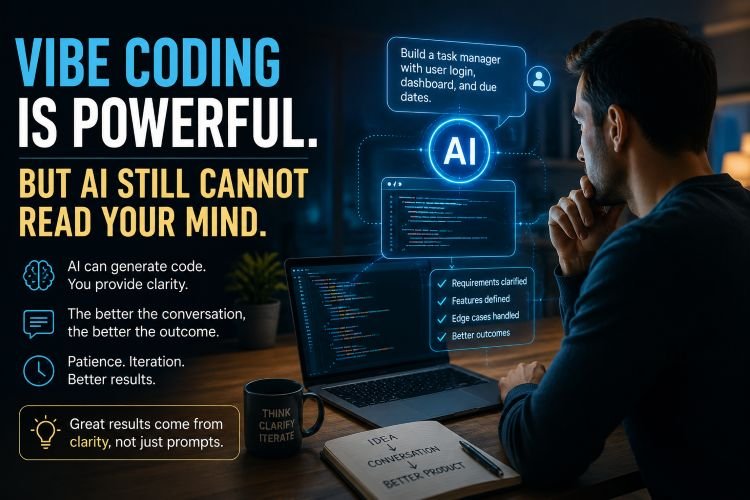
Because AI can generate code.
It cannot automatically understand your mind.
The Myth of Instant Creation
One of the biggest misconceptions about AI is that people assume speed removes the need to think.
It does not.
AI reduces execution friction. But someone still needs to define:
- What success looks like
- What problem is being solved
- What tradeoffs are acceptable
- What should happen in edge cases
- What quality actually means
Without those inputs, AI does not magically produce perfect outcomes.
It produces probable outcomes.
AI Reflects the Quality of Interaction
Traditional development looked something like this: Idea → Human → Code
Vibe Coding changes the flow: Idea → Conversation → AI → Iteration → Product
The conversation becomes part of the build process. That means:
- Unclear inputs create unclear outputs
- Changing requirements create changing results
- Vague expectations create frustration
The interesting part is that AI is not necessarily failing.
Sometimes it is simply a matter of responding to incomplete instructions.
“But That’s Not What I Meant…”
This may be the most common sentence in AI-assisted work.
You ask. AI generates. You review. Then you say: “That’s not what I wanted.”
And suddenly something important happens.
You begin discovering what you actually wanted. The clarification process starts. Requirements appear. Priorities become visible.
That process is surprisingly similar to project execution in the real world.
Patience Is Becoming a Technical Skill
Good AI users are not always the people who write the most advanced prompts.
Often they are the people who:
- Observe outputs carefully
- Provide structured feedback
- Explain examples
- Iterate calmly
- Refine expectations
They treat AI less like magic. And more like collaboration.
Vibe Coding Does Not Remove Thinking
AI may continue getting faster. But speed alone does not guarantee outcomes.
The future may belong to people who can combine:
- Clarity of thought
- Patience in iteration
- Good communication
- Strong judgment
- Fast execution
AI can accelerate creation. But it still depends on one thing.
The person behind the conversation. Because AI can generate code. But it cannot auto-read your brain.
Question for readers: Have you tried vibe coding? Did AI build exactly what you wanted – or did the real work begin after the first output?
If You Want to Use Vibe Coding, Bring the Right Mindset
Do not expect AI to replace thinking. Use it to accelerate thinking. Start with rough ideas, but be willing to clarify them.
Accept that your first output may not be your final product. Give context. Provide examples. Explain constraints.
Treat AI less like a vending machine and more like a collaborator. The goal is not to become dependent on AI.
The goal is to become better at communicating ideas and turning them into outcomes.
And perhaps the most important reminder:
Do not judge AI by the first response. Judge the process by how quickly you and AI improve together.
Recommended Reading for the Vibe Coding Era
If this topic interests you and you want to improve not just your prompts—but your thinking, communication, and execution—these books are worth exploring.
1. Co-Intelligence – Ethan Mollick
A practical look at how humans and AI can work together. One of the strongest reminders that AI performs best when treated as a collaborator, not a replacement.
Key takeaway: Learn to work with AI, not simply delegate to it.

Get this Book from Amazon.in
2. The Mom Test – Rob Fitzpatrick
A powerful book about asking better questions and uncovering real requirements instead of assumptions.
Key takeaway: Better inputs create better outputs—whether from users, teams, or AI.
Get this Book from Amazon.in
3. The Pragmatic Programmer – David Thomas & Andrew Hunt
A timeless book on building, problem-solving, iteration, and engineering judgment.
Key takeaway: Tools evolve. Thinking and decision-making remain valuable.
Get this Book from Amazon.in
4. Thinking, Fast and Slow – Daniel Kahneman
A deep dive into how people think, decide, and sometimes misjudge situations.
Key takeaway: Your first answer may not be your best answer—iteration matters.

Get this Book from Amazon.in
5. The Lean Startup – Eric Ries
Introduces the Build → Measure → Learn mindset that maps surprisingly well to AI-assisted creation.
Key takeaway: The first version is not failure. It is feedback.
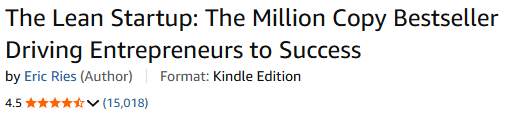
Get this Book from Amazon.in
You do not need to read all of them. But if Vibe Coding is becoming part of your workflow, these books can help build something even more valuable than technical skills: clarity of thought.
If this resonates with your experience or challenges it. I would genuinely like to hear from you. The conversation around AI-assisted creation is still evolving, and your perspective matters. Connect with me on LinkedIn to share your thoughts, or reach out to the team directly if you have questions. We read every message.