Let’s first talk about return on investment (ROI) because that’s usually top of mind for anyone launching an AI project.
Most of us think of ROI only in financial terms, but there are many ways to measure success…
- Financial Savings: How much money a project will generate or save.
- Time Savings: Reducing the hours a team needs to spend on repetitive tasks or reducing the errors in a previously manual process.
- Resource Savings: Lowering operational costs or cutting down on manual processes.
The key is to figure out what a positive return means for your specific organization and your specific project.
Is it worthwhile to move forward with this AI project?
AI GO/NO-GO DECISION.
This phase is all about clarifying the business problem and the feasibility of solving it with AI.

An AI initiative can progress successfully only when three key feasibility dimensions are aligned.
Explore each dimension to assess readiness.
Business Feasibility of AI Project
- Is the business problem clearly defined and well understood?
- Is the organization prepared to invest in and support change?
- Is there a meaningful return on investment or measurable business impact?
If these questions cannot be confidently answered with “yes,” additional discovery and alignment may be required before moving forward.
Data Feasibility
- Does the available data truly represent what matters for the problem?
- Is there sufficient, accessible data to train and validate AI models?
- Is the data of adequate quality and reliability?
If the required data is unavailable, difficult to access, or too costly to clean, the AI approach may need to be reconsidered.
Implementation Feasibility
- Do you have the necessary technology, infrastructure, and skills?
- Can the solution be developed and deployed within acceptable timelines?
- Can the model operate effectively in the intended production environment?
Think of each question as a traffic signal:
- Green means go
- Yellow means proceed with caution
- Red means stop
The more yellow and red signals you encounter, the higher the overall project risk becomes.
Some answers may fall into a “maybe” category – these are effectively yellow lights. A yellow does not mean the project must be abandoned, but it does signal uncertainty. Ideally, these uncertainties should be addressed and resolved before committing significant time, budget, or resources.
If you choose to move forward without resolving them, you should do so with a clear understanding that you are operating in a high-risk environment.
The goal is to answer all the key questions of feasibility and ensure that we have as many green lights as possible.
A common pitfall in AI initiatives is investing significant time and effort in proofs of concept or prototypes that never progress to real-world deployment.
AI tools can be exciting to experiment with, and it often feels like meaningful progress is being made with minimal effort. However, turning these early wins into solutions that consistently deliver real, measurable business value is far more challenging.
Rather than focusing on a proof of concept—which is typically aimed at exploring tool capabilities—shift the emphasis to a pilot.
A pilot is executed using real data, in a real environment, to address a real business problem.
This approach helps teams validate not just what the technology can do, but whether it can succeed where it actually matters.
If you find yourself in the proof-of-concept stage, challenge the team to shift toward a pilot as early as possible, using an agile or adaptive mindset.
This pilot is often referred to as a Minimum Viable Product (MVP)—the smallest real-world solution that can be delivered while still providing meaningful value.
CPMAI Phase One is where you define the success criteria for that MVP. This ensures the initiative is focused on solving a real business problem, rather than simply demonstrating that AI tools can be experimented with.
Ask yourself:
- What does success look like?
- Which AI pattern best fits this problem?
By focusing on an MVP, teams are encouraged to think big, start small, and iterate frequently, increasing the likelihood of delivering successful, value-driven AI solutions.
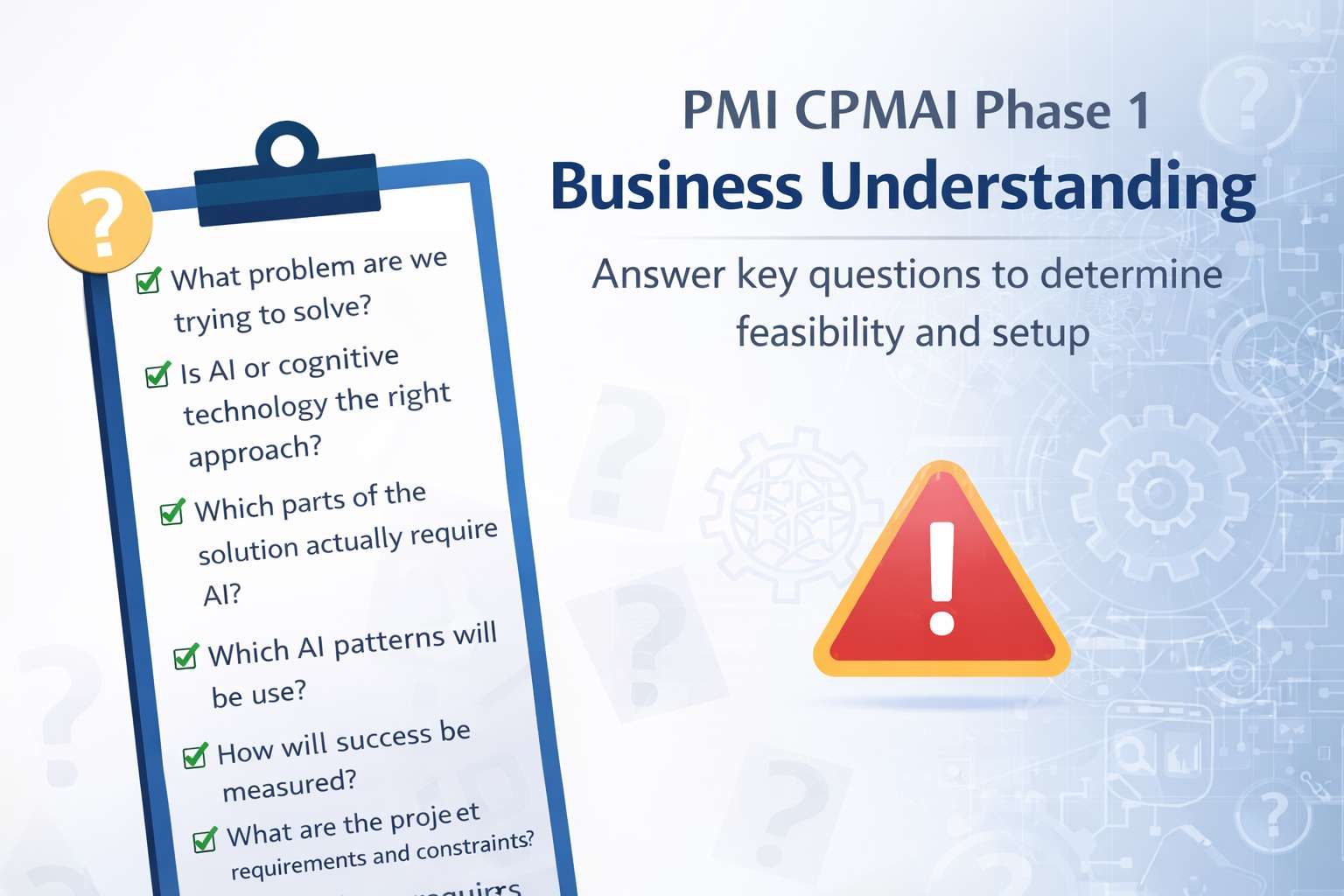
Beyond the seven AI patterns and the AI Go / No-Go decision, CPMAI Phase I focuses on addressing a set of foundational questions that shape the entire initiative:
- What problem are we trying to solve?
- Is AI or cognitive technology the right approach?
- Which parts of the solution actually require AI?
- Which AI patterns should be applied?
- How will success be measured—financial impact, time savings, compliance, user satisfaction, or other outcomes?
- What are the project requirements and constraints?
- What additional considerations or risks exist?
- What skills, capabilities, or resources are required?
The objective of CPMAI Phase I is to gather clear, aligned answers to these questions from key stakeholders, enabling the team to move forward confidently into the next phases of CPMAI.
It’s important to remember that not every problem requires AI, and not every component of a project should use AI. If AI is not the right solution for a clearly defined problem, the initiative should pause until a more suitable approach is identified.
Identifying feasibility issues early is far better than pushing ahead and uncovering them months later. This is precisely why CPMAI Phase I exists: to validate the business case, align expectations, and reduce risk—giving the rest of the AI journey the strongest possible foundation for success.
Reach out to us if you have deeper questions about this phase of CPMAI. You can also talk to a freelance AI Project Manager and hire them if needed.
Suggested Read: Next Phase – Data Understanding