How a single LinkedIn image revealed the deepest blind spot in project management dashboards. I came across a LinkedIn graphic recently. Simple. Two halves. And it stopped me mid-scroll.
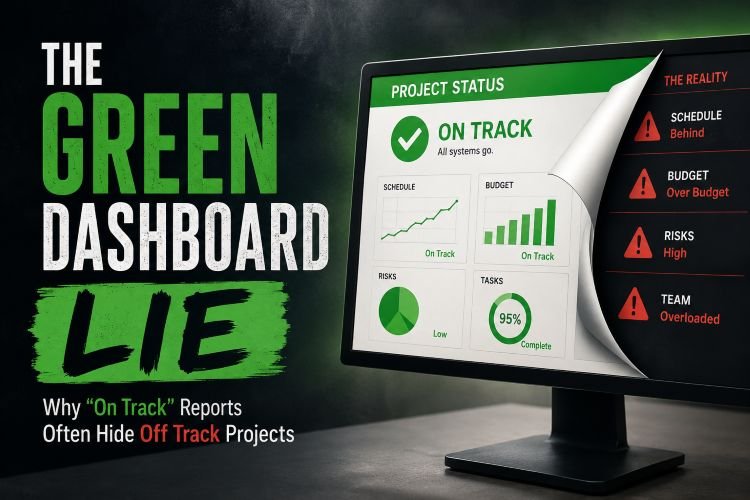
The top half showed a row of projects. Every single one was green – schedule, scope, cost, risk. Each project manager could look their stakeholder in the eye and say, without flinching: “We’re on track.”
And they would have been telling the truth.
The bottom half of the image showed what connected them: one shared, specialized resource. The same developer. The same architect. The same QA team. Five green projects. One human being. And suddenly, every one of those dashboards became a polite fiction.
“A collection of successful projects does not automatically create a successful program.”
I learned this the hard way.
Early in my career, I believed good project managers solved problems quietly. If another team’s overload was threatening my timeline, I’d find a workaround. I’d absorb the pressure. I thought escalation was a sign of weakness.
What I didn’t yet understand was this: the most dangerous projects are often the ones that keep showing green. They look fine on every dashboard while quietly consuming the capacity of a shared team, blocking a higher-priority initiative down the hall, or accumulating technical debt that someone else will pay for in six months.
The project succeeds. The program suffers. And nobody connected the two.
The resource conflict nobody wants to name.
Most project plans are built on a comfortable assumption: that the people assigned to them are actually available. In reality, the same developer is supporting three products simultaneously. The same architect is the bottleneck on five approval chains. Leadership priorities shift every quarter, sometimes every week.
While individual project managers optimize their own delivery, someone at the program level must continuously ask a different question: What is best for the business overall?
That question creates uncomfortable answers. It sometimes means one project must slow down so a more critical initiative can survive. That’s not a management failure. That’s maturity.
The addiction to green.
Organizations develop a kind of cultural reflex around status reporting. The moment something turns amber or red, scrutiny arrives. So teams learn, often without anyone saying it out loud, that green is safer. That reporting dependency risks, team fatigue, or delivery pressure invites questions nobody wants to answer.
The irony is painful. Delayed transparency doesn’t prevent difficult conversations; it guarantees worse ones, later, when there’s less time to act.
A healthy program culture isn’t one where everything is green. It’s one where reality is visible early enough to make intelligent decisions. That difference, compounded over months and years, determines whether programs succeed or quietly collapse under their own weight.
Two very different out-of-dashboard questions.
Project management asks: “Are we delivering this project successfully?”
Program management asks: “Are we delivering the right outcomes, collectively?”
Those are two very different conversations. And organizations that confuse them pay the price in slow-motion failures that never appear on any single dashboard.
The managers worth learning from.
The best program managers I’ve worked with were never the ones with the most polished dashboards. They were the ones who could name the hidden conflict before it appeared in a status report. Who spoke honestly about capacity. Who protected teams from the kind of silent overload that shows up as burnout six weeks later.
They zoomed out. Not once, constantly. They understood that success at the project level and success at the program level aren’t the same thing, and that sometimes protecting one requires deliberately constraining the other.
What the image was really showing.
That LinkedIn graphic looked simple. A row of green lights. A shared resource. A problem revealed.
But what it was really illustrating is a fundamental truth about scale: execution alone is not enough. Alignment, visibility, sequencing, and honest prioritization are the invisible infrastructure that determines whether a program holds together or quietly fractures under the surface.
And sometimes, the most responsible decision a leader can make is to let one project slow down so the larger mission succeeds.
That’s not failure. That’s leadership.
Connect with me, the author.
Good Read: How Focused Business Architecture Shapes System Design for Good