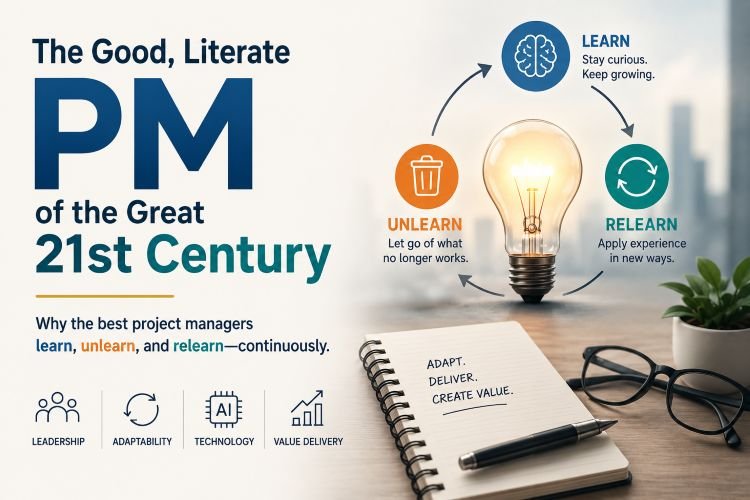
“The illiterate of the 21st century will not be those who cannot read and write, but those who cannot learn, unlearn, and relearn.”
— Alvin Toffler
For project managers, this quote has never been more relevant.
Project management has always been about delivering scope, on time, within budget, and with acceptable quality. Those fundamentals haven’t changed.
Everything else has.
The tools, technologies, delivery methods, stakeholder expectations, and even the role of the project manager are evolving at a pace we’ve never experienced before.
Today’s most valuable project managers aren’t simply those with the most years of experience.
They’re the ones who continuously learn, unlearn, and relearn.
Literate Who Keeps Learning: Staying Relevant
Every year introduces something new.
- AI copilots.
- Predictive analytics.
- Cloud-native architecture.
- Low-code platforms.
- Remote-first collaboration.
- Agile scaling frameworks.
- New cybersecurity requirements.
- Changing compliance standards.
A project manager who stops learning quickly finds themselves managing projects using yesterday’s knowledge.
Learning isn’t about collecting certifications. It’s about continuously expanding your ability to solve today’s problems.
The PMP certification, PRINCE2, Scrum, or ITIL are excellent foundations. They should never become the finish line.
Literate Who Know Unlearning: The Hardest Leadership Skill
Learning is difficult. Unlearning is uncomfortable.
Many project managers unknowingly carry practices that once worked but now slow their teams down.
Examples include:
- Believing documentation is more important than communication.
- Measuring success only by schedule and budget.
- Treating change requests as failures instead of business evolution.
- Assuming meetings create alignment.
- Managing tasks instead of enabling outcomes.
The most experienced PMs sometimes struggle because experience can become attachment.
They defend processes rather than question them. Great project managers challenge their own assumptions before someone else has to.
Literate Who Know Relearning: Applying Experience in a New World
Relearning doesn’t mean starting over. It means rebuilding your expertise with new capabilities.
Consider just a few examples:
- A traditional project manager learns Agile.
- An Agile practitioner learns AI-assisted planning.
- A delivery manager learns how to work with distributed global teams.
- A program manager begins using predictive dashboards instead of manually creating status reports.
None of these erase previous experience. They make it more valuable.
Experience multiplied by adaptability is far more powerful than experience alone.
AI Isn’t Replacing Project Managers
There’s growing concern that Artificial Intelligence will replace project managers.
The reality is more nuanced.
AI can:
- Generate project plans.
- Summarize meetings.
- Write risk registers.
- Draft stakeholder communications.
- Analyze schedules.
- Identify project risks.
- Produce dashboards in seconds.
So where does that leave project managers? Exactly where they should be.
- Leading people.
- Resolving conflicts.
- Making decisions under uncertainty.
- Influencing stakeholders.
- Balancing competing priorities.
- Building trust.
AI changes how project managers work. It doesn’t eliminate why organizations need project managers.
Those who learn to work alongside AI will outperform those who resist it.
What This Means for PMOs
This principle applies beyond individuals. PMOs must also learn, unlearn, and relearn.
Many organizations continue measuring project success using metrics designed twenty years ago.
Modern PMOs should ask different questions.
- Are we enabling faster decision-making?
- Are our governance processes helping or slowing delivery?
- Are we measuring business outcomes instead of only project outputs?
- Are we using AI to reduce administrative effort?
- Are we giving project managers more time to lead rather than report?
The PMO of the future won’t exist to enforce templates. It will exist to improve organizational delivery capability.
Three Questions Every Project Manager Should Ask
At the end of every major project—or even every month—reflect on these questions:
What did I learn?
- A new technology?
- A stakeholder management technique?
- A better estimation approach?
What did I unlearn?
- Which assumption turned out to be wrong?
- Which process added little value?
- What habit should I stop carrying into the next project?
What did I relearn?
- Which old lesson became relevant again?
- How did I apply my previous experience differently when the environment changed?
Growth isn’t just about acquiring knowledge. It’s about continuously reshaping it.
I Personally Think…Being literate is a MUST!
The project managers who thrive over the next decade won’t necessarily have the longest resumes.
They’ll be the ones to continue being literate:
- Who remain curious.
- Those who challenge their own methods.
- Those who embrace change before change forces them to.
Because in project management, the greatest risk isn’t learning something new.
It’s believing you’ve already learned enough.
As Alvin Toffler wisely observed, the true literacy of the 21st century isn’t simply the ability to read and write. It’s the willingness to learn, unlearn, and relearn.
If you wish to connect with me and bounce your thoughts, then reach out to me via LinkedIn. Or just write it to the team, and we will get back to you.
At PMProcesses.com, we believe project management is no longer just about managing projects. It’s about managing change – technological, organizational, and personal. The professionals who invest in continuous learning today will shape the delivery organizations of tomorrow.