Namdev had been managing projects for two years before he even heard the term “PMP.”
A junior operations manager at a mid-sized logistics company, he’d been handed project after project – a warehouse process redesign here, a vendor onboarding rollout there. Small stuff, mostly. A few weeks, a handful of people, a clear deadline.
He was coping. But only just.
Plans would go stale within a week. Stakeholders would show up at the end with opinions no one had asked for earlier. Scope would quietly balloon. And when things went wrong, there was rarely a clear answer to the question: “Who’s supposed to fix this?”
Then a colleague mentioned the PMP – the PMP certification from PMI, the Project Management Institute. Namdev looked it up. The eligibility requirements alone were daunting: 36 months of project leadership experience, 35 hours of formal education, and an exam covering predictive, agile, and hybrid approaches across hundreds of pages of study material.
He closed the tab.
And that’s completely understandable. The PMP certification is designed for experienced professionals managing complex, often large-scale projects. For someone running a four-week internal project with a team of three, it can feel like buying a commercial kitchen to make toast.
But here’s what Namdev – and many newcomers like him – missed: you don’t need the certification to benefit from the thinking behind it.
The frameworks, principles, and habits that PMP-certified managers use? Most of them are documented, freely available, and entirely applicable to small projects. You just need to know which ones to borrow.
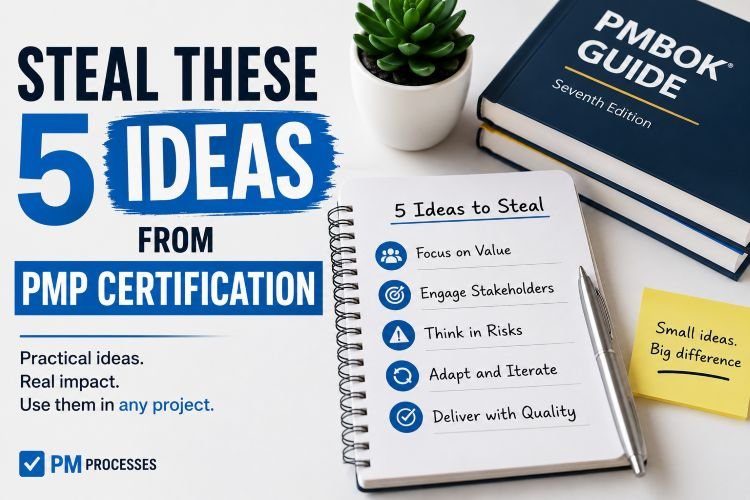
Here are the five most valuable ideas from the PMP world that any newcomer can use right now – no exam required.
1. Manage for value, not just completion
Today’s project management thinking says: delivering the project is not enough – the project must create results.
A project can be delivered on time, within budget, and exactly to scope – and still be a failure. If it doesn’t deliver something useful to the people it was meant to serve, it has failed at the one thing that actually matters.
PMP-trained managers are taught to ask a deceptively simple question at every stage of a project: Is this still delivering value?
For a small project, this translates into a habit: before you start, write down in plain language what “valuable” looks like when you’re done. Not “we completed the task” – but “here is what is better, faster, cheaper, or more reliable because of what we did.”
Then check back against that definition periodically. Projects drift. Scope expands. Original goals get forgotten. A 30-second sanity check – “are we still working towards the thing that matters?” – is one of the cheapest and most powerful tools you have.
This also gives you a principled way to say no. When someone asks you to add something mid-project, your value statement is your filter. Does this addition make the outcome more valuable, or does it just make the project bigger?
2. Know who your stakeholders are – and talk to them before they find you
In PMP thinking, a stakeholder is anyone who is affected by your project or who can affect it. That’s a broader definition than most newcomers apply.
Newcomers tend to think of stakeholders as the people directly working on the project. PMP-trained managers think much more expansively: who will use this output? Who approves it? Who depends on a system that this project will change? Who has to clean up if this goes wrong?
On a small project, you probably have fewer stakeholders than a large one. But the mistake of ignoring them is just as costly.
The classic failure looks like this: a project delivers exactly what was asked for, and then someone who wasn’t consulted – a department head, a compliance team, a key end user – raises a serious objection at the last minute. Not because they were unreasonable, but because nobody thought to loop them in.
The fix is simple, and it takes less than an hour at the start of any project. Ask yourself: who are all the people this project touches, directly or indirectly? Write them down. Then ask: which of them have I spoken to? Which of them need to be informed? Which of them need to actively approve something?
You don’t need a formal stakeholder register with color-coded matrices and engagement levels. You need a list and a plan to communicate with each person on it at the right time.
Engage them early. Update them regularly. Surprises at the end are almost always the result of silence in the middle.
3. Tailor how you work to the project – not the other way around
One of the most significant shifts in modern PMI guidance is the emphasis on tailoring. The idea is that no single approach works for every project. A good project manager doesn’t pick a methodology and apply it uniformly – they look at the project in front of them and ask: what does this project need?
For some projects, a detailed upfront plan works well – the requirements are clear, the dependencies are known, the outcome is predictable. For others, especially those where the goal is somewhat uncertain or where feedback needs to shape the output, a more iterative approach makes more sense.
As a newcomer managing small projects, this principle liberates you from a trap that catches many people early in their careers: the belief that there is One Right Way to run a project.
There isn’t.
What there is: a set of good questions to ask before you decide how to structure your work.
- How well-defined is the end result at the start?
- How likely is it to change?
- How long is the project?
- How many people are involved, and how closely do they need to coordinate?
If the answers point to clarity and stability – plan in detail upfront, and manage to that plan. If the answers point to uncertainty and change – break the work into short bursts, deliver something, get feedback, adjust, repeat.
Most small projects will be somewhere in the middle. The skill is in reading the project honestly rather than defaulting to habit.
4. Risks are assumptions that haven’t been tested yet
Most newcomers treat risk management as an optional extra – something you do on big, complicated projects but can safely skip on small ones.
This is one of the most common and most expensive mistakes in project management.
Here is a more useful way to think about risk: every plan you write is built on assumptions. You assume the key person will be available. You assume the approval will come in time. You assume the technology will work the way you expect. You assume the scope won’t change.
A risk is simply an assumption that might turn out to be wrong.
PMP-trained managers are taught to surface these assumptions explicitly, name what happens if they’re wrong, and decide in advance how to respond. This isn’t pessimism – it’s preparation.
For a small project, you need no more than a simple list. Go through your plan and ask: what am I assuming here? For each assumption, ask: what happens if I’m wrong? If the answer is “mild inconvenience,” move on. If the answer is “the project misses its deadline” or “we have to start over,” write it down and make a plan.
There’s a secondary benefit that most people don’t anticipate: writing down your risks makes you a more confident project manager. Instead of a vague sense that things might go wrong, you have a specific list of things you’ve already thought about. When one of them happens and something usually does – you’re not caught off guard. You’re prepared.
5. Close properly – or the work isn’t really done
This is the most consistently skipped step in small project management, and it creates a surprisingly large amount of organizational pain.
Projects end in two ways.
They can close properly – with a deliberate handover, confirmed acceptance of the output, a record of what was done and what was learned, and a clear signal that the project is complete.
Or
They can simply stop – the deadline passes, people move on to the next thing, and the project just… trails off.
The second kind of ending creates problems that show up weeks or months later. Who owns the output now? What was the final version? What did we learn that we should apply next time? Nobody knows, because nobody wrote it down.
PMP-trained managers treat closure as a formal step, not an afterthought. Even on a small project, closing properly takes less than an hour and saves far more than that in confusion later.
What does “closing properly” look like on a small project?
- Get explicit sign-off from your sponsor that the output meets the agreed definition of done
- Hand over anything that needs ongoing ownership (a document, a process, a system) to the person responsible for it going forward
- Write a brief note – even just a few bullet points – on what went well, what didn’t, and what you’d do differently next time
- Send a short message to the project team and stakeholders confirming it’s complete
That last one matters more than people realize. A clear “we’re done” signal lets everyone involved mentally close the loop. It’s respectful of their time, and it builds your reputation as someone who runs things properly.
What about the PMP certification itself?
If you find yourself managing projects regularly and want to grow in the field, the PMP certification is genuinely worth considering – eventually. PMP is one of the most widely recognized credentials in project management globally, and the process of studying for it will deepen your understanding considerably.
But it’s a significant investment of time, money, and effort. It makes most sense when you have a few years of experience, are managing projects of real complexity, and want formal recognition of your capability.
In the meantime, the ideas above – focus on value, engage stakeholders early, tailor your approach, take risks seriously, and close deliberately – will take you further than most tools or templates ever will.
You don’t need the PMP certification to think like a good project manager. You just need to ask the right questions, consistently, at the right moments.
Start there.
Running a small project and not sure where to start? Use the five ideas above as a pre-project checklist. And if you’re further along the journey and thinking about formal certification, feel free to share your questions via linkedin – happy to point you in the right direction.
You can connect with the team to discuss any other questions you may have.