
Tag: strategic project alignment

  • Adopted PMI Mindset – For Better Change

    Adopted PMI Mindset – For Better Change

    When I first started preparing for the PMI-PMP exam, I honestly believed success would come from memorizing frameworks, formulas, and process groups.

    Like many professionals, I thought PMI was mainly testing my knowledge and my past experience. I was wrong.

    The deeper I went into mock tests, situational questions, and real project discussions, the more I realized something uncomfortable:

    PMI is not really checking whether you can remember terms.

    It is checking how you think when things start going wrong.

    And that realization completely changed the way I looked at project management.

    For years, I had worked on projects where speed mattered more than structure. Clients wanted faster delivery. Teams were overloaded. Stakeholders changed priorities overnight. Escalations happened emotionally. Decisions were often reactive.

    In many organizations, surviving the week becomes more important than following ideal project management practices.

    So naturally, when I started answering PMP questions, I often found myself choosing options that felt “practical” from real-world experience.

    But PMI kept telling me I was wrong. At first, that frustrated me.

    Then I slowly understood what PMI was actually trying to teach.

    PMI’s mindset is not about becoming robotic or theoretical. It is about becoming disciplined in judgment. That is the real exam.

    The PMP exam constantly pushes you into uncomfortable situations where every option looks partially correct. A stakeholder is angry. A team member is underperforming. A sprint is slipping. A vendor has failed. A risk has become an issue.

    And in those moments, PMI wants to know something very specific: Can you respond as a professional leader rather than react emotionally?

    That single shift changed everything for me. I started noticing patterns in PMI’s thinking.

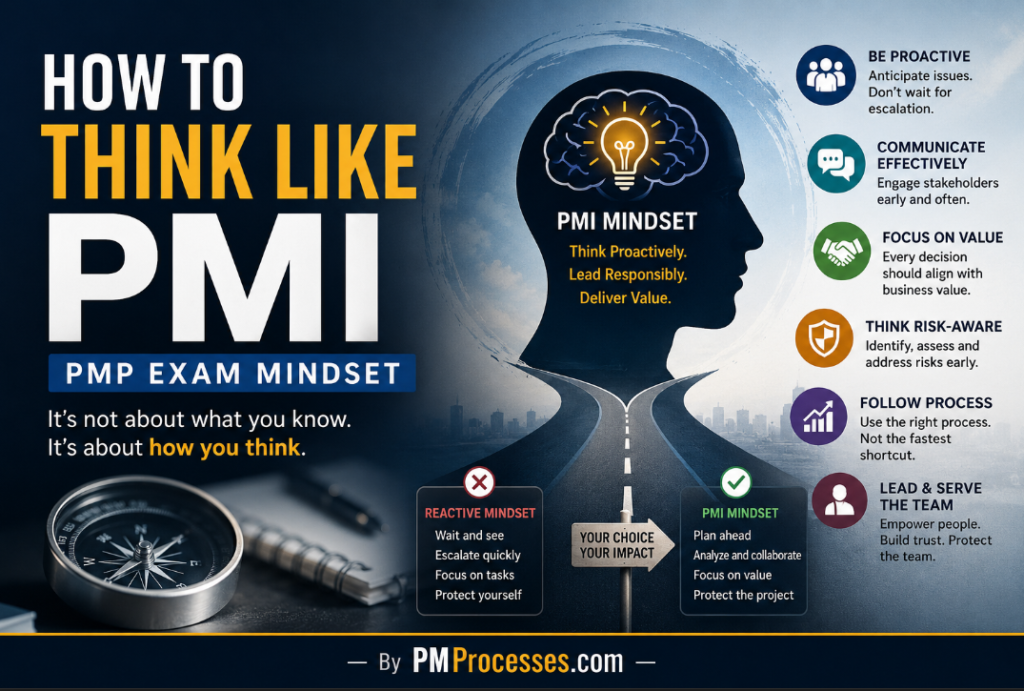
    PMI prefers proactive behavior over reactive firefighting.

    • Instead of waiting for escalation, identify the issue early.
    • Instead of blaming the team, understand the root cause.
    • Instead of immediately escalating upward, first attempt resolution at your level.
    • Instead of making assumptions, gather information.
    • Instead of protecting ego, protect project value.

    Once I began seeing these patterns, the PMP exam no longer felt random.

    The questions started feeling psychological.

    One of the biggest mindset shifts for me was understanding stakeholder thinking.

    In many real projects, teams become output-focused. Finish the task. Close the ticket. Deliver the feature. But PMI repeatedly pushes you to think beyond delivery.

    • Does the stakeholder understand the impact?
    • Was communication clear?
    • Did the decision increase trust?
    • Did the action align with business value?

    That is why, in many PMP questions, technically correct actions are still considered wrong if communication or stakeholder engagement was ignored.

    And honestly, that reflects real leadership more than most people realize. A project manager who delivers but damages relationships creates future problems.

    PMI understands that.

    Another major lesson was around escalation.

    In corporate environments, escalation sometimes becomes a shortcut. People escalate too early to avoid responsibility or protect themselves politically.

    But PMI’s mindset is different.

    • First collaborate.
    • Then analyze.
    • Then communicate to solve.
    • Then attempt resolution.
    • Then escalate only when necessary.

    That sequence matters. The exam trains you to think like someone who stabilizes situations instead of amplifying chaos.

    I also realized PMI strongly values emotional maturity, even if it never directly says so. Many PMP questions are actually testing composure.

    • How do you react under pressure?
    • Do you create panic?
    • Do you make assumptions?
    • Do you isolate stakeholders?
    • Do you ignore the team?
    • Or do you slow down, gather facts, communicate calmly, and move systematically?

    That is PMI thinking. And strangely enough, once I started applying this mindset at work, I noticed something important.

    • Conflicts reduced.
    • Meetings became more structured.
    • Conversations became less emotional.
    • Teams felt safer discussing problems early.
    • Even difficult stakeholders responded differently when communication became proactive instead of defensive.

    The PMP mindset slowly started improving my real-world leadership – not because PMI is perfect, but because structured thinking reduces unnecessary damage during uncertainty.

    Of course, real-world project management is still messier than exam scenarios.

    • Budgets get cut.
    • Leadership changes priorities overnight.
    • Politics exists.
    • Clients become unreasonable.
    • Teams burn out.

    No certification can magically solve that. But the PMI mindset gives something extremely valuable:

    A professional framework for decision-making under pressure.

    And that is what many professionals misunderstand about PMP.

    It is not just a certification in project management. It is training for judgment.

    The more I reflect on it, the more I feel PMI is trying to develop project leaders who think long-term rather than react short-term.

    • Leaders who create alignment instead of confusion.
    • Leaders who reduce risk instead of increasing panic.
    • Leaders who communicate before situations explode.

    My final view on PMI-PMP
    For aspiring PMI-PMP professionals

    I often tell aspiring PMI-PMP professionals something very simple:

    • Don’t just study the processes.
    • Study the behavior behind the processes.

    Because eventually, the exam is not asking “Do you know project management?” It is asking, “Can people trust your judgment when projects become difficult?”

    And honestly, that question matters far beyond the PMP exam itself.

    Written by Rohit Katke for PMProcesses.com

    Another Read: PMP vs CAPM: What I Truly Wish…
  • Project Management Business Value: Unlock Stunning Strategic Results

    Project Management Business Value: Unlock Stunning Strategic Results

    In today’s fast-paced and competitive business environment, project management business value is more critical than ever. Organizations are no longer focused solely on completing projects on time and within budget; they want to unlock tangible benefits that drive growth, innovation, and competitive advantage. This shift highlights the importance of strategic project management—a discipline that aligns project goals with business objectives to create measurable value. Understanding how to leverage project management for business advantage enables companies to run value-driven projects that yield impressive strategic results.

    What is Project Management Business Value?

    At its core, project management business value refers to the tangible and intangible benefits an organization gains by effectively managing projects. These benefits extend beyond simple deliverables and timelines, encompassing enhanced customer satisfaction, improved operational efficiency, market expansion, increased profitability, and stronger stakeholder relationships.

    Unlike traditional project management, which often emphasizes processes and deliverables, focusing on business value encourages project managers and executives to prioritize outcomes that align with strategic goals. This perspective transforms projects from isolated tasks into powerful tools for organizational growth and competitive positioning.

    The Rise of Strategic Project Management

    Aligning Projects with Business Strategy

    Strategic project management is the practice of ensuring that every project undertaken serves a specific business objective or supports a broader strategic initiative. Instead of treating projects as standalone efforts, this approach views them as building blocks of a larger organizational plan.

    By embedding strategy into project selection, planning, and execution, companies can allocate resources efficiently, minimize wasted effort, and focus on initiatives that promise the highest return on investment. This alignment ensures that all projects contribute meaningfully to long-term success, not just short-term wins.

    Benefits of Strategic Project Management

    Prioritized Initiatives: Projects with the greatest potential business impact get prioritized.
    Resource Optimization: Aligning projects with strategy helps allocate funds, talent, and time more effectively.
    Better Risk Management: Understanding strategic context helps identify and mitigate risks proactively.
    Enhanced Communication: Clear links between projects and strategy make it easier to communicate value to stakeholders.
    Improved Decision-Making: Project decisions are guided by overarching business goals, increasing relevance and value.

    Driving Value with Value-Driven Projects

    One of the most effective ways to realize project management business value is through value-driven projects. These initiatives are purposefully designed to deliver measurable benefits aligned with client, customer, or stakeholder expectations.

    Characteristics of Value-Driven Projects

    Clear Value Proposition: Each project defines what value it aims to deliver and how it will be measured.
    Customer-Centric: Outcomes focus on meeting or exceeding customer needs.
    Measurable Goals: Key performance indicators (KPIs) are established to quantify success.
    Continuous Feedback: Regular checkpoints ensure the project stays aligned with evolving requirements and expectations.
    Outcome-Oriented: Success is defined by results, not just compliance with timelines or budget.

    Implementing Value-Driven Projects

    1. Stakeholder Engagement: Early and ongoing involvement of stakeholders to clarify priorities and expectations.
    2. Value Mapping: Identifying how project outcomes contribute to business goals and objectives.
    3. Agile Practices: Using iterative development and feedback loops to enhance flexibility.
    4. Performance Metrics: Establishing and tracking KPIs tied directly to business value.
    5. Benefit Realization: Ensuring value is captured and embedded into business operations post-project completion.

    Measuring and Communicating Project Management Business Value

    It’s not enough to deliver projects; organizations must also be able to measure and communicate the value generated. Demonstrating clear project management business value boosts stakeholder confidence and builds support for future initiatives.

    Key Metrics to Track

    Return on Investment (ROI): Financial gains compared to project costs.
    Customer Satisfaction: Surveys, Net Promoter Scores (NPS), or feedback indicating project impact.
    Operational Efficiency: Improvements in speed, quality, or cost savings.
    Market Impact: New customers, increased market share, or competitive differentiation.
    Employee Engagement: How initiatives improve workforce productivity or morale.

    Effective Communication Strategies

    Storytelling: Use narrative techniques to explain how projects solve problems and create value.
    Dashboards and Reports: Visual tools to present data clearly and succinctly.
    Executive Summaries: Focused overviews that highlight strategic impact.
    Success Stories: Case studies showcasing tangible outcomes and benefits.
    Regular Updates: Consistent communication to keep stakeholders informed and engaged.

    Overcoming Challenges to Realize Business Value in Projects

    Despite the clear benefits, many organizations struggle to fully capture project management business value. Common obstacles include insufficient strategic alignment, poor communication, resistance to change, and a focus on output rather than outcomes.

    Solutions to Unlock Value

    Leadership Commitment: Senior leaders must champion strategic project alignment.
    Training and Development: Equip project managers with the skills to focus on value realization.
    Cultural Shift: Foster a culture that values innovation, customer-centricity, and continuous improvement.
    Integrated Tools: Utilize project management platforms that support strategic planning and value tracking.
    Feedback Loops: Promote transparency and learning from successes and failures.

    Real-World Examples of Project Management Business Value

    Case Study 1: Technology Company Scaling Innovation

    A global technology firm implemented strategic project management by establishing a portfolio review process that prioritized projects aligned with long-term R&D goals. They adopted value-driven initiatives focused on speed to market and customer adoption, resulting in a 30% increase in product launches reaching profitability within the first year.

    Case Study 2: Manufacturing Operational Efficiency

    A manufacturing company targeted value-driven projects to improve production processes. By aligning projects with operational KPIs and engaging frontline employees, they reduced downtime by 25% and improved product quality, resulting in significant cost savings and higher customer satisfaction.

    Case Study 3: Healthcare Provider Enhancing Patient Care

    A healthcare provider utilized strategic project management to design and implement new patient service workflows. The focus on outcome metrics such as patient wait times and satisfaction enabled continuous improvement, improving quality of care while lowering operational costs.

    Best Practices to Maximize Project Management Business Value

    Define Clear Strategic Objectives: Understand what the business aims to achieve.
    Establish a Robust Governance Framework: Ensure accountability and oversight.
    Focus on Outcome Delivery: Shift attention from outputs to impacts.
    Engage Cross-Functional Teams: Leverage diverse expertise to enhance project outcomes.
    Leverage Technology and Data: Use analytics to track progress and forecast benefits.
    Adopt Agile and Adaptive Approaches: Allow flexibility to respond to changing business environments.

    Conclusion

    Unlocking stunning strategic results through project management business value requires a deliberate approach that blends strategy, execution, and measurement. Through strategic project management and value-driven projects, organizations can transcend traditional project constraints, turning initiatives into powerful engines of growth and innovation. By embracing these principles, companies not only improve project success rates but also create lasting business advantages that drive competitive differentiation in a complex marketplace.

    Incorporating a strong focus on delivering measurable value through every project ensures that resources are invested wisely and outcomes clearly demonstrate business impact. As more organizations adopt this mindset, project management continues to evolve from a tactical discipline into a strategic driver of business success.

    Learn more about Project Managementconnect with us

  • Project Success Metrics: Must-Have Tips for Best Business Value

    Project Success Metrics: Must-Have Tips for Best Business Value

    In the ever-evolving landscape of modern business, understanding and applying project success metrics is essential to delivering the best business value. Without the right metrics, organizations can struggle to assess whether their projects meet intended objectives, deliver tangible benefits, or maintain alignment with strategic goals. The integration of effective project success metrics enables leaders to evaluate project performance, make data-driven decisions, and ensure that all initiatives contribute meaningfully to the organization’s growth and sustainability.

    This comprehensive article delves into the various facets of project success metrics, explores approaches to business value measurement, and offers actionable tips for optimizing project performance evaluation. By the end, you will have a solid understanding of how to define, implement, and utilize these metrics to maximize your projects’ impact.

    Understanding Project Success Metrics

    Project success metrics are quantifiable measures used to determine the effectiveness and quality of a project’s outcomes. These metrics go beyond just finishing within deadline and budget—they encompass multiple dimensions of success that together give a holistic view of project performance.

    The Importance of Project Success Metrics

    Why focus on project success metrics? Because a project’s completion alone does not guarantee value delivery. Classic notions like “on time, on budget” are necessary but not sufficient to prove success in today’s competitive environment. Projects must align with broader business goals, positively impact stakeholders, and create measurable improvements.

    By using the right set of metrics, businesses can:

    Monitor progress in real time: Quick feedback enables corrective actions before issues escalate.
    Align project outcomes with business strategy: Make sure projects support high-level organizational goals.
    Communicate achievements effectively: Well-chosen KPIs make reports clearer to stakeholders.
    Drive continuous improvement: Metrics reveal bottlenecks and inefficiencies for future optimization.

    Business Value Measurement: Linking Projects to Strategic Goals

    A critical subset of project success metrics is business value measurement, which evaluates how a project’s deliverables contribute to the organization’s financial and strategic objectives.

    Defining Business Value in Projects

    Business value is the quantifiable benefit a project brings to the company. This can manifest in increased revenue, reduced costs, improved customer satisfaction, enhanced brand reputation, or competitive advantage.

    Common Business Value Metrics

    Here are prevalent ways organizations measure business value:

    Return on Investment (ROI): The net gain from a project divided by its cost. High ROI projects are prioritized for better resource allocation.
    Net Present Value (NPV): Evaluates the present value of future cash flows generated by the project, discounted back to today’s value.
    Customer Satisfaction Scores (CSAT or NPS): Measures how well the project’s outputs meet customer expectations, reflecting value in customer-centric terms.
    Market Share Growth: Indicates whether the project helped increase the company’s share in the target market.
    Cost Savings: Tracks reduction in operational expenses as a direct result of the project.

    The Challenge of Measuring Intangible Value

    Not all business value is financial or easily quantified. Some projects aim to improve internal processes, compliance, or employee wellbeing. Metrics addressing these may include employee engagement scores, compliance audit success rate, or time saved on routine tasks.

    Project Performance Evaluation: Tips for Effective Assessment

    Project performance evaluation assesses how well a project adheres to its scope, schedule, budget, and quality parameters and the achievement of its business objectives.

    Developing a Balanced Scorecard Approach

    A single metric rarely covers all bases. Using a balanced scorecard approach helps evaluate projects from multiple angles:

    Financial Metrics: Cost variance, budget adherence, ROI.
    Process Metrics: Schedule variance, milestone completion ratio.
    Customer Metrics: Satisfaction ratings, defect rates.
    People Metrics: Team productivity, stakeholder engagement.

    By creating a balanced set of KPIs, organizations can avoid tunnel vision on one aspect and gain a comprehensive perspective.

    Establishing Clear, Measurable KPIs Early On

    Starting a project without explicit KPIs can lead to ambiguous success definitions. At the proposal or planning phase, define what success looks like with measurable targets—for instance, “Reduce processing time by 25%” or “Achieve 90% positive user feedback.”

    Using Real-Time Dashboards and Analytics

    Modern technology offers real-time project dashboards that pull data from multiple sources, displaying metrics visually. Continuous monitoring through these dashboards enables quicker analysis of project health and swift decision-making.

    Must-Have Tips for Using Project Success Metrics

    To maximize business value through project success metrics, integrate the following best practices into your project management framework:

    1. Align Metrics with Business Priorities

    Start by understanding your organization’s strategic priorities. Tailor project success metrics to reflect these priorities, ensuring every project contributes to overarching business goals.

    2. Involve Stakeholders in Metric Selection

    Engage sponsors, team members, and customers when deciding on metrics. This inclusive approach ensures metrics represent diverse perspectives and are more widely accepted.

    3. Differentiate Between Leading and Lagging Indicators

    Leading Indicators predict future performance (e.g., number of defects found early, team velocity).
    Lagging Indicators represent end results (e.g., final budget spent, customer satisfaction post-implementation).

    Balancing both types helps anticipate risks and evaluate ultimate outcomes.

    4. Periodically Review and Adapt Metrics

    As projects evolve, project metrics should also be reassessed. Metrics irrelevant to current objectives or insufficient for capturing new risks should be replaced or updated.

    5. Focus on Outcome, Not Just Output

    Many projects are evaluated on outputs (deliverables produced) rather than outcomes (actual benefits realized). Shift focus towards the latter for true business value measurement.

    6. Utilize Benchmarking for Context

    Compare project performance to past projects or industry standards. Benchmarking helps set realistic targets and identify areas of exceptional performance or concern.

    7. Communicate Metrics Clearly

    Make data transparent and understandable for all team members and stakeholders. Use visual aids like charts and graphs to make complex data more accessible.

    Practical Examples of Project Success Metrics in Action

    To illustrate, consider the following examples of tailored project success metrics:

    Example 1: Software Development Project

    Cycle Time: Average time taken to complete a feature.
    Bug Count: Number of defects reported after deployment.
    Customer Adoption Rate: Percentage of users actively using the new software.
    ROI: Revenue generated by the software minus development and maintenance costs.

    Example 2: Marketing Campaign Project

    Lead Conversion Rate: Percentage of leads converted into customers.
    Brand Awareness Growth: Measured via surveys or social media mentions.
    Cost Per Lead: Marketing spend divided by number of leads generated.
    Sales Increase: Incremental increase in sales attributed to the campaign.

    Example 3: Process Improvement Project

    Cycle Time Reduction: Minutes or hours saved per process iteration.
    Error Rate Reduction: Decrease in errors or rework instances.
    Employee Satisfaction: Improvement in team morale through surveys.
    Cost Savings: Reduction in operational expenses as a direct outcome.

    Overcoming Common Challenges in Project Success Metrics

    While measuring success is invaluable, there are common pitfalls:

    Choosing Too Many Metrics: This leads to “metric overload,” diluting focus.
    Lack of Data Quality: Poor data undermines metric reliability.
    Ignoring Qualitative Factors: Solely quantitative metrics miss the bigger picture.
    Resistance to Transparency: Teams may hide poor performance if metrics aren’t perceived as constructive.

    Overcome these by setting a focused set of metrics, investing in data collection tools, blending qualitative feedback with quantitative data, and fostering a culture of trust and learning.

    The Future of Project Success Metrics

    As technology advances, project success metrics will increasingly leverage AI, machine learning, and predictive analytics. These technologies can provide deeper insights, forecast risks, and simulate outcomes before committing resources. Equally important will be the evolution of metrics toward capturing sustainability, social impact, and innovation as integral components of business value.

    Conclusion

    Project success metrics are indispensable tools for achieving and demonstrating the best business value from your projects. By thoughtfully selecting, implementing, and continuously refining these metrics, businesses can better measure project performance, enhance decision-making, and ensure alignment with strategic goals. Remember that the ultimate purpose of success metrics is not just data collection but driving meaningful outcomes that propel your organization forward.

    Focus on what truly matters, maintain transparency, and adapt to evolving business contexts—these principles will help you turn project success metrics from mere numbers into powerful levers of business excellence.

    Learn more about Project Managementconnect with us