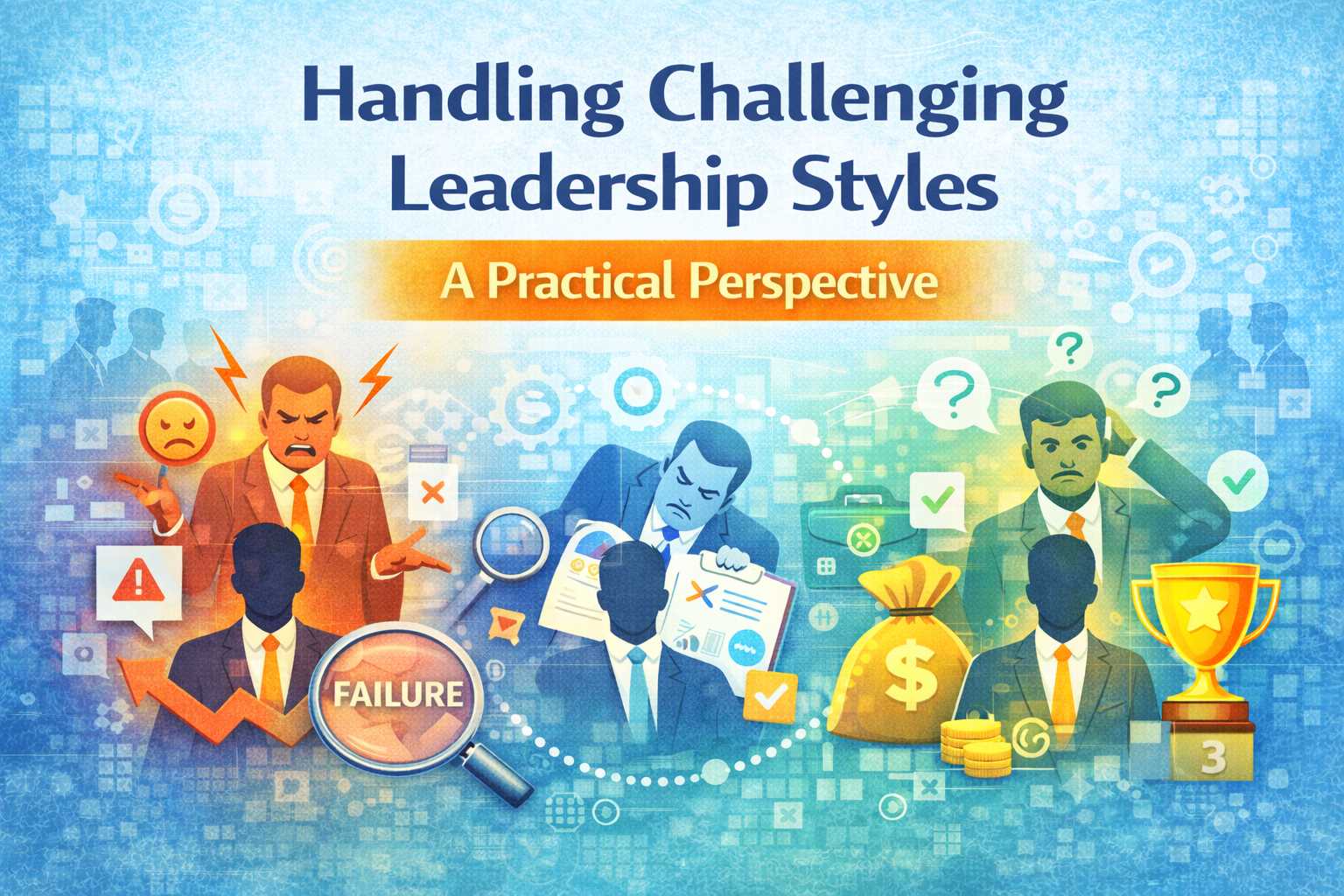
Handling Challenging Leadership Styles: A Practical Perspective. The Project Managers who master this skill become anchors in difficult organizations. Their leadership is not always loud – but it is lasting.
Introduction: The Reality Project Managers Rarely Talk About
Project Management is often described through frameworks, processes, and certifications. But seasoned Project Managers know that projects don’t fail because of missing templates—they struggle because of people, power dynamics, and leadership behavior.
In many organizations, Project Managers and Team Leads operate under leaders who may be technically competent but emotionally detached, ego-driven, or inconsistent in their respect and support. Empathy may be absent, yet expectations remain high. Deadlines don’t move. Accountability doesn’t soften.
This creates a difficult reality:
How do you lead, deliver, and protect your team when leadership lacks empathy?
This article explores practical strategies Project Managers can use to:
- Lead effectively when respect is inconsistent
- Maintain professionalism under pressure
- Recognize subtle manipulation tactics
- Set expectations without triggering retaliation
- Keep teams focused, motivated, and protected
This is not about diagnosing personalities. It’s about operating professionally and strategically in challenging leadership environments.
1. Leading Effectively When Respect Is Inconsistent
Inconsistent respect is one of the most destabilizing leadership patterns Project Managers face. One week your judgment is trusted; the next, your decisions are questioned publicly. One sprint review ends with appreciation; the next becomes a blame exercise.
For Project Managers, this inconsistency creates authority erosion—especially in front of teams and stakeholders.
How Project Managers Can Respond
The mistake many PMs make is seeking emotional validation or approval. That approach makes leadership effectiveness dependent on someone else’s behavior.
Instead, anchor your leadership in structure and predictability:
- Approved scope documents
- Clearly defined milestones
- RAID logs
- Decision records
- Agreed success metrics
When respect fluctuates, process becomes your credibility.
Lead through:
- Clear agendas
- Written summaries
- Objective reporting
- Outcome-focused discussions
Your team will follow consistency, even if leadership behavior is unpredictable.
Key Insight:
Project authority doesn’t come from personal approval—it comes from clarity and structure.
2. Maintaining Professionalism Under Pressure
Projects are pressure environments by default. Add emotionally reactive or ego-driven leadership, and pressure can quickly turn toxic.
Project Managers often face:
- Public questioning of decisions
- Escalations without warning
- Emotionally charged meetings
- Unrealistic demands framed as urgency
The instinctive reaction is to defend yourself or push back emotionally. But experienced PMs know this rarely ends well.
The Professional Response
Professionalism under pressure means controlling tone, not surrendering authority.
Effective Project Managers:
- Separate issue ownership from personal emotion
- Respond with facts, not feelings
- Frame conversations around impact, risk, and trade-offs
- Avoid emotional escalation, even when provoked
Your calm becomes a stabilizing force. Teams notice. Stakeholders notice. Even difficult leaders notice—even if they never acknowledge it.
Key Insight:
Professional calm is not silence—it is controlled leadership.
3. Recognizing Subtle Manipulation in Project Environments
Manipulation in leadership is rarely dramatic. It’s subtle, plausible, and often disguised as “business pressure.”
In project settings, it may appear as:
- Verbal approvals later denied
- Scope changes introduced informally
- Praise given privately, blame assigned publicly
- Escalations framed without full context
- Shifting success criteria mid-project
Left unrecognized, these behaviors create confusion, self-doubt, and delivery risk.
What Project Managers Should Do
The goal is not confrontation, but protection.
Strong PMs respond with:
- Written confirmations after meetings
- Documented decisions and assumptions
- Neutral meeting minutes
- Transparent risk communication
This is not bureaucracy. It’s risk mitigation.
When narratives shift, documentation provides continuity. When accountability becomes selective, records provide fairness.
Key Insight:
Awareness creates distance. Documentation creates safety.
4. Setting Expectations Without Triggering Retaliation
Project Managers must constantly set boundaries—on scope, timelines, quality, and resources. In empathy-deficient leadership environments, boundary-setting can be misinterpreted as resistance or incompetence.
This is where many PMs struggle.
The Framing That Works
The secret lies in how expectations are framed.
Avoid:
- “I can’t do this.”
- “My team is overloaded.”
- “This is unreasonable.”
Instead, focus on:
- Delivery impact
- Risk exposure
- Trade-offs
- Business consequences
For example:
“If we accelerate this timeline, quality risk increases here. To mitigate that, we’ll need either additional resources or reduced scope.”
Follow verbal conversations with written summaries. Keep language neutral and professional.
Key Insight:
Frame boundaries as project protection, not personal limitation.
5. Keeping the Team Focused and Protected
Teams sense leadership instability long before it’s acknowledged. When leadership lacks empathy, the impact trickles down as:
- Anxiety
- Confusion
- Fear of blame
- Reduced psychological safety
A Project Manager’s role expands in such environments—from coordinator to buffer.
How Project Managers Protect Their Teams
Effective PMs:
- Filter unnecessary noise from leadership
- Translate vague or emotional directives into actionable tasks
- Maintain clarity around priorities
- Absorb pressure so teams can focus on delivery
This doesn’t mean hiding reality. It means containing emotional volatility and protecting focus.
Teams don’t need every leadership emotion—they need direction, safety, and predictability.
Key Insight:
When leadership is unpredictable, the team relies on the Project Manager for stability.
6. Leading Without Losing Yourself
One overlooked cost of working under empathy-deficient leadership is burnout. Project Managers are often expected to be endlessly resilient, neutral, and composed—without acknowledgment.
Sustainable leadership requires:
- Emotional boundaries
- Peer support
- Self-awareness
- Periodic detachment from toxic dynamics
Strong PMs know when to push, when to document, when to escalate—and when to disengage emotionally.
Leadership effectiveness is not measured by how much pressure you absorb, but by how well you sustain delivery over time.
Key Insight:
Resilience is not endurance without limits—it’s endurance with awareness.
Conclusion: Quiet Leadership That Sustains Projects
Project Managers don’t always have the power to change leadership behavior. But they do have the responsibility to:
- Protect delivery
- Preserve team health
- Maintain professionalism
- Lead with clarity and restraint
Handling leadership that lacks empathy is not about confrontation or ego battles. It’s about structure over emotion, facts over narratives, and consistency over approval.
The Project Managers who master this skill become anchors in difficult organizations. Their leadership is not always loud—but it is lasting.
Learn more about Project Management. connect with us