When I first started preparing for the PMI-PMP exam, I honestly believed success would come from memorizing frameworks, formulas, and process groups.
Like many professionals, I thought PMI was mainly testing my knowledge and my past experience. I was wrong.
The deeper I went into mock tests, situational questions, and real project discussions, the more I realized something uncomfortable:
PMI is not really checking whether you can remember terms.
It is checking how you think when things start going wrong.
And that realization completely changed the way I looked at project management.
For years, I had worked on projects where speed mattered more than structure. Clients wanted faster delivery. Teams were overloaded. Stakeholders changed priorities overnight. Escalations happened emotionally. Decisions were often reactive.
In many organizations, surviving the week becomes more important than following ideal project management practices.
So naturally, when I started answering PMP questions, I often found myself choosing options that felt “practical” from real-world experience.
But PMI kept telling me I was wrong. At first, that frustrated me.
Then I slowly understood what PMI was actually trying to teach.
PMI’s mindset is not about becoming robotic or theoretical. It is about becoming disciplined in judgment. That is the real exam.
The PMP exam constantly pushes you into uncomfortable situations where every option looks partially correct. A stakeholder is angry. A team member is underperforming. A sprint is slipping. A vendor has failed. A risk has become an issue.
And in those moments, PMI wants to know something very specific: Can you respond as a professional leader rather than react emotionally?
That single shift changed everything for me. I started noticing patterns in PMI’s thinking.
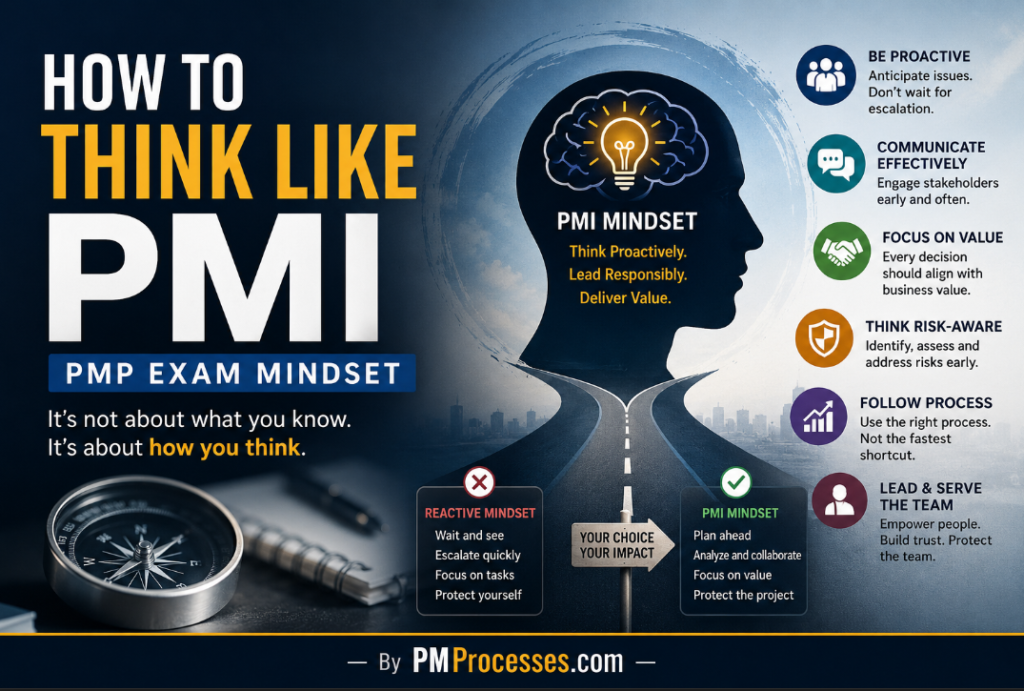
PMI prefers proactive behavior over reactive firefighting.
- Instead of waiting for escalation, identify the issue early.
- Instead of blaming the team, understand the root cause.
- Instead of immediately escalating upward, first attempt resolution at your level.
- Instead of making assumptions, gather information.
- Instead of protecting ego, protect project value.
Once I began seeing these patterns, the PMP exam no longer felt random.
The questions started feeling psychological.
One of the biggest mindset shifts for me was understanding stakeholder thinking.
In many real projects, teams become output-focused. Finish the task. Close the ticket. Deliver the feature. But PMI repeatedly pushes you to think beyond delivery.
- Does the stakeholder understand the impact?
- Was communication clear?
- Did the decision increase trust?
- Did the action align with business value?
That is why, in many PMP questions, technically correct actions are still considered wrong if communication or stakeholder engagement was ignored.
And honestly, that reflects real leadership more than most people realize. A project manager who delivers but damages relationships creates future problems.
PMI understands that.
Another major lesson was around escalation.
In corporate environments, escalation sometimes becomes a shortcut. People escalate too early to avoid responsibility or protect themselves politically.
But PMI’s mindset is different.
- First collaborate.
- Then analyze.
- Then communicate to solve.
- Then attempt resolution.
- Then escalate only when necessary.
That sequence matters. The exam trains you to think like someone who stabilizes situations instead of amplifying chaos.
I also realized PMI strongly values emotional maturity, even if it never directly says so. Many PMP questions are actually testing composure.
- How do you react under pressure?
- Do you create panic?
- Do you make assumptions?
- Do you isolate stakeholders?
- Do you ignore the team?
- Or do you slow down, gather facts, communicate calmly, and move systematically?
That is PMI thinking. And strangely enough, once I started applying this mindset at work, I noticed something important.
- Conflicts reduced.
- Meetings became more structured.
- Conversations became less emotional.
- Teams felt safer discussing problems early.
- Even difficult stakeholders responded differently when communication became proactive instead of defensive.
The PMP mindset slowly started improving my real-world leadership – not because PMI is perfect, but because structured thinking reduces unnecessary damage during uncertainty.
Of course, real-world project management is still messier than exam scenarios.
- Budgets get cut.
- Leadership changes priorities overnight.
- Politics exists.
- Clients become unreasonable.
- Teams burn out.
No certification can magically solve that. But the PMI mindset gives something extremely valuable:
A professional framework for decision-making under pressure.
And that is what many professionals misunderstand about PMP.
It is not just a certification in project management. It is training for judgment.
The more I reflect on it, the more I feel PMI is trying to develop project leaders who think long-term rather than react short-term.
- Leaders who create alignment instead of confusion.
- Leaders who reduce risk instead of increasing panic.
- Leaders who communicate before situations explode.
My final view on PMI-PMP
I often tell aspiring PMI-PMP professionals something very simple:
- Don’t just study the processes.
- Study the behavior behind the processes.
Because eventually, the exam is not asking “Do you know project management?” It is asking, “Can people trust your judgment when projects become difficult?”
And honestly, that question matters far beyond the PMP exam itself.
Written by Rohit Katke for PMProcesses.com
Another Read: PMP vs CAPM: What I Truly Wish…