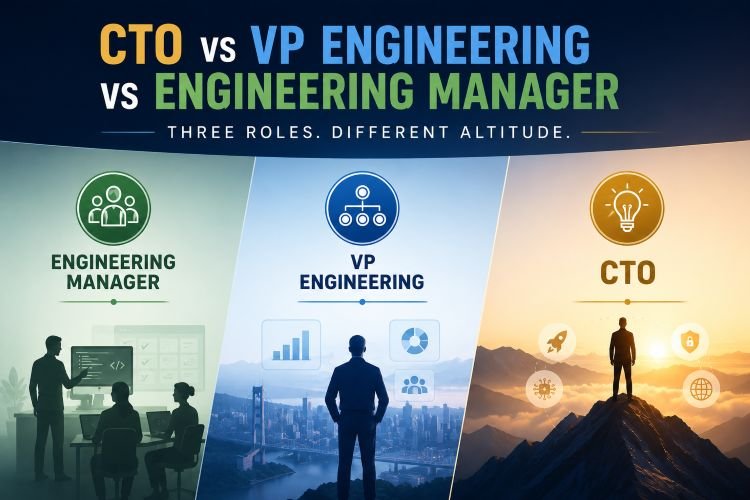
I keep seeing job postings labeled “CTO” that actually read like VP of Engineering roles. Sometimes the listing is really for an Engineering Manager wearing a bigger title.
It’s not just recruiters getting sloppy. Plenty of people walking around with “CTO” on their LinkedIn profiles spend their days merging pull requests, triaging Jira tickets, and firefighting production issues. That’s not a CTO job – it’s an operational one.
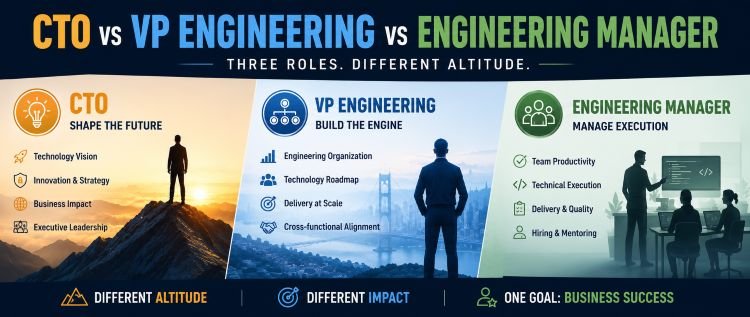
The real difference between these three roles isn’t seniority. It’s altitude – how far above the code you’re expected to operate, and what kind of decisions you’re trusted to make.
Getting this wrong is costly. Companies stall on innovation, teams grow frustrated, and strategic bets stumble because leadership expected boardroom thinking from someone hired to run sprints – or expected someone hired to set a five-year technology strategy to also review every pull request.
Here’s a clearer breakdown of what each role actually does.
1. Engineering Manager – Closest to the Work
This is the role most embedded in day-to-day execution: sprint planning, one-on-ones, hiring and coaching engineers, unblocking delivery risks, and turning business requirements into shipped code.
Owns: team output, sprint delivery, technical execution, team hiring and mentoring, quality, and day-to-day engineering processes.
Doesn’t own: company-wide technology strategy, product vision, architecture beyond their team, technology budget, or a seat at board-level discussions.
What they need from the business: clear priorities, a stable roadmap, realistic timelines, and the autonomy to actually run their team.
Startup vs. enterprise: At a startup, an Engineering Manager is often still writing code and shipping fast – success looks like features going out the door. At an enterprise, the job shifts toward coordination, predictability, and team health across a bigger, more compliance-heavy machine.
2. VP of Engineering – The Translation Layer
The VP of Engineering sits between strategy and execution. Their calendar is split between the executive table and the engineering floor.
The Engineering Manager asks, “Will we hit this sprint?” The VP asks a bigger question: “Can this organization keep delivering on the business’s goals for the next few years?”
Owns: the engineering org itself – hiring strategy, budget, roadmap execution, culture, delivery predictability, and cross-team alignment.
Doesn’t own: overall business strategy, market positioning, investor relations, or the company’s product-market fit.
What they need from the business: a real seat at the table during planning and hiring, budget authority, executive trust, and priorities that don’t shift every quarter.
Startup vs. enterprise: At a startup, one VP of Engineering often juggles hiring, architecture, DevOps, security, and culture simultaneously. At an enterprise, they’re managing multiple engineering orgs, and the job relies far more on organizational leadership than on hands-on technical skills.
3. CTO – The Business Executive Who Happens to Know Tech
A CTO isn’t just the most senior engineer in the building. It’s a business executive role where technology is the domain – not the job title.
A CTO’s week is full of conversations about AI strategy, cybersecurity posture, M&A due diligence, platform direction, partnerships, and long-term competitive positioning. Ironically, they often talk about code less than the Engineering Manager does – because code isn’t what they’re managing anymore. The business is.
Owns: technology vision, innovation strategy, enterprise architecture, technology investment decisions, risk, cybersecurity direction, and communication with the board.
Doesn’t own: sprint reviews, code reviews, production support, task assignment, or every individual architectural call.
What they need from the business: a seat at the table for strategic decisions, authority over long-term tech investment, direct access to executive leadership, and – critically – time to build capability rather than just ship projects.
Startup vs. enterprise: At a startup, the CTO is often the technical co-founder, building the product and shaping the company’s future simultaneously. At an enterprise, the role shifts toward transformation – AI, cloud, security, data, digital platforms, governance – where technology becomes a genuine competitive advantage rather than just a support function.
The One-Line Test
- Engineering Manager: “Can my team deliver this release?”
- VP of Engineering: “Can this organization consistently deliver on business objectives?”
- CTO: “How does technology create a competitive advantage for this business over the next five years?”
Why This Keeps Going Wrong
Most bad technology leadership hires aren’t a talent problem – they’re a role-definition problem. Companies:
- Hire a CTO, then expect them to manage the Jira board.
- Hire a VP of Engineering, then leave them out of strategic planning.
- Hire an Engineering Manager, then expect them to own enterprise architecture.
Titles don’t make someone a leader. Decision-making authority does.
Before taking your next technology leadership role, ask one question: “Which decisions will I actually be in the room for?” That answer will tell you more about the real job than the title ever will.
The Bottom Line…
Tech Leadership Roles – Leadership today isn’t measured by headcount, server count, or lines of code written. It’s measured by the extent to which your technical judgment shapes business decisions.
The higher you go, the less your value comes from solving technical problems yourself – and the more it comes from helping the business make smarter decisions through technology.
If you wish to connect with the author (me), here is my LinkedIn Address. Or you can connect with the PMProcesses Team for any other query.