
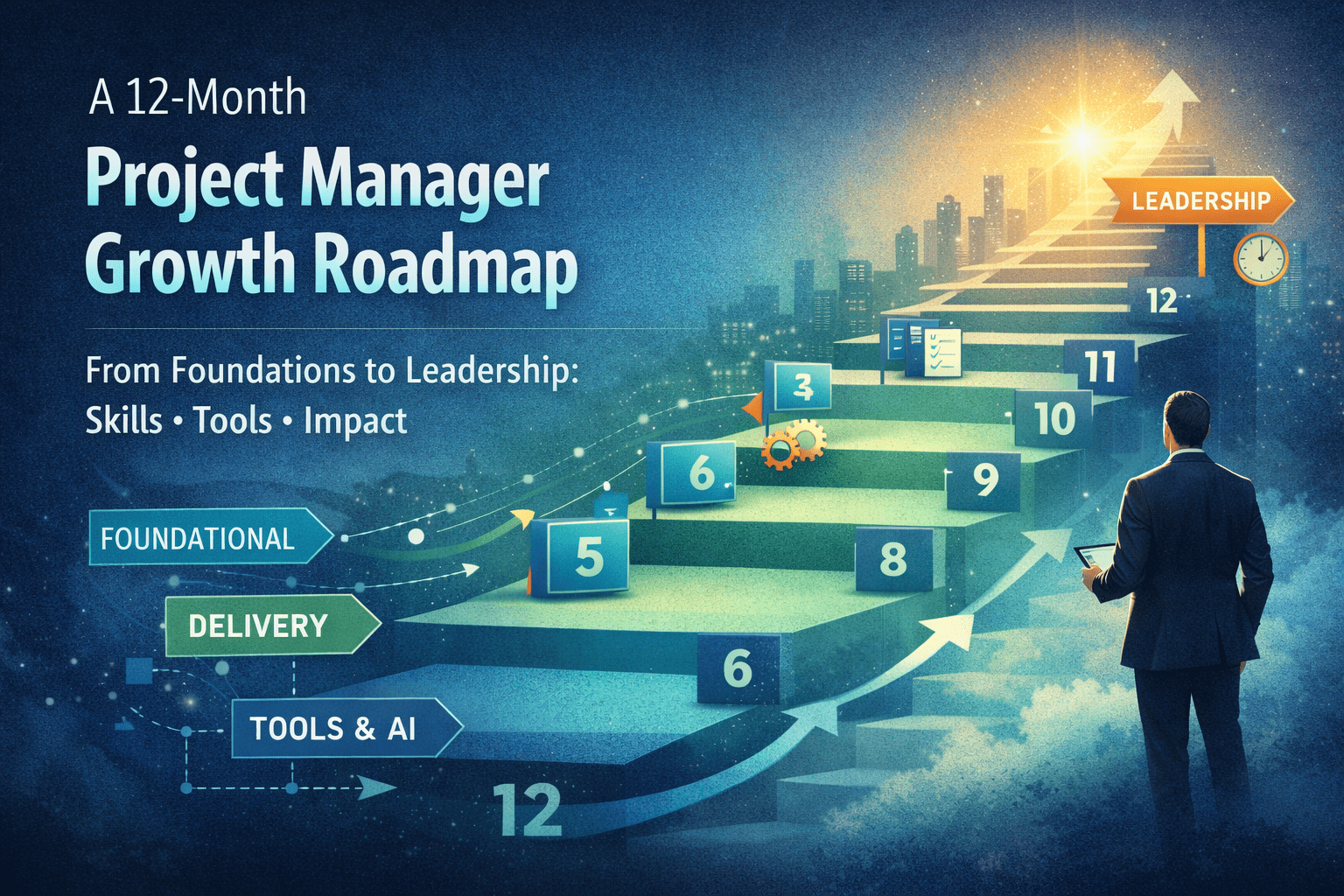
This Project Manager growth roadmap is built on one principle:
Grow capability first. Add tools and certifications only when they support real work.
Each quarter focuses on a different layer of maturity.
Quarter 1 (Months 1–3): Build Strong Foundations
Month 1: Core PM Thinking
Focus: Mindset & fundamentals
What to work on:
- Project lifecycle clarity (initiation → closure)
- Scope definition & boundary setting
- Stakeholder identification & analysis
Outcome:
You stop reacting to projects and start structuring them.
Month 2: Planning & Execution Discipline
Focus: Predictable delivery
What to work on:
- Work breakdown structures
- Milestones vs deliverables
- Sprint planning or phase planning
- Dependency mapping
Outcome:
Your plans are realistic, not optimistic.
Month 3: Risk & Communication Basics
Focus: Visibility & control
What to work on:
- RAID logs
- Risk impact analysis
- Status reporting formats
- Escalation framing
Outcome:
Stakeholders feel informed and confident—even when risks exist.
Quarter 2 (Months 4–6): Strengthen Delivery Skills
Month 4: Agile & Sequential Fluency
Focus: Fit-for-purpose delivery
What to work on:
- Agile vs Waterfall decision criteria
- Hybrid delivery models
- Sprint reviews & retrospectives
Outcome:
You stop forcing frameworks and start choosing wisely.
Month 5: Collaboration & Ownership
Focus: Cross-team alignment
What to work on:
- RACI matrices
- Vendor coordination
- Resolving ownership gaps
- Managing conflicting priorities
Outcome:
Fewer delays caused by “someone else owns this.”
Month 6: Execution Health & Metrics
Focus: Data-driven delivery
What to work on:
- Throughput & predictability
- Bottleneck identification
- Delivery health indicators
Outcome:
You rely less on gut feeling and more on evidence.
Quarter 3 (Months 7–9): Tools, Automation & AI
Month 7: Planning & Tracking Tools
Focus: Tool mastery (not overload)
What to work on:
- Azure DevOps / Planner fundamentals
- Backlog hygiene
- Dependency visibility
Outcome:
Tools start working for you, not against you.
Month 8: Documentation & Visual Communication
Focus: Clarity at scale
What to work on:
- SharePoint structures
- RAID dashboards
- Visual storytelling (flows, timelines)
Outcome:
Less explanation is required in meetings.
Month 9: AI-Assisted PM
Focus: Productivity & insight
What to work on:
- AI-generated summaries
- Drafting status updates
- OKR alignment using AI tools
Outcome:
You spend time thinking—not formatting.
Quarter 4 (Months 10–12): Leadership & Career Growth
Month 10: Stakeholder & Executive Presence
Focus: Influence
What to work on:
- Executive-level communication
- Decision framing
- Trade-off discussions
Outcome:
You’re trusted with ambiguity—not just tasks.
Month 11: Business & Strategic Alignment
Focus: Value delivery
What to work on:
- Business cases
- Benefits realization
- Connecting delivery to outcomes
Outcome:
You’re seen as a business partner.
Month 12: Certification & Positioning
Focus: Formal validation
What to work on:
- PMP / PSM I / PMI-ACP (choose based on role)
- Reflect on growth gaps
- Define your PM identity
Outcome:
You close the year with clarity and credibility.
How to Use This Roadmap
- You don’t need 10 hours a week—2–3 focused hours is enough
- Apply learnings directly to your current project
- Revisit earlier months as your responsibilities grow
Final Thought
The best Project Managers in 2026 won’t be the ones who know the most tools.
They’ll be the ones who think clearly, communicate simply, and deliver consistently.
Learn more about Project Management.
Want to Grow as a Project Manager in 2026?
As we move toward 2026, the expectations from Project Managers are becoming clearer—and more demanding. Organizations no longer need PMs who simply track tasks or chase updates. They need professionals who can think strategically, communicate with clarity, and guide teams through uncertainty with confidence. This 12-month growth roadmap is not about doing more; it is about becoming better, step by step, while continuing to deliver in real-world environments.
What makes this roadmap effective is its balance. It respects the reality that most Project Managers are already working full-time, managing pressure, stakeholders, and shifting priorities. By focusing on one capability area at a time, you allow learning to compound naturally through practice. Each month builds on the previous one, helping you grow from execution-focused delivery to leadership-driven impact.
Most importantly, this roadmap reminds us that tools, certifications, and AI are enablers—not substitutes—for strong judgment and human skills. When you combine structured learning with intentional application, growth stops being overwhelming and starts becoming sustainable.
Whether you are an aspiring Project Manager, an experienced professional looking to stay relevant, or someone preparing for the next leadership step, this roadmap can serve as your guide. Progress may feel gradual—but consistency over twelve months can redefine your career trajectory in powerful ways.