
Introduction
A project plan is more than a document—it is a decision-making framework. While many projects fail due to execution challenges, research consistently shows that poor or rushed planning is the root cause.
In this article, we’ll break down how to write an effective project plan using a 10-step structure that combines classic project management principles with modern, data-driven thinking.
1. What Is a Project Plan?
A project plan is a formal document that defines how a project will be executed, monitored, and controlled.
Why it matters:
- Organizations using formal planning improve success rates by ~28%
- Nearly 70% of failed projects lacked structured planning
- A plan aligns scope, schedule, cost, and expectations
At its core, a project plan transforms:
Ideas → Structure → Execution
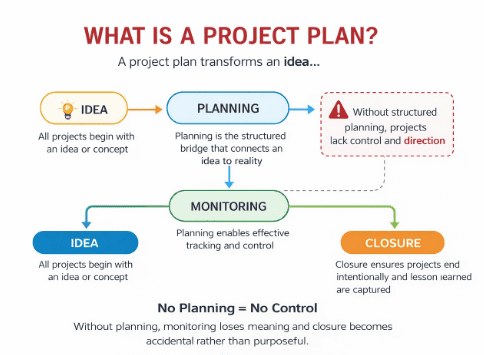
So, a project plan is not a document created after work begins. It is the structural bridge that transforms an idea into a controlled, monitorable, and closable initiative. The flow diagram emphasizes that without planning, monitoring loses meaning, and closure becomes accidental rather than intentional.
2. Project Plan Success Statistics
Planning is not bureaucracy—it’s leverage.
Key insights:
- Projects with proper planning have 2.5× higher success rates
- Validation and structured closure reduce rework
- Cost overruns can be reduced by up to 30%
- Schedule delays can drop by 8–30%
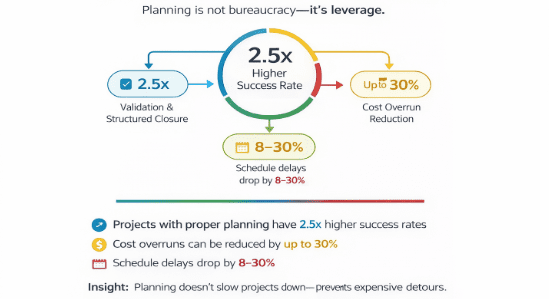
📌 Insight: Planning doesn’t slow projects down—it prevents expensive detours.
3. Step-by-Step Project Plan Framework
A solid project plan follows a logical sequence:
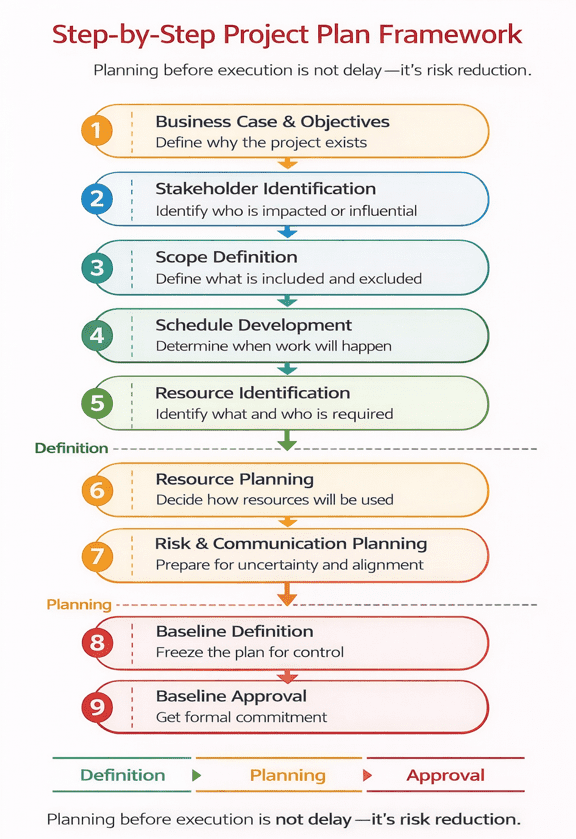
- Business Case & Objectives
- Purpose: Define why the project exists.
- Includes:
- Business problem or opportunity
- Measurable objectives
- Success criteria
- High-level benefits
- 📌 If this is weak, the entire plan collapses later.
- Stakeholder Identification
- Purpose: Identify who is impacted or influential.
- Includes:
- Sponsors
- Customers/users
- Internal teams
- Vendors & external partners
- 📌 Stakeholders define requirements, risks, and approvals.
- Scope Identification
- Purpose: Define what is included and excluded.
- Includes:
- Deliverables
- Boundaries
- Assumptions
- Constraints
- 📌 Poor scope definition causes 52%+ rework (as noted later in the image).
- Schedule Development
- Purpose: Define when work will happen.
- Includes:
- Work Breakdown Structure (WBS)
- Task sequencing
- Dependencies
- Milestones
- 📌 A schedule without scope is guesswork. A scope without a schedule is theory.
- Resource Identification
- Purpose: Identify what and who is required.
- Includes:
- Human resources
- Tools & technology
- Infrastructure
- Budgetary inputs
- 📌 This answers: “What do we need to execute?”
- Resource Planning
- Purpose: Decide how resources will be used.
- Includes:
- Allocation
- Availability
- Utilization
- Skill mapping
- 📌 This prevents overloading and hidden delays.
- Risk and Communication Planning
- Purpose: Prepare for uncertainty and alignment.
- Includes:
- Risk register
- Mitigation strategies
- Communication matrix
- Reporting cadence
- 📌 Most project failures happen here — not in execution.
- Baseline Definition
- Purpose: Freeze the control plan.
- Includes:
- Scope baseline
- Schedule baseline
- Cost baseline
- 📌 Without baselines, monitoring is meaningless.
- Baseline Approval
- Purpose: Get formal commitment.
- Includes:
- Stakeholder sign-off
- Sponsor approval
- Change control activation
- 📌 This is where planning officially ends, and execution begins.
Each step builds clarity before commitment.
4. Core Project Plan Components
A project plan is not a collection of independent documents. It is an integrated system where scope, time, cost, quality, resources, risk, and stakeholders are continuously balanced through coordinated planning and control.
An effective project plan integrates multiple management areas:
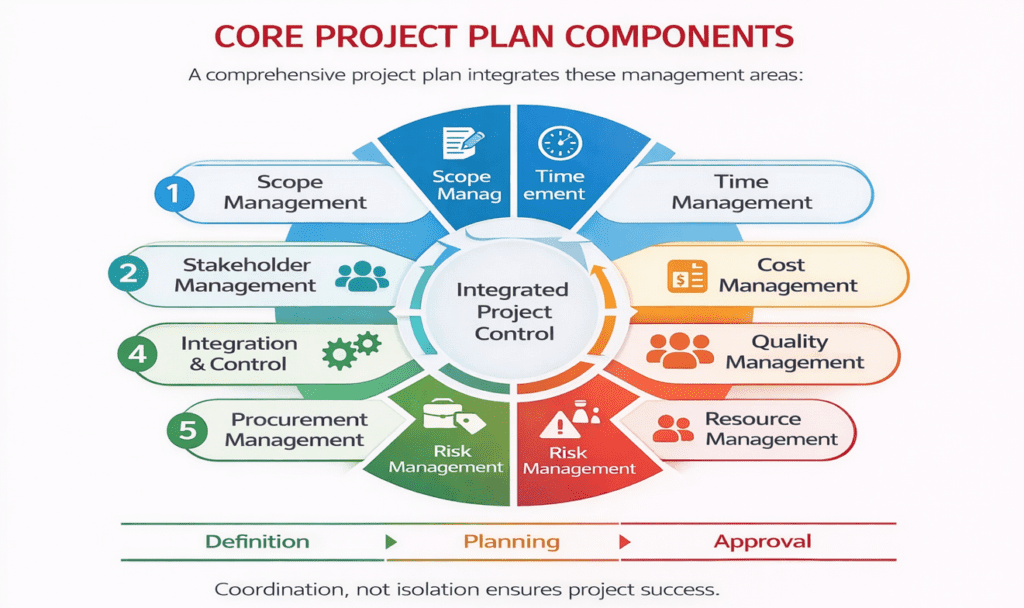
- Scope Management
- Defines what is included and excluded in the project.
- Weak scope leads to rework, scope creep, and stakeholder dissatisfaction.
- Time Management
- Converts scope into a realistic timeline with dependencies and milestones.
- Unplanned schedules create invisible delays that surface late.
- Cost Management
- Ensures the project stays financially viable.
- Without cost tracking, overruns are discovered too late to correct.
- Quality Management
- Quality management defines how “good” is measured, not just when work is completed.
- It sets standards, acceptance criteria, and review mechanisms to ensure deliverables meet expectations.
- Without quality planning, teams deliver fast — but fail acceptance.
- Speed without quality creates rework disguised as progress.
- Resource Management
- Resource management ensures the right people, skills, tools, and capacity are available when needed.
- It prevents overallocation, burnout, and dependency risks.
- Projects often fail not due to lack of talent, but due to poor resource planning.
- A plan that ignores capacity is a plan built on assumptions.
- Risk Management
- Risk management prepares the project for uncertainty.
- It involves identifying potential risks, assessing impact, and planning responses.
- Without risk planning, teams react emotionally under pressure instead of responding logically.
- Risk ignored in planning becomes a crisis during execution.
- Procurement Management
- Procurement management governs external dependencies such as vendors, tools, licenses, and services.
- It defines sourcing strategies, contracts, and delivery expectations.
- Weak procurement planning often leads to delays that the project team cannot control.
- External dependencies don’t follow your internal schedules.
- Stakeholder Management
- Stakeholder management identifies who has influence, interest, or impact on the project.
- It defines engagement strategies, communication needs, and approval expectations.
- Many project issues are not technical — they are stakeholder misalignment issues.
- Projects fail quietly when stakeholders are not heard early.
- Integration & Control
- Integration is the glue that holds all components together.
- It ensures that scope, time, cost, quality, resources, risks, and stakeholders are continuously aligned through monitoring and control.
- This is where the project manager truly adds value — by balancing trade-offs, not just tracking tasks.
- Coordination, not isolation, ensures project success.
These components work together through Integrated Project Control, not in isolation.
5. Essential Formulas & KPIs (EVM)
Planning is only effective when progress can be measured objectively.
Earned Value Management (EVM) provides a quantitative view of project health by combining scope, schedule, and cost into a single performance framework.
Instead of relying on gut feeling, EVM answers one critical question:
Are we getting the value we expected for the time and money spent?
Earned Value Management (EVM) provides objective performance visibility.
Key EVM Metrics Every Project Manager Should Know
1. Earned Value (EV)
What it means: The value of work actually completed, measured against the plan.
📌 EV tells you how much work has truly been accomplished, not just how much time has passed.
2. Actual Cost (AC)
What it means: The actual cost incurred for the work completed so far.
📌 AC reveals how much money you have spent to achieve the earned value.
3. Planned Value (PV)
What it means: The value of work that was planned to be completed by a specific time.
📌 PV represents your baseline expectation.
Core Performance Indicators
🔹 Cost Performance Index (CPI)
Formula: CPI = EV / AC
What it tells you:
- CPI > 1 → Project is under budget
- CPI < 1 → Project is over budget
📌 A declining CPI is an early warning of budget trouble.
🔹 Schedule Performance Index (SPI)
Formula: SPI = EV / PV
What it tells you:
- SPI > 1 → Project is ahead of schedule
- SPI < 1 → Project is behind schedule
📌 SPI shows schedule health based on delivered value, not time spent.
🔹 Cost Variance (CV)
Formula: CV = EV − AC
📌 Shows how much budget variance exists at a given point in time.
🔹 Schedule Variance (SV)
Formula: SV = EV − PV
📌 Indicates whether progress is ahead or behind the approved baseline.
Why These KPIs Matter in Real Projects
Organizations using EVM consistently report:
- Better forecast accuracy (~35% improvement)
- Earlier detection of cost and schedule risks
- Fewer late-stage surprises
Without EVM, problems surface late.
With EVM, problems surface while they are still fixable.
EVM is not about complex math.
It is about early visibility and informed decisions.
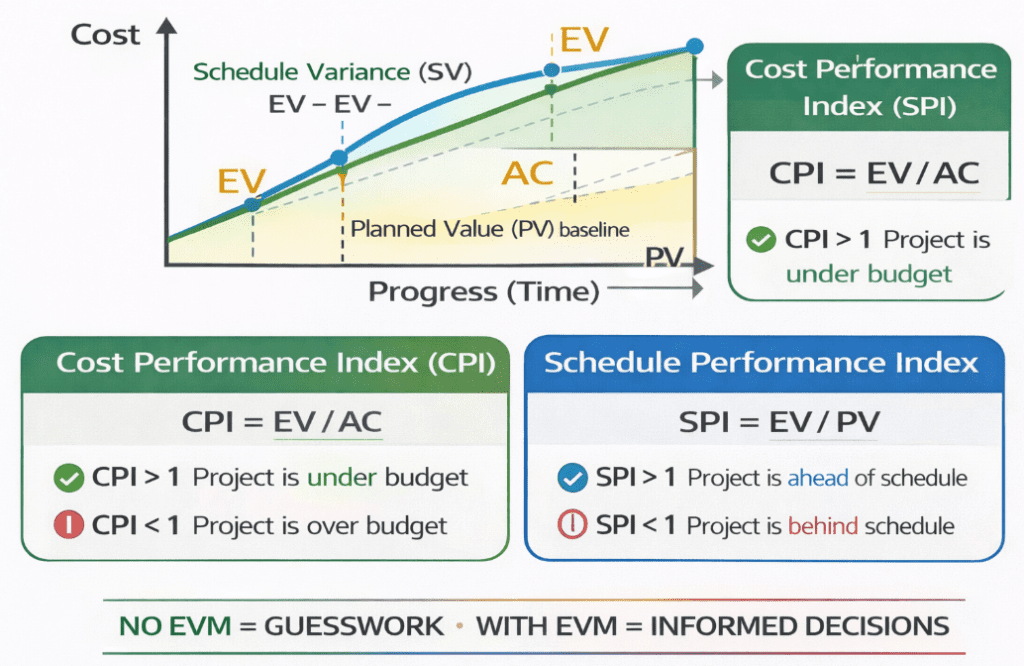
If a project plan does not define how performance will be measured, it is not a plan — it is a guess.
6. Essential Project Plan Document Outputs
A well-defined project plan does not end with ideas or calculations.
It produces formal documents that guide execution, enable control, and support decision-making throughout the project lifecycle.
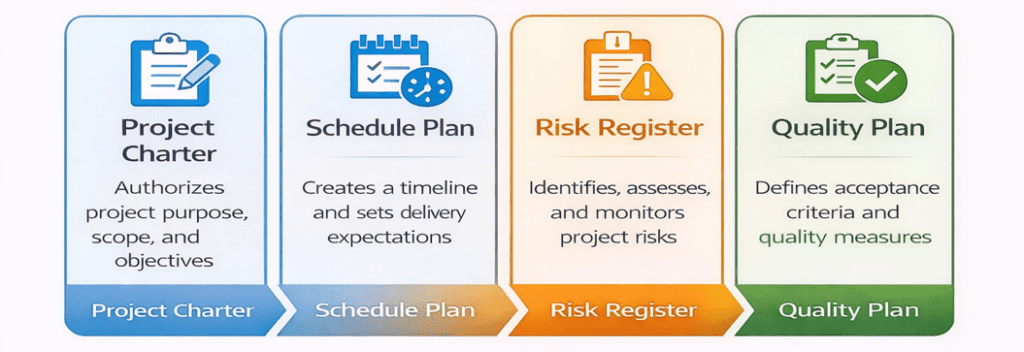
These documents are not just deliverables — they are reference points for alignment, accountability, and governance.
A project plan typically produces:
- 📄 Project Charter
- The Project Charter formally authorizes the project and gives the project manager the authority to apply resources.
- It defines the project’s purpose, objectives, high-level scope, key stakeholders, and success criteria. Without a clear charter, projects often suffer from unclear ownership and shifting expectations.
- The charter answers one critical question: “Why does this project exist?”
- 📅 Schedule Plan
- The Schedule Plan translates scope into a time-bound execution roadmap.
- It defines activities, dependencies, milestones, and delivery timelines.
- This document becomes the baseline against which progress, delays, and corrective actions are measured.
- A schedule plan turns intent into commitment.
- ⚠️ Risk Register
- The Risk Register captures identified risks, their impact, probability, and response strategies.
- It ensures that risks are discussed early, tracked continuously, and managed proactively rather than reactively.
- Projects without a risk register don’t avoid risks — they simply get surprised by them.
- Risks ignored during planning appear as crises during execution.
- ✅ Quality Plan
- The Quality Plan defines how quality will be measured, reviewed, and accepted.
- It establishes standards, acceptance criteria, review processes, and responsibility for quality assurance.
- Without a quality plan, teams may deliver on time but fail acceptance.
- Quality is not inspected at the end — it is planned from the start.
These are not just deliverables—they are control instruments throughout execution. These documents are not created to satisfy process requirements.
They exist to reduce ambiguity, support informed decisions, and protect the project under pressure.
When project documentation is treated as a control mechanism rather than paperwork, execution becomes predictable and resilient.
7. Common Project Planning Mistakes
The most frequent (and costly) planning mistakes include:
- ❌ Poor scope definition (causes ~52% rework)
- ❌ No stakeholder mapping
- ❌ Unrealistic scheduling
- ❌ Missing risk planning
- ❌ Weak communication strategy
Mistake → Impact → Cost Increase
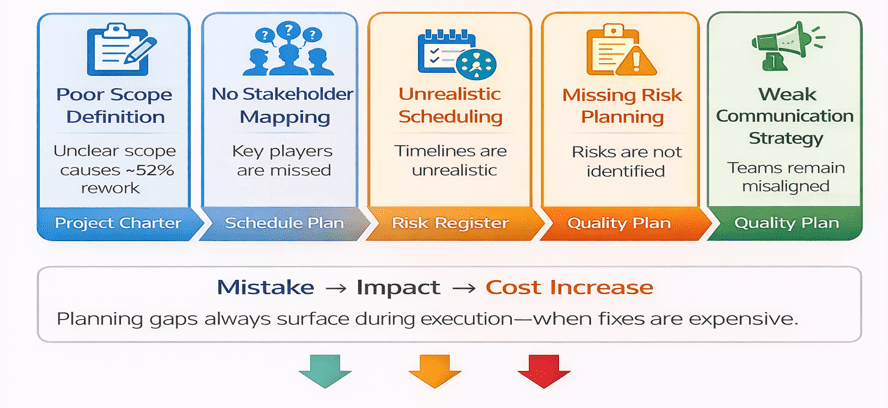
Planning gaps always surface during execution—when fixes are expensive.
8. Modern Project Planning with Data & AI
Project planning today is no longer based solely on experience, intuition, or static documents.
It is increasingly data-assisted, enabling project managers to make faster, more informed decisions.
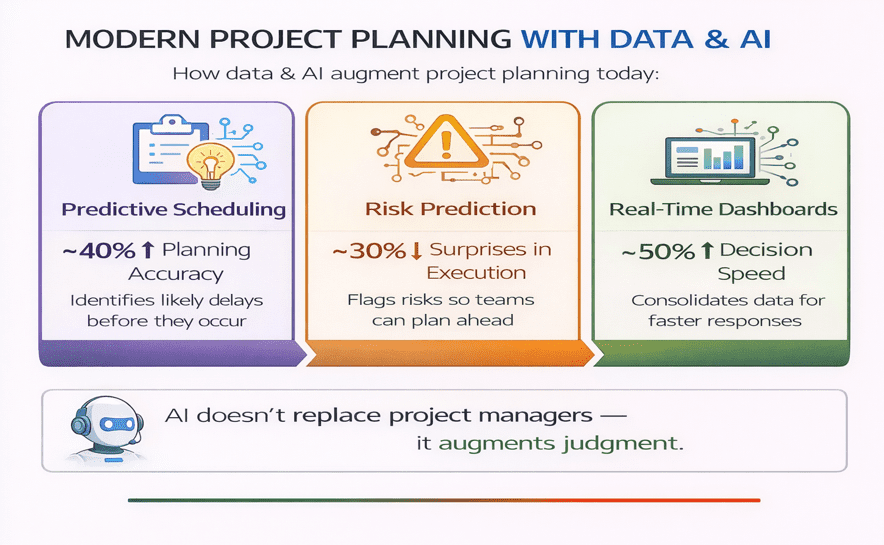
Modern tools analyze historical project data, execution patterns, and real-time signals to surface insights that were previously invisible during planning.
Where Data & AI Add Real Value in Project Planning
Predictive scheduling uses historical delivery data and dependency patterns to identify likely delays before they occur.
This improves planning accuracy by ~40%, especially in complex or multi-team projects.
Risk prediction models analyze past issues, scope changes, and dependency failures to highlight potential risk areas early.
This reduces execution surprises by ~30% and allows teams to plan mitigations proactively.
Real-time dashboards consolidate schedule, cost, resource, and risk data into a single view.
This improves decision-making speed by ~50%, particularly for senior stakeholders and sponsors.
AI as a Planning Assistant, Not a Replacement
AI does not replace project managers.
It augments judgment by:
- Highlighting patterns humans may miss
- Flagging early warning signals
- Simulating “what-if” scenarios
- Supporting faster trade-off decisions
Final decisions still require context, stakeholder awareness, and leadership — areas where human judgment remains critical.
The Shift in the Project Manager’s Role
As data and AI handle more analysis and prediction, the project manager’s role evolves from:
- Task tracking → Decision facilitation
- Status reporting → Insight communication
- Reactive problem-solving → Proactive risk management
Projects still succeed because of people, but people succeed faster when supported by data.
Modern project planning is not about choosing between experience and technology.
It is about combining human judgment with data-driven insight to reduce uncertainty and improve outcomes.
AI accelerates planning.
Project managers provide direction.
AI doesn’t replace project managers — it augments judgment.
9. Project Plan Approval Flow
A typical approval flow looks like this:
Draft → Stakeholder Validation → Baseline → Execution
This ensures:
- Shared understanding
- Formal commitment
- Controlled change management
📌 Skipping validation often leads to silent misalignment, where teams believe they are aligned—until execution exposes conflicting expectations.
Approval is not a formality.
It is the moment where assumptions are replaced with agreement.
10. Final Success Message
A strong project plan transforms uncertainty into structured execution.
Teams that invest time in planning consistently deliver faster, cheaper, and with higher quality outcomes.
Planning is not about predicting the future — it’s about being ready for it.
✅ Conclusion
Writing a project plan is not a paperwork exercise. It is a leadership act that creates clarity, alignment, and confidence.
Whether you manage traditional, agile, or hybrid projects, these 10 steps provide a practical blueprint for planning that actually works.
To hire a Freelance Project Manager, you can connect with Team MumbaiFreelancer.com. If you want to discuss more about this topic, connect with us.
I came across the following, which I think can help you, too.