
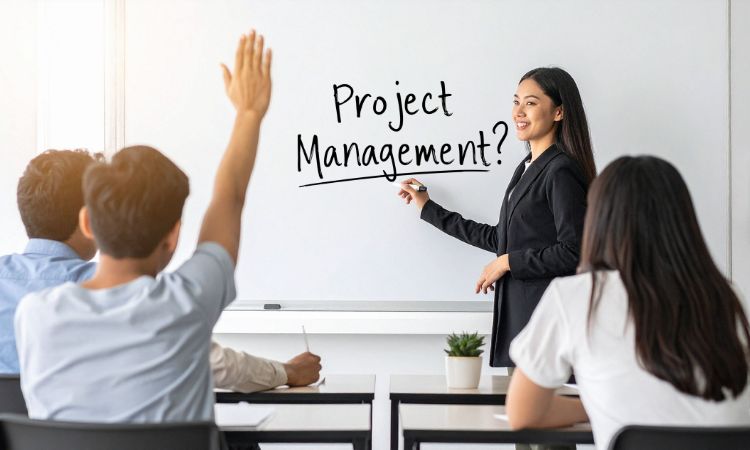
Project management is more than just organizing tasks—it’s a disciplined approach that combines planning, teamwork, and strategic thinking to achieve defined goals within fixed timelines. For 10th-grade students, understanding project management fundamentals lays the groundwork for success in academics and beyond, equipping them with valuable skills in organization, communication, and leadership.
What Is a Project?
A project is a temporary effort undertaken to create a unique product, service, or result (PMI, A Guide to the Project Management Body of Knowledge, 7th Edition). Unlike routine, ongoing operations, every project has a defined beginning and end, unique objectives, and measurable outcomes. Whether it’s designing a science fair exhibit or organizing a school campaign, understanding these parameters helps students think more strategically about how to complete tasks effectively.

The Project Management Lifecycle
A structured project typically goes through five distinct stages known as the project lifecycle:
- Initiation: Identifying goals, stakeholders, and the feasibility of the project. Students can start by outlining what needs to be achieved and why the project matters.
- Planning: Developing a roadmap—defining tasks, assigning roles, estimating time, and allocating resources. This stage builds time management and foresight.
- Execution: Implementing the plan by performing the actual work. Collaboration and communication become crucial here.
- Monitoring and Controlling: Tracking progress, ensuring adherence to the plan, and making adjustments as needed. Students learn adaptability in this phase.
- Closure: Completing deliverables, evaluating outcomes, and documenting lessons learned for future improvement.
These stages mirror professional practices used across industries, from engineering and software development to marketing and education (Project Management Institute, 2021).
Popular Project Management Methodologies: Agile vs. Waterfall
Project managers across industries use structured frameworks known as methodologies to plan and execute projects efficiently. Introducing students to these approaches fosters strategic thinking and adaptability.
- Waterfall Methodology: A linear, step-by-step process where each phase must be completed before the next begins. It’s best suited for projects with clear, stable requirements—such as writing a research paper or conducting a lab experiment.
- Agile Methodology: A more flexible, iterative approach where teams work in “sprints” and adapt to change quickly. This model works well for creative or technology-driven projects that require feedback and revision.
By understanding these models, students can apply the right strategy for their school assignments, extracurricular projects, or even personal goals.
Incorporating Practical Activities and Real-World Applications
Hands-on learning transforms project management theory into tangible experience. Teachers can bring this subject alive through experiential learning projects that encourage teamwork and real-world problem-solving.
Effective Classroom Activities
- Team-based projects: Assign students to plan and execute a shared project, such as designing a community initiative or conducting a group presentation.
- Case studies: Analyze real-world project successes and failures—from NASA’s Mars Rover missions to major product launches—to illustrate practical lessons.
- Scenario-based learning: Have students simulate managing a marketing event, developing a prototype, or creating a public-awareness campaign.
According to Edutopia (2022), project-based learning significantly improves critical thinking and student engagement when real-life relevance is emphasized.
Leveraging Technology for Project Management
Modern project management thrives on technology. Using digital tools allows students to plan, communicate, and monitor progress efficiently—mirroring the tools used in professional settings.
Recommended Tools
- Trello: Visualizes workflow with digital boards and task cards, promoting collaboration.
- Asana: Great for breaking down projects into tasks and tracking progress over time.
- Google Workspace: Enables shared documents, spreadsheets, and slides for real-time collaboration.
- ClickUp and Todoist: Perfect for individual task management, reminders, and productivity tracking.
These platforms not only make project management engaging but also teach digital literacy—an essential 21st-century skill highlighted by UNESCO’s Education for Sustainable Development framework (2020).
Assessing Learning Outcomes and Continuous Improvement
Assessment ensures that students not only complete projects but also understand and internalize each concept. A comprehensive evaluation approach combines group performance, individual reflection, and feedback-driven iteration.
Effective Assessment Strategies
- Rubrics: Clearly outline expectations for teamwork, execution, and application of project management principles.
- Reflective journals: Encourage students to document their learning journey, challenges, and lessons learned.
- Peer and self-evaluations: Promote accountability and critical self-assessment.
- Feedback loops: Conduct surveys and class discussions to refine teaching methods and improve future projects.
According to the Australian Institute of Project Management (AIPM, 2021), constructive feedback and self-assessment play a pivotal role in developing long-term project management competence.
So to summarise …
Teaching project management to 10th-grade students prepares them for future academic, personal, and professional success. By integrating theoretical knowledge, practical activities, technology use, and structured assessment, educators can create a dynamic and engaging learning experience. These fundamentals don’t just help students manage projects—they empower them to take initiative, think critically, and work collaboratively, all essential traits in the evolving global workplace.
To Know And Learn More… References
- Project Management Institute (PMI). A Guide to the Project Management Body of Knowledge (PMBOK® Guide).
- Project-Based Learning Research Review. https://www.edutopia.org
- Australian Institute of Project Management (AIPM). (2021). Competency Standards for Project Managers.
- UNESCO. (2020). Education for Sustainable Development: A Roadmap. https://unesdoc.unesco.org
Connecting project management concepts directly to students’ real-life academic scenarios makes it more meaningful and actionable. Below is an extended section you can read to understand why project management is relevant to students and how they can adopt its principles in their studies.
The Relevance of Project Management for Students
Project management isn’t just for businesses, engineers, or software teams — it’s a life skill that every student can benefit from. For 10th-grade students in particular, learning how to plan, organize, and execute tasks systematically helps them take ownership of their learning and prepares them for higher education and even future careers.
Why Project Management Matters to Students
Students are constantly managing “projects” — even if they don’t call them that. Preparing for exams, organizing a science fair exhibit, producing a group presentation, or managing a community service task — each involves setting goals, allocating time, coordinating with others, and delivering results. Understanding project management helps them:
- Develop time management and prioritization skills. Students often juggle multiple assignments and extracurriculars. Project management helps break large tasks into smaller, scheduled milestones, reducing procrastination and stress.
- Improve teamwork and collaboration. In group projects, students learn how to define roles, set expectations, hold team meetings, and resolve conflicts — just like professional teams do.
- Build accountability and ownership. With defined project goals and timelines, students can track their own progress and take responsibility for outcomes.
- Enhance problem-solving and adaptability. When plans change, or challenges arise, students develop resilience and learn to adjust strategies — a critical skill both in academics and in life.
- Prepare for future career demands. Many modern career paths—from marketing to healthcare—demand strong project management skills. Learning these concepts early gives students a head start.
A 2023 report by the Project Management Institute (PMI) emphasized that project-based learning boosts critical thinking and communication skills identified as essential for the future workforce.
How Students Can Apply Project Management Principles in Studies
Applying project management in school doesn’t require complex software or corporate-level planning. Instead, it’s about adopting structured thinking and organization. Here’s how students can integrate these principles into their daily routines:
1. Define Clear Goals
Before starting any task, students should ask: What am I trying to achieve, and by when? Whether it’s writing a report or preparing for finals, setting SMART goals (Specific, Measurable, Achievable, Relevant, Time-bound) provides direction.
2. Create a Study Plan (Planning Phase)
Just like in formal projects, students can develop a simple study roadmap:
- Break subjects or tasks into smaller objectives.
- Assign deadlines based on difficulty and exam schedules.
- Allocate time for review and unexpected hurdles.
This converts abstract “study time” into actionable steps.
3. Execute and Track Progress
Students can use planners, calendars, or even digital tools like Google Tasks, Trello, or Notion to track progress. Visual boards showing completed and pending tasks give a sense of achievement and momentum.
4. Monitor and Control
If students notice they’re falling behind, they should reflect on what’s causing delays — poor time estimation, distractions, or overscheduling. Adjusting workload or priorities mid-way helps keep them on track.
5. Reflect and Improve
After a project ends (e.g., submitting a major assignment), students can evaluate what worked well and what didn’t. Reflection is critical for continuous improvement — just as professionals conduct a post-project review.
Real-Life Examples for Students
To make project management tangible:
- Exam preparation: Treat studying as a project with phases—topic research, revision cycles, mock tests, and final review.
- Science exhibition: Plan stages like brainstorming, designing experiments, gathering materials, testing, and presenting.
- Community project or event: Use a timeline to assign roles, gather resources, communicate updates, and execute efficiently.
These applications teach valuable habits — planning, collaborating, and delivering results under deadlines—that will serve students long after school.
Final Thoughts
For students, project management is more than an academic framework—it’s a life skill that builds independence, organizational ability, and confidence. By embracing simple project management techniques early, students learn how to convert ideas into outcomes and transform challenges into structured, achievable goals. These skills not only boost academic success but also shape capable, self-directed learners ready for the real world.
If you have any doubts, do reach out to us. In case you want to talk to the author, then reach him at rohitkatke.com.