
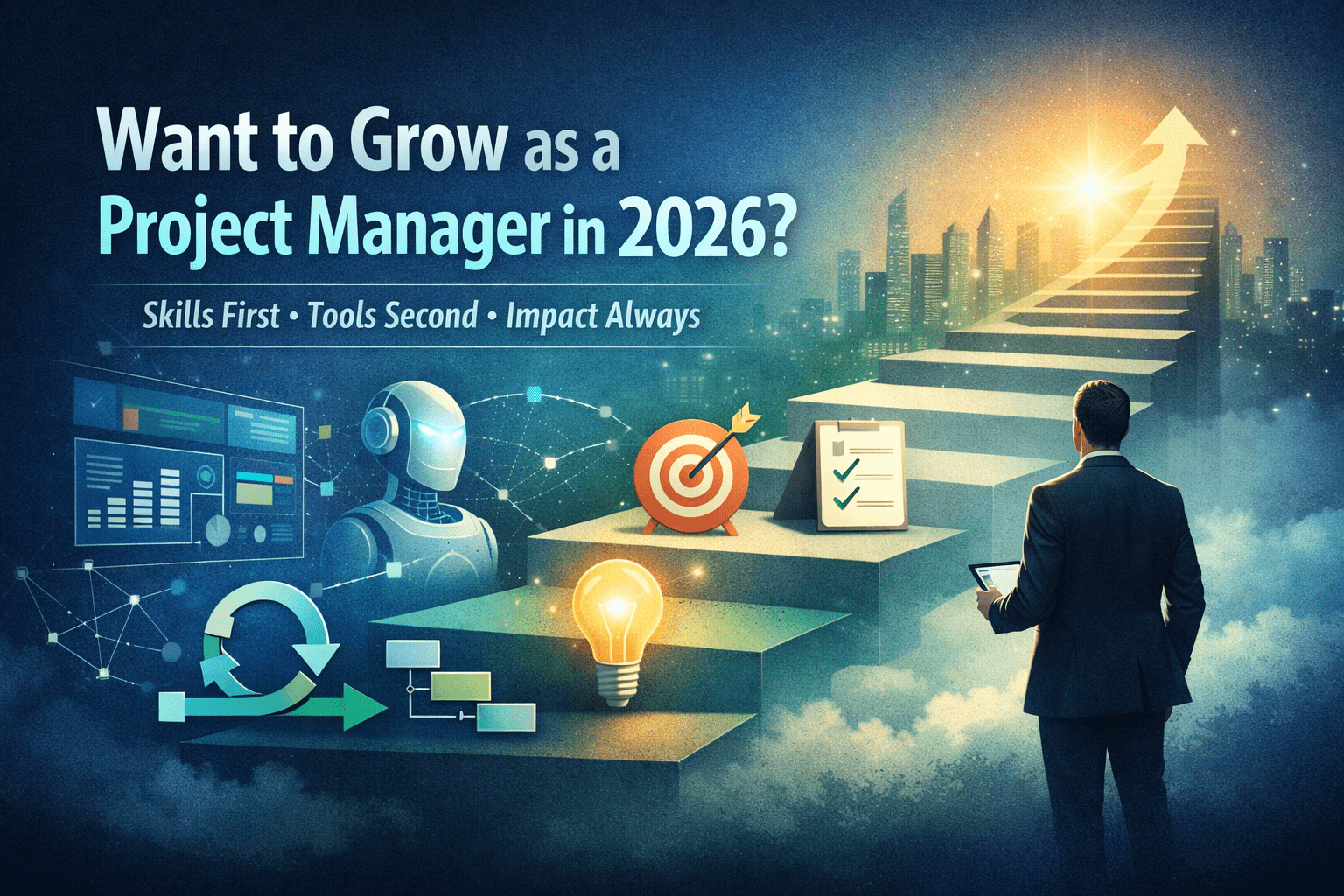
Start With Skills. Add Tools. Then Scale Your Impact.
The role of a Project Manager is evolving faster than ever.
In 2026, successful Project Managers are no longer judged only by timelines and status reports. They are evaluated on judgment, clarity, adaptability, and business alignment. Tools matter—but only after the fundamentals are strong.
If you want to grow as a Project Manager in 2026, the formula is simple:
Skills first. Tools second. Impact always.
Let’s break this down into key skills you must master and tools that truly support those skills—without hype or buzzwords.
Table of Contents
Key Skills Every Project Manager Must Strengthen
Strategic Planning
Strategic planning elevates you from managing tasks to shaping outcomes. It helps you connect roadmaps with business goals, define priorities through OKRs, and explain why a project exists—not just what needs to be delivered.
When a Project Manager understands strategy, leadership starts trusting decisions instead of micromanaging execution.
Execution Mastery
Execution mastery is about turning plans into predictable delivery. This includes scope control, milestone tracking, sprint discipline, and handling dependencies without chaos.
Strong execution keeps projects moving forward—even when requirements change or teams shift.
Risk & Issue Management (RAID)
Risk management is not about documentation—it’s about foresight. Maintaining effective RAID logs helps you identify risks early, assess impact, and plan mitigation before problems become escalations.
A PM who anticipates issues is always seen as reliable under pressure.
Communication
Clear communication is one of the most underrated PM skills. Executive-ready updates, structured escalation, and stakeholder-specific messaging prevent confusion and speed up decision-making.
Great PMs don’t just share information—they provide clarity.
Collaboration
Modern projects span multiple teams, vendors, and time zones. Collaboration skills help you align cross-functional teams, manage external partners, and close ownership gaps before they affect delivery.
Collaboration keeps work flowing smoothly across organizational boundaries.
Agile & Sequential Delivery Fluency
In 2026, rigid frameworks fail fast. Effective Project Managers understand when to use Agile, when to use Waterfall, and when to blend both.
Delivery fluency allows you to choose the right approach based on risk, uncertainty, and compliance—not trends.
Metrics & Delivery Health
Metrics like flow efficiency, throughput, and predictability tell the real story of delivery health. They help you spot bottlenecks, assess team capacity, and make data-backed decisions.
When metrics guide action, surprises reduce significantly.
Tools That Support (Not Replace) PM Skills
Planning & Tracking Tools
Tools like Azure DevOps and Microsoft Planner help manage backlogs, timelines, dependencies, and sprint execution. They provide a single source of truth for work progress.
Used well, these tools reinforce discipline—not bureaucracy.
Documentation & Dashboards
SharePoint, Power BI, and Excel-based RAID logs centralize knowledge and visualize trends. Dashboards help leadership see patterns rather than individual updates.
Good documentation reduces dependency on individuals and preserves organizational memory.
Visual Thinking Tools
Visio, Whiteboard, and PowerPoint help simplify complexity. Whether mapping processes, explaining dependencies, or presenting transformation journeys, visuals improve alignment.
People understand plans faster when they can see them.
Templates & Frameworks
RACI matrices, risk logs, communication plans, and delivery checklists standardize thinking and reduce errors. Templates don’t limit creativity—they protect consistency.
They are especially powerful in scaled or multi-project environments.
AI Assistants
AI tools like Microsoft Copilot, Loop AI, and Viva Goals reduce administrative load. They help draft updates, summarize meetings, and align OKRs.
AI doesn’t replace the PM—it gives time back for thinking and decision-making.
Communication & Collaboration Platforms
Teams, Outlook, OneNote, and Stream enable daily coordination, async updates, and knowledge sharing. When used intentionally, they reduce meeting fatigue.
Communication platforms work best when clarity is the priority.
Certifications
Certifications like PSM I, PMP, PMI-ACP, and Microsoft’s Project Management Certificate provide structured learning and professional credibility.
They open doors—but skills keep you relevant.
The Real Growth Truth for Project Managers in 2026
Tools will continue to evolve. AI will get smarter. Dashboards will get faster.
But judgment, empathy, communication, and decision-making will remain human strengths.
Tools amplify skills.
Skills create trust.
Trust drives impact.
If you focus on mastering the fundamentals and using tools intentionally, you won’t just survive as a Project Manager in 2026—you’ll lead.
A 12-Month Project Manager Growth Roadmap (2026 Edition)
This roadmap is built on one principle:
Grow capability first. Add tools and certifications only when they support real work.
Each quarter focuses on a different layer of maturity.
Read Now.
Learn more about Project Management.