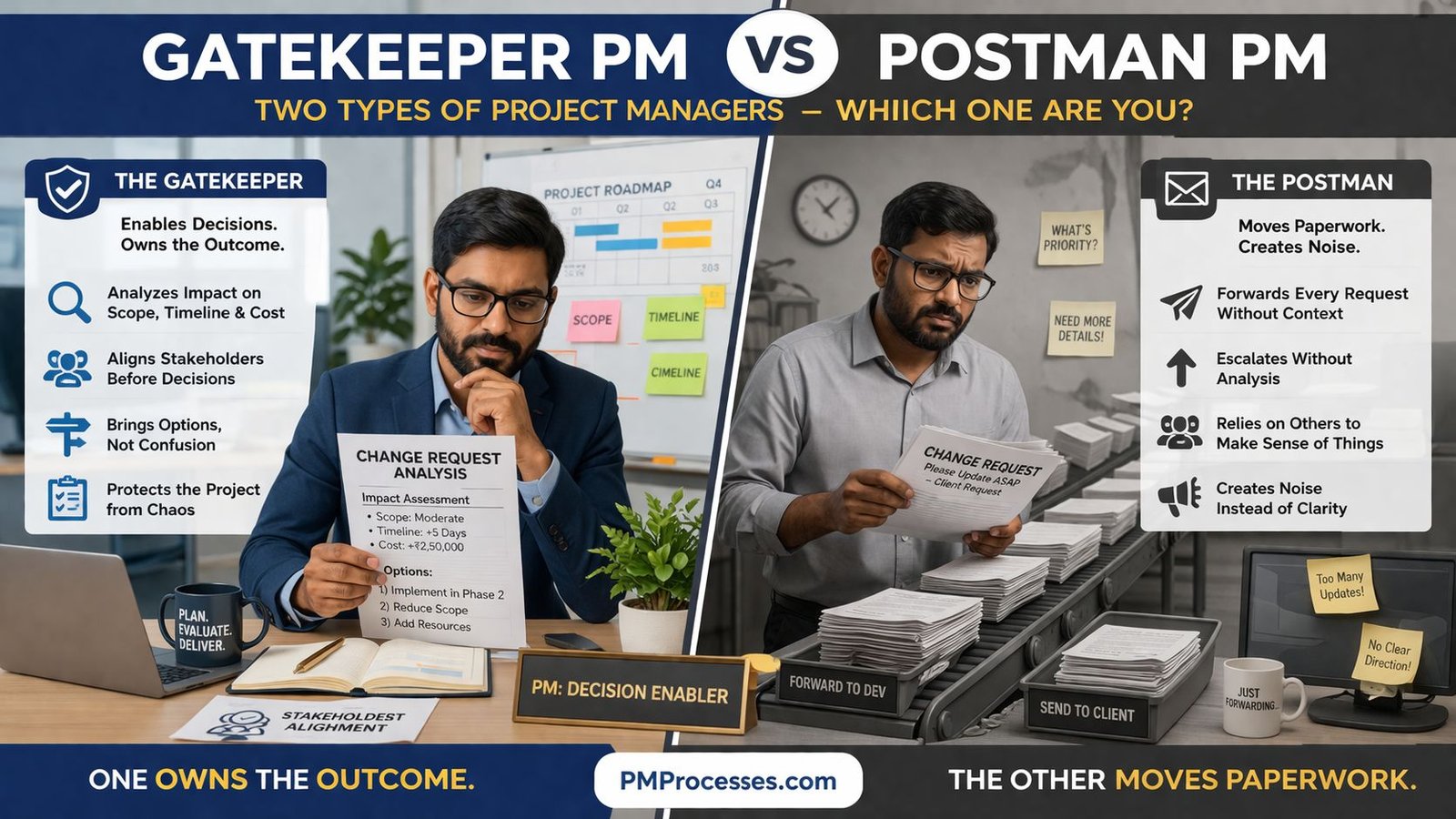
In real-world projects, especially those involving evolving requirements, multiple stakeholders, and tight deadlines, you’ll often encounter two distinct types of project managers:
- The Gatekeeper
- The Postman
At first glance, both may appear to be “doing their job.” But the difference between them can determine whether a project succeeds, struggles, or completely derails.
Let’s break this down in detail – with real-world examples, practical insights, and lessons you can apply immediately.
1. The Gatekeeper Project Manager
A Gatekeeper is not someone who blocks progress.
They are someone who controls the quality and clarity of change.
Key Characteristics
- Doesn’t just “forward” change requests
- Evaluates impact on scope, timeline, and cost
- Aligns stakeholders before decisions
- Presents options with clarity
- Protects the project from chaos
Real-World Example
Scenario: Feature Addition in a Website Project
A client says:
“Can we add a chatbot, a blog section, and a multilingual feature?”
Postman Approach:
- Forwards the request to the development team
- The team starts working
- Timeline slips
- Budget increases
- Client gets confused
Gatekeeper Approach:
- Breaks request into components
- Evaluates:
- Chatbot → 2 days + API cost
- Blog → 3 days + CMS changes
- Multilingual → 5 days + UX redesign
- Aligns with stakeholders:
- “Which is priority?”
- “What is the business goal?”
- Suggests:
- Phase 1 → Blog
- Phase 2 → Chatbot
- Phase 3 → Multilingual
Result: Controlled execution, no chaos.
What Makes a Gatekeeper Valuable?
1. They Own the Outcome
They don’t just “manage tasks.”
They ensure the project delivers value.
2. They Think Like a Business Partner
Instead of asking:
“What should I do?”
They ask:
“What should we do, and why?”
3. They Enable Smart Decisions
They convert confusion into:
- Structured options
- Clear trade-offs
- Actionable decisions
2. The Postman Project Manager
The Postman is not “wrong”—but incomplete.
They act as a messenger, not a decision enabler.
Key Characteristics
- Forwards every request without context
- Escalates without analysis
- Relies on others to interpret requirements
- Creates noise instead of clarity
Real-World Example
Scenario: Change Request in a Mobile App
Client says:
“Let’s redesign the dashboard UI.”
Postman Approach:
- Sends a request to the design team
- Design team asks questions
- Questions go back to the client
- Back-and-forth loops begin
Result:
- Delays
- Miscommunication
- Frustration on all sides
Hidden Cost of a Postman PM
This is where things get serious.
1. Decision Fatigue
Stakeholders are bombarded with unclear questions.
2. Team Confusion
Developers/designers lack direction.
3. Scope Creep
Every request gets accepted without evaluation.
4. Loss of Trust
Client starts feeling:
“Does anyone know what’s going on?”
The Core Difference
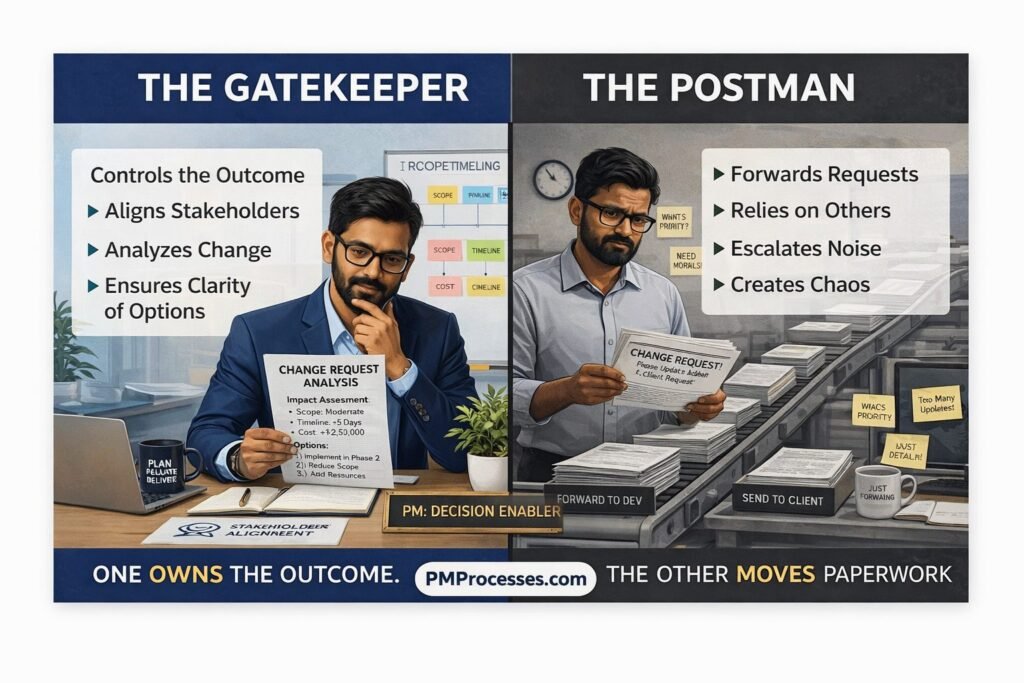
| Aspect | Gatekeeper | Postman |
|---|---|---|
| Role | Decision Enabler | Message Carrier |
| Focus | Outcome | Activity |
| Change Handling | Evaluated | Forwarded |
| Stakeholder Alignment | Proactive | Reactive |
| Impact | Clarity & Control | Chaos & Noise |
One owns the outcome. The other moves paperwork.
Why This Matters in High-Stakes Projects
In projects like:
- Software development
- Digital transformation
- Product launches
- AdTech platforms
Requirements are constantly evolving.
If every change is blindly accepted:
- You don’t have agility.
- You have uncontrolled scope creep.
Change Management ≠ Blocking Change
A common misconception:
“A strong PM slows things down.”
Reality: A strong PM enables faster, better decisions.
Example: Agile Environment
In Agile, change is welcome.
But even in Agile:
- Backlog is prioritized
- Sprint scope is controlled
- Trade-offs are made
Gatekeeper in Agile: Ensures change is intentional
Postman in Agile: Treats every change as urgent
Result: Broken sprints, Burnout, Poor delivery
How to Become a Gatekeeper Project Manager
This is where you level up.
1. Always Ask “WHY”.
Before forwarding any request:
- What problem does this solve?
- Is it urgent or important?
2. Analyze Impact
Every change affects: Scope, Timeline, Cost, Resources
Make this visible.
3. Provide Options, Not Questions
Instead of asking: “What should we do?”
Say: “We have 3 options…”
This shifts you from: Coordinator → Decision Enabler
4. Align Before Acting
Never assume alignment.
Confirm:
- Stakeholders agree
- Priorities are clear
- Trade-offs are accepted
5. Document Intent
Every change should answer:
- Why are we doing this?
- What is the expected outcome?
Final Thought
The difference between a struggling project and a successful one often comes down to this:
Is the Project Manager just passing messages…
Or shaping decisions?
A strong Project Manager doesn’t block change.
They ensure that every change is: Understood, Evaluated, and Intentional.
Because unmanaged change isn’t agility… It’s just scope creep in disguise.
If You’re a PM Reading This
Ask yourself:
- Am I forwarding requests… or shaping outcomes?
- Do I create clarity… or amplify noise?
Your answer defines your impact.
You can connect with me via LinkedIn to discuss more about this post. Or, write back to PMProcesses.com Team.