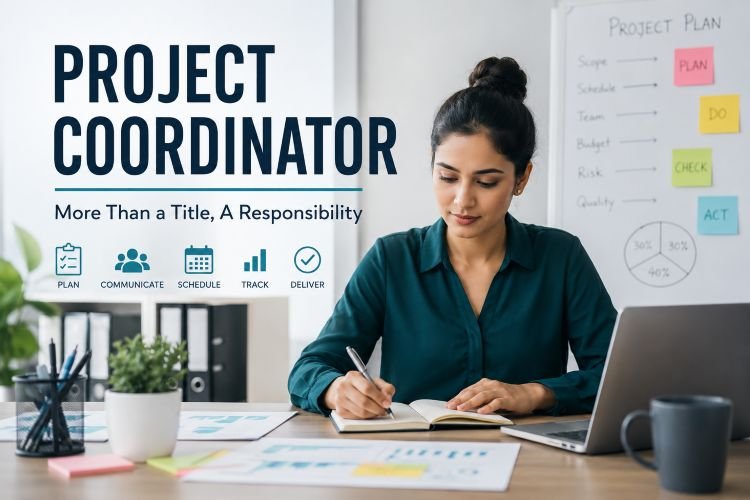
Project Coordinator: Easy to Get the Title, Hard to Do the Work
A practical, first-person reflection on why project coordination is much more than tracking tasks, sending follow-ups, and scheduling meetings.
There is one statement I have heard many times in different forms:
“Anyone can become a Project Coordinator.”
Sometimes it is said casually. Sometimes it is said as career advice. Sometimes it is said with the intention of encouraging beginners to enter the project management field.
And to some extent, I understand why people say it.
A Project Coordinator role does not always require deep coding knowledge. It may not require you to design system architecture. It may not demand that you master a specific programming language, database, cloud platform, or complex technical stack before you begin.
On the surface, the entry requirements look simple.
- You should be organized.
- You should communicate well.
- You should follow up with people.
- You should track progress.
- You should schedule meetings.
- You should prepare updates.
- You should keep everyone informed.
Because of this, many people assume that project coordination is an easy role.
But after being close to real projects, real teams, real deadlines, real clients, and real delivery pressure, I have understood one thing very clearly:
It may be easy to get the title of Project Coordinator, but it is not easy to do the work well.
There is a big difference between holding the role and handling the responsibility.
The Role Looks Simple from the Outside
From the outside, a Project Coordinator may look like someone who is only managing task lists, reminders, meetings, and status updates.
People may think:
“He is just asking for updates.”
“She is just scheduling meetings.”
“They are only sending follow-up emails.”
“The real work is being done by developers, designers, testers, business analysts, and managers.”
This is where the misunderstanding begins.
A good Project Coordinator is not merely pushing people for updates. A good Project Coordinator is trying to understand the movement of the project before the problem becomes visible to everyone else.
The role is not only about asking:
“Is this done?”
The real role is about understanding:
That is where the role becomes difficult.
Project coordination is not just about tracking work. It is about managing the space between planning and reality.
The First Challenge: Small Changes Are Not Always Small
One of the biggest lessons in project coordination is that a “small change” is often not small.
A client may say:
“This is just a small change.”
“Can we quickly add this?”
“This should not take much time.”
But the Project Coordinator cannot afford to look only at the sentence. The coordinator has to understand the impact behind the request.
A small change may affect:
- Current sprint planning
- Developer allocation
- Testing scope
- Delivery timeline
- Existing approved logic
- Related modules
- User interface behavior
- Database changes
- Reporting flow
- Client expectations
- Previously committed deadlines
To someone outside the delivery process, it may look like a minor adjustment.
But to the project team, that one change may disturb the entire sprint logic.
This is where the Project Coordinator’s role becomes sensitive.
The coordinator cannot simply reject the request harshly. At the same time, the coordinator cannot blindly accept it and put the team under pressure.
The real skill is in asking the right questions:
This is not just administration. This is judgment.
A weak coordinator only passes the request to the team.
A mature coordinator understands the impact, communicates clearly, and protects the project from hidden scope creep.
The Second Challenge: Managing Technical Blockers Without Creating Panic
Another difficult part of project coordination is handling technical blockers.
In many projects, developers may get stuck. Testers may find defects. APIs may not respond as expected. Requirements may be unclear. A third-party dependency may delay the work. Something that looked simple during planning may become complicated during execution.
At this point, the Project Coordinator is in a very delicate position.
- The client wants an update.
- The management wants progress.
- The developer needs time.
- The tester needs clarity.
- The timeline is under pressure.
And the coordinator has to communicate without creating panic.
This is not easy.
If the coordinator hides the problem, trust is damaged later.
If the coordinator communicates too aggressively, the team feels exposed.
If the coordinator communicates too technically, the client may get confused.
If the coordinator gives a vague update, stakeholders may lose confidence.
So the coordinator must translate the situation carefully.
Instead of saying:
“The developer is stuck and we don’t know what is happening.”
A better communication may be:
“The team has identified a technical dependency that needs additional validation. We are reviewing the impact and will share a clear update with the revised direction.”
This kind of communication requires maturity.
It requires the ability to stay calm while things are uncertain.
A good Project Coordinator does not create drama around a blocker. They create visibility, clarity, and movement.
The Third Challenge: Saying “No” Without Damaging Relationships
One of the hardest parts of project coordination is learning how to say “No.”
Not every request can be accepted.
Not every timeline is practical.
Not every escalation requires panic.
Not every idea can be added immediately.
Not every stakeholder demand is good for the project.
But saying “No” in a project environment is not as simple as saying the word directly.
The Project Coordinator often has to say “No” in a way that keeps the relationship healthy.
Instead of saying:
“No, we cannot do this.”
A more professional response could be:
“We can consider this, but adding it now may affect the current delivery timeline. I suggest we capture it as an enhancement and review it for the next sprint.”
This approach does three things.
- It does not dismiss the stakeholder.
- It protects the current team commitment.
- It gives the request a proper place in the project process.
That is the balancing act.
A Project Coordinator is often standing between stakeholder expectations and team capacity. If the coordinator agrees to everything, the team suffers. If the coordinator refuses everything, stakeholders feel ignored.
The real skill is not just saying “Yes” or “No.”
The real skill is helping people understand what is possible, what is risky, and what needs to be planned properly.
The Fourth Challenge: Holding the Big Picture
In a project, different people focus on different areas.
- Developers focus on development.
- Testers focus on quality.
- Designers focus on user experience.
- Business users focus on outcomes.
- Clients focus on expectations.
- Management focuses on delivery and business impact.
But someone has to hold the full picture.
That is often where the Project Coordinator plays an important role.
The coordinator may not be writing the code. The coordinator may not be testing every feature. The coordinator may not be making every business decision.
But the coordinator needs to know how all the moving parts connect.
This big-picture awareness is one of the most underrated parts of project coordination.
A person who only tracks tasks may miss the real project story.
A person who understands the full picture can identify risk early.
That is why project coordination is not only about checklists. It is about connecting dots.
The Hidden Emotional Load of the Role
One thing people rarely talk about is the emotional load of project coordination.
A Project Coordinator has to deal with many emotions at the same time.
- Client frustration
- Developer pressure
- Tester concerns
- Management expectations
- Business urgency
- Timeline anxiety
- Scope confusion
- Repeated follow-ups
- Unclear ownership
The coordinator is expected to stay calm even when everyone else is tense.
When the client is unhappy, the coordinator has to listen.
When the team is overloaded, the coordinator has to understand.
When management wants answers, the coordinator has to provide clarity.
When the project is delayed, the coordinator has to help organize the next step.
This is why the role requires emotional intelligence.
You cannot do this role well only by maintaining an Excel sheet or project management tool.
Tools help, but tools do not replace judgment.
Tracking Progress Is Only One Part of the Job
Many people reduce project coordination to progress tracking.
But progress tracking is only one part of the role.
A Project Coordinator also supports:
- Communication flow
- Meeting discipline
- Follow-up structure
- Risk visibility
- Dependency tracking
- Stakeholder alignment
- Documentation
- Delivery coordination
- Scope awareness
- Timeline monitoring
- Team support
- Escalation management
The visible work may be a meeting note or a status update.
But behind that update, there may be multiple conversations, clarifications, reminders, decisions, and risk checks.
A poor coordinator may write:
“Task is in progress.”
A better coordinator may write:
“Development is in progress. API dependency is pending from the integration team. If the dependency is not resolved by Wednesday, testing may shift by two days.”
The second update gives direction. It helps people act.
That is the difference between mechanical tracking and meaningful coordination.
The Role Requires Practical Intelligence
Project coordination needs a very practical type of intelligence.
It is not always about having the highest technical knowledge in the room.
It is about knowing how to move work forward.
A Project Coordinator should understand:
- Who needs to be informed
- Which issue needs escalation
- Which discussion needs documentation
- Which dependency is becoming risky
- Which stakeholder needs reassurance
- Which team member needs support
- Which commitment should not be made without confirmation
- Which meeting is necessary and which one is avoidable
This kind of intelligence develops through experience.
It develops when you observe how projects succeed and fail.
It develops when you see how one unclear requirement can create multiple defects.
It develops when you understand how one missed communication can delay delivery.
It develops when you realize that coordination is not about control. It is about clarity.
The Best Project Coordinators Create Calm
A good Project Coordinator may not always be noticed.
In fact, when coordination is done well, things may look smooth from the outside.
- Meetings happen on time.
- People know what to do.
- Risks are raised early.
- Stakeholders receive updates.
- Tasks are followed up.
- Blockers are visible.
- The team is not constantly disturbed.
- The client is not constantly anxious.
Because everything looks calm, people may assume the role is easy.
But often, that calm exists because someone is working hard behind the scenes.
Someone is connecting people.
Someone is asking uncomfortable questions.
Someone is documenting decisions.
Someone is reminding the team about commitments.
Someone is protecting focus.
Someone is managing expectations.
Someone is making sure that confusion does not become conflict.
That is the invisible value of a Project Coordinator.
The Real Value: Managing the Gap Between Imagination and Possibility
For me, one of the most powerful ways to understand this role is this:
A Project Coordinator manages the gap between what is imagined and what is possible.
Clients imagine outcomes.
Business teams imagine features.
Management imagines timelines.
Users imagine convenience.
Developers understand effort.
Testers understand quality risk.
Designers understand experience.
Operations teams understand support issues.
Somewhere between all of this, the Project Coordinator helps bring reality into the conversation.
Not to kill ideas.
Not to slow down progress.
Not to block innovation.
But to make sure that imagination is converted into planned, realistic, and deliverable work.
That is the real responsibility.
A Project Coordinator should not just ask, “Can we do this?”
They should also ask:
These questions make the role valuable.
Why Beginners Should Still Consider This Role
Even though the role is difficult, I still believe project coordination is a great entry point for people who want to grow in project management.
It gives exposure to real projects.
It teaches communication.
It builds discipline.
It improves planning awareness.
It develops stakeholder management skills.
It helps you understand how teams actually work.
It shows the difference between theory and execution.
But anyone entering this role should not treat it casually.
Do not think project coordination is only about reminders and follow-ups.
Treat it as a learning ground for leadership.
Because if you do this role seriously, you will learn some of the most important lessons in project management.
- You will learn how to listen.
- You will learn how to ask better questions.
- You will learn how to manage pressure.
- You will learn how to handle conflict.
- You will learn how to protect the team.
- You will learn how to communicate risk.
- You will learn how to bring structure into chaos.
These are not small skills.
These are leadership skills.
What Makes a Good Project Coordinator?
In my view, a good Project Coordinator is not defined only by tool knowledge.
Yes, tools are important.
Knowing how to use project management software, spreadsheets, calendars, documentation tools, dashboards, and reporting formats is useful.
But the deeper qualities matter more.
A good Project Coordinator is someone who:
- Communicates clearly
- Follows up without irritating people
- Understands urgency without creating panic
- Documents decisions properly
- Knows when to escalate
- Respects technical complexity
- Protects team focus
- Keeps stakeholders informed
- Understands the project objective
- Learns from every delivery cycle
The best coordinators are not just organized.
They are observant.
They notice patterns.
They sense when something is off.
They know when a task is “in progress” only on paper.
They know when silence from a team member may indicate a blocker.
They know when a stakeholder’s casual comment may become a scope change.
They know when a meeting needs a decision, not just discussion.
This awareness is built slowly.
Conclusion: Respect the Role Behind the Title
So yes, someone may say:
“Anyone can become a Project Coordinator.”
Maybe that is true at the entry level.
But not everyone can become a good Project Coordinator.
Because the role requires more than being organized.
It requires patience, judgment, communication, emotional intelligence, project awareness, and the ability to stay calm under pressure.
It is easy to get the title.
It is hard to do the work.
And it is even harder to do the work in such a way that everyone else feels the project is under control.
That is the quiet strength of a Project Coordinator.
They may not always be the loudest person in the room.
They may not always make the final decision.
They may not always get the most visible credit.
But many times, they are the person holding the project together when things become unclear, delayed, tense, or complicated.
Project coordination is not just progress tracking.
It is balance.
It is judgment.
It is communication.
It is calm under pressure.
And most importantly, it is the ability to manage the gap between what people imagine and what the team can realistically deliver.
Connect with the Author or Write bact to the team