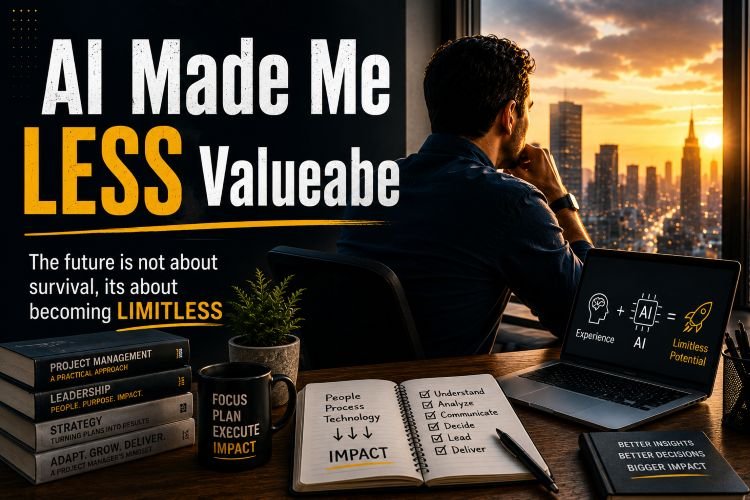
AI Made Me Less Valuable, Really? When AI started becoming mainstream, I noticed two types of reactions around me.
- One group treated it like magic.
- The other treated it like a threat.
Some believed Artificial Intelligence would replace entire industries overnight. Others dismissed it as hype that would eventually fade away like every other technology trend before it.
But somewhere between those two extremes, I quietly started experimenting with it.
- Not as a researcher.
- Not as a full-time engineer.
- Not as an influencer trying to predict the future.
I started using Artificial Intelligence as a working project manager, dealing with actual operational pressure, communication overload, delivery timelines, documentation, stakeholder expectations, technical ambiguity, and constant context switching.
And honestly, what happened surprised me.
- It didn’t make me feel less valuable. It made me feel more capable than I had in years.
- Not because it replaced my thinking. But because it amplified it.
The Fear Around Artificial Intelligence Is Real
I understand why so many professionals feel uncomfortable right now.
Every week, there’s a new headline:
- AI replacing jobs
- AI generating code
- AI creating content
- AI automating workflows
- AI is reducing manual effort
- AI outperforms humans in certain tasks
If you work in technology, management, operations, marketing, design, or communication, it’s almost impossible to ignore the psychological pressure these conversations create.
Even experienced professionals silently wonder:
“Will my experience still matter?”
That question is deeper than people admit publicly.
Because most careers are built over years of repetition, learning, mistakes, pressure, adaptation, and accumulated judgment.
When it suddenly appears capable of doing tasks in seconds that previously required hours of human effort, it naturally creates uncertainty.
I felt that too. But over time, I realized something important.
It was not replacing the most valuable parts of my work.
It was exposing the repetitive parts that consumed too much of my energy.
That distinction changed everything for me.
Experience Still Matters, Maybe More Than Ever
One thing became obvious very quickly. Artificial Intelligence can generate outputs.
But it still depends heavily on:
- Context
- Judgment
- Direction
- Prioritization
- Onterpretation
- Refinement
- Decision-making
And those things usually come from experience.
The better I understood projects, people, systems, communication, delivery pressure, and operational complexity, the more effectively I could use Artificial Intelligence.
That’s when I stopped seeing it as a competitor. I started looking at it as leverage. A multiplier. A thinking accelerator.
It Reduced the Friction Between Thought and Execution
Before Artificial Intelligence, many tasks carried invisible mental resistance. Not because they were impossible. But because they were exhausting.
Things like:
- Structuring documentation
- Rewriting communication
- Brainstorming approaches
- Summarizing discussions
- Analyzing options
- Refining ideas
- Researching unfamiliar topics
- Preparing frameworks
- Organizing thoughts
None of these tasks was individually difficult. But together, they consumed enormous cognitive energy.
Especially in project management roles where your brain is constantly shifting between:
- People
- Systems
- Priorities
- Blockers
- Communication
- Escalation
- Planning
- Risk
- Execution
Artificial Intelligence dramatically reduced that friction for me.
What I now feel is:
- Rough ideas became structured faster
- Technical concepts became easier to explore
- Communication became sharper
- Brainstorming became deeper
- Analysis became faster
- Learning became less intimidating
And the interesting part was, the more experience I had, the more powerful the Artificial Intelligence became. Because I knew what to ask.
- I knew what looked unrealistic.
- I knew where the risk hid.
- I knew where assumptions fail.
- I knew when something sounded operationally disconnected from reality.
That human layer still mattered enormously.
AI Didn’t Replace My Thinking – It Expanded It
This is probably the biggest misconception people have. Many assume using AI means “letting it think for you.”
My experience has been the opposite. Artificial Intelligence increased the number of perspectives I could evaluate. Sometimes, while solving a project challenge, I’ll use AI to:
- Explore alternative approaches
- Simulate stakeholder concerns
- Identify possible risks
- Structure communication
- Compare strategies
- Refine documentation
- Simplify technical understanding
- Brainstorm operational improvements
Not because I blindly trust the output. But it helps me think more widely and faster.
The PMI prompt engineering discussions describe something very similar, using it not just for automation but also for assistance and augmentation of project work.
That distinction matters. Automation saves time. Augmentation expands thinking. And honestly, augmentation is where AI became transformational for me.
I Started Operating Differently
The change wasn’t just technical. It became behavioral.
I noticed myself:
- Exploring ideas faster
- Asking deeper questions
- Researching more confidently
- Entering technical discussions with more curiosity
- Validating assumptions quicker
- Communicating more clearly
- Iterating ideas rapidly
- Becoming more experimental
Earlier, many ideas stayed trapped in mental backlog because execution felt too time-consuming.
AI lowered the activation energy required to explore those ideas. That changes how professionals operate.
Especially experienced professionals. Because experience plus speed is a dangerous combination.
The Real Power Is Human Judgment + AI Acceleration
I think this is where many public conversations become unrealistic. Some people underestimate Artificial Intelligence completely. Others overestimate it blindly.
My experience sits somewhere in the middle. AI is incredibly powerful. But it still lacks:
- Accountability
- Ownership
- Emotional intelligence
- Political awareness
- Contextual sensitivity
- Organizational intuition
- Human trust
- Leadership maturity
Projects are still deeply human environments.
- Deadlines affect emotions.
- Stakeholders change priorities.
- Teams experience burnout.
- Clients become impatient.
- Requirements evolve.
- Conflicts emerge.
- Trade-offs happen constantly.
AI can support these environments. But humans still navigate them. That’s why I don’t think experienced professionals become weaker because of Artificial Intelligence.
I think adaptable professionals become exponentially stronger.
The Professionals Who Will Struggle Aren’t the Least Technical
This is another realization I’ve had. The professionals most at risk are not necessarily the least technical people. The real risk is rigidity.
The inability to:
- Adapt
- Learn continuously
- Evolve workflows
- Rethink processes
- Collaborate with new systems
- Question old habits
Because Artificial Intelligence is not just changing tools. It is changing professional behavior itself.
The way we learn, communicate, analyze, create, structure information, brainstorm, document, and make decisions…is evolving rapidly.
And professionals who evolve with that shift will become incredibly effective.
I Became More Limitless – Amplified My Existing Strengths
That’s the best way I can explain it. Artificial Intelligence did not create my professional experience. It amplified it.
It accelerated structured thinking, communication, experimentation, research, analysis, operational understanding, and learning speed.
The foundation was already there. Artificial Intelligence simply removed the friction that slowed execution. And when experienced professionals remove friction from execution, their output changes dramatically.
Final Say…
I no longer see Artificial Intelligence as something that competes with my career.
I see it as something reshaping how capable professionals operate.
And honestly, I think many mid-career professionals are underestimating how valuable their accumulated experience still is.
Because experience combined with adaptability becomes incredibly powerful in the AI era. Not every professional needs to become an AI engineer.
But professionals who learn how to think, operate, communicate, and adapt alongside Artificial Intelligence will likely outperform those who resist it entirely.
For me, It didn’t reduce my value; it expanded my range, it increased my speed, it sharpened my thinking, and it strengthened my curiosity again.
And in many ways, it made me feel professionally energized at a stage when many people quietly begin to feel outdated.
That’s why I no longer describe Artificial Intelligence as a threat. I describe it as leverage.
And when leverage reaches someone with years of operational experience, pattern recognition, an understanding of delivery, and human judgment…they don’t become less valuable.
They become far more limitless.
I would like to know your perspective on Artificial Intelligence and how it has impacted your career. Would you like to connect with me?
Read: Partner With AI
Shout out: ProjectingAi.com is for sale!