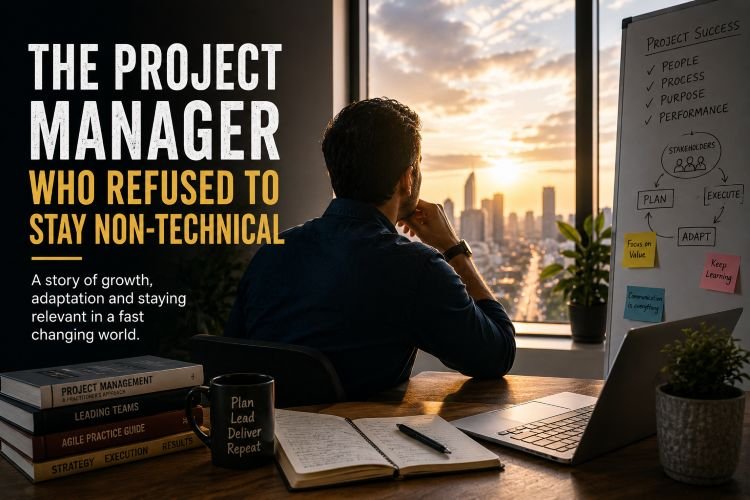
There was a time when I was deeply involved in the project’s technical execution.
I wasn’t just attending meetings or reviewing status reports. I was writing code, troubleshooting systems, understanding databases, experimenting with tools, and solving problems directly inside the implementation layer. Technology didn’t feel distant back then. It felt personal.
But careers evolve. As I moved deeper into project management, something quietly began to change.
The more responsibilities I took on, the further I drifted from hands-on technical work. My days slowly became filled with stakeholder communication, sprint discussions, delivery pressure, resource planning, timelines, escalations, expectation management, coordination calls, approvals, reporting structures, and operational decisions.
At first, it felt like growth. And honestly, it was.
But somewhere in that transition, I also started noticing something uncomfortable. Technology was moving faster than I was.
New frameworks appeared every few months. AI exploded into every conversation. Automation tools became smarter. Developers discussed architectures and integrations that sounded increasingly unfamiliar. Even the industry’s vocabulary began evolving rapidly.
I could still manage projects. I could still lead teams.
I could still communicate effectively between business and technical stakeholders. But internally, I knew something had changed.
I was becoming more managerial than technical. And I don’t think enough project managers openly talk about how uncomfortable that realization can feel.
The industry often portrays project managers as naturally “non-technical” roles, but that’s not always true. Many of us started our careers in technical execution. We moved into leadership because we could understand both people and systems. Over time, however, delivery ownership slowly replaces deep implementation exposure.
You stop building. You start coordinating the building. There’s a difference.
And if enough years pass, that difference becomes visible.
I remember sitting in discussions where developers referenced technologies, integrations, APIs, automation flows, cloud architectures, or AI concepts at a pace that reminded me of how much the industry had evolved while I was busy managing deadlines and people.
The strange part is that this realization doesn’t usually happen dramatically. It happens quietly. A moment during a technical call.
A concept that takes longer to understand. A conversation where you realize you’re depending more on interpretation than direct understanding.
And for many mid-career professionals, that feeling creates a sense of silent insecurity. Not because we stopped learning.
But because operational responsibilities consumed the space where technical curiosity once lived.
Then AI arrived.
Initially, I looked at AI the same way many professionals did – as another powerful tool entering the market with a mix of excitement, exaggeration, fear, and uncertainty surrounding it.
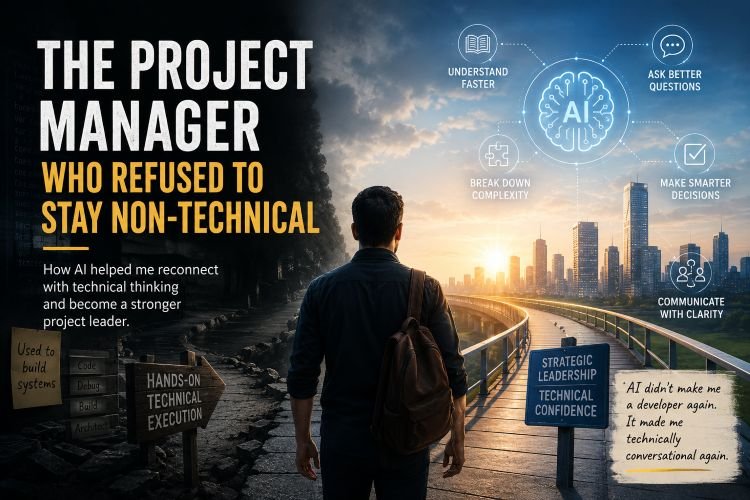
But over time, something unexpected happened. AI didn’t just help me work faster. It helped me reconnect with technical thinking again.
That distinction matters.
Most conversations around AI focus heavily on productivity. People talk about generating emails, summarizing meetings, creating presentations, or automating repetitive tasks. Those things are useful, but that’s not where AI changed my professional life the most.
For me, AI became a bridge. A bridge back toward exploration.
A bridge back toward systems thinking. A bridge back toward asking technical questions confidently again.
I started using AI not merely to produce outputs, but to understand concepts faster. When I encountered unfamiliar technologies, frameworks, workflows, or architectural patterns, I no longer felt blocked by the intimidating learning curve that usually discourages busy professionals.
Instead, I could have structured conversations. I could ask follow-up questions.
I could break down complexity into smaller layers. I could challenge assumptions.
I could request comparisons. I could simulate discussions.
And slowly, something changed psychologically.
I stopped feeling disconnected from the pace of technical evolution.
To clarify, AI didn’t magically turn me back into a full-time developer. And honestly, that was never the goal.
What AI gave me was something more practical. It made me technically conversational again.
That single shift restored confidence in ways I did not initially expect.
Today, when discussing workflows, integrations, automation opportunities, AI-assisted systems, reporting structures, or technical feasibility, I find myself engaging with more clarity and curiosity than I had in years.
Not because I suddenly know everything. But because AI has reduced the friction between curiosity and understanding.
That friction is important.
Most mid-career professionals are not incapable of learning new technologies. They are exhausted. Their calendars are full.
Their responsibilities are layered. Their energy is fragmented across meetings, escalations, planning, communication, people management, reporting, and business pressure.
Learning something deeply technical after a ten-hour workday is psychologically harder than most people admit.
AI changes that equation. It creates a low-resistance learning environment. Instead of reading thirty disconnected articles, you can begin with a conversation.
Instead of feeling embarrassed about asking basic questions publicly, you can privately explore concepts without judgment.
Instead of spending hours searching for fragmented explanations, you can progressively build understanding through structured dialogue.
Ironically, the better project manager I became operationally, the more I needed AI to reconnect me with the industry’s technical side.
And this is where I believe many organizations misunderstand the future role of project managers.
The future project manager will not succeed by becoming fully technical again.
Nor will they survive by remaining purely administrative. The role itself is evolving.
Modern project managers are increasingly becoming translators between complexity, business intent, technology, systems, people, and decision-making.
AI strengthens that capability. Not by replacing judgment. But by augmenting understanding.
The strongest professionals in the coming years may not necessarily be the ones who know the most syntax, frameworks, or certifications.
They may be the ones who can continuously learn, adapt, interpret, communicate, and make decisions across changing environments.
That requires technical awareness. But it also requires human maturity.
Because, despite all the AI advancements, projects are still driven by uncertainty, emotions, priorities, politics, pressure, expectations, and human behavior.
AI can support thinking. But humans still carry responsibility.
And perhaps that’s why I no longer see AI as a threat to project management. I see it as an opportunity for experienced professionals to reconnect with curiosity again.
- To rebuild confidence.
- To explore faster.
- To ask better questions.
- To understand systems more deeply.
- To communicate more intelligently.
- And maybe most importantly, to stop feeling left behind by technology.
I think many project managers secretly fear becoming irrelevant in an industry moving faster every year.
I understand that fear. But my experience with AI has changed my perspective.
The goal is not to compete with machines. The goal is to evolve alongside them.
And in a strange way, AI helped me rediscover a part of myself that I thought my career had slowly moved away from.
AI The Project Managers – Friend!!!
Not the developer. Not the coder. But the learner.
If you feel the same, do let me know. If you want to connect with me, please do. I would love to hear your side of the story.
Good Read: 7 Fundamental AI Patterns To Apply To Meet Business Needs