
Category: Project Management Processes

  • Project Management in a VUCA World: 7 Strategies to Thrive Amid Uncertainty

    Project Management in a VUCA World: 7 Strategies to Thrive Amid Uncertainty

    In today’s fast-paced business landscape, project managers face constant disruptions—from supply chain shocks and geopolitical shifts to AI-driven market changes. Project management in a VUCA world demands more than traditional Gantt charts; it requires agility and foresight. VUCA, an acronym for Volatility, Uncertainty, Complexity, and Ambiguity, originated in military strategy but now defines modern enterprises. For PMO leaders, Agile practitioners, and PMP-certified professionals, mastering VUCA leadership isn’t optional—it’s essential for delivering results.

    Navigating Project Management in a VUCA World

    This article breaks down VUCA’s impact on projects and equips you with seven practical strategies. You’ll gain tools for adaptive planning, hybrid project management, and beyond to turn chaos into opportunity.

    What is VUCA in the Modern Business Context?

    VUCA captures the turbulent environment where change is the only constant. Coined by the U.S. Army War College in the late 1980s, it has evolved with globalization, digital transformation, and events like the COVID-19 pandemic.

    • Volatility: Rapid, unpredictable changes in speed and magnitude. Think stock market swings or sudden tech outages.
    • Uncertainty: Lack of predictable outcomes. Will remote work policies shift again, post-2025 economic recoveries?
    • Complexity: Interconnected factors with multiple moving parts. Supply chains span continents, involving dozens of vendors.
    • Ambiguity: Unclear meanings and multiple interpretations. A client’s “urgent” request might mean different priorities to stakeholders.

    In 2026, VUCA manifests in hybrid work models, cybersecurity threats, and AI integration. Project managers must navigate these without rigid playbooks, emphasizing systems thinking to map interconnections.

    How VUCA Impacts Project Management

    Traditional project management—linear phases, fixed scopes—crumbles under VUCA. Delays cascade: a volatile supplier issue in one region ripples globally, creating uncertainty in timelines. Complexity overwhelms with data overload from tools like Jira or Microsoft Project, while ambiguity leads to misaligned teams.

    Real-world fallout includes:

    • Scope creep from ambiguous requirements, inflating budgets by 20-30% (PMI Pulse of the Profession, 2025).
    • Risk blind spots, where uncertainty hides threats like regulatory changes.
    • Team burnout amid volatile priorities, eroding morale.

    Project governance falters without adaptive structures, turning PMOs into bottlenecks. Enter hybrid project management: blending Waterfall precision with Agile flexibility to build resilience.

    7 Actionable Strategies for Project Management in a VUCA World

    These strategies draw from ITIL, PMP best practices, and real enterprise case studies. Implement them sequentially for maximum impact.

    1. Embrace Adaptive Planning Over Rigid Schedules

    Ditch annual baselines; adopt rolling-wave planning, updating forecasts every sprint or quarter.

    Practical Example: A Mumbai-based EdTech firm faced volatile enrollment drops in 2025. Their PM shifted to bi-weekly adaptive planning in Asana, reallocating resources from underperforming courses to AI tutoring modules. Result: 15% faster pivots, on-time delivery despite 40% demand swings.

    2. Build Risk Intelligence Through Proactive Scenario Mapping

    Elevate risk registers with “what-if” simulations using Monte Carlo tools or Excel add-ons.

    Practical Example: In a cybersecurity project for an Indian bank, the PM used risk intelligence to model three scenarios: mild breach (30% probability), major attack (50%), and blackout (20%). Pre-allocating failover teams cut downtime from days to hours during a real 2026 ransomware hit.

    3. Leverage Hybrid Project Management for Flexibility

    Combine Agile sprints with Waterfall milestones for dynamic environments.

    Practical Example: A global NFT platform’s PMO integrated Scrum for feature development and Prince2 gates for compliance. Amid ambiguous Web3 regulations, this hybrid approach launched a compliant marketplace 25% under budget, blending speed with governance.

    4. Apply Systems Thinking to Untangle Complexity

    View projects as ecosystems, mapping dependencies with tools like Lucidchart.

    Practical Example: During a domain portfolio migration for a digital marketing agency, complexity arose from 500+ interlinked sites. Systems thinking revealed SEO bottlenecks; the PM restructured into micro-clusters, reducing migration risks by 60% and preserving rankings.

    5. Strengthen Emotional Intelligence in Project Management

    Foster team resilience with regular pulse checks and empathy-driven feedback.

    Practical Example: A PMP-certified PM leading a remote Agile team amid 2026 layoffs used EQ tools like Gallup’s Q12 surveys. Weekly “resilience huddles” addressed ambiguity fears, boosting velocity by 18% and retention during uncertainty.

    6. Implement Robust Project Governance with Agile Guardrails

    Define lightweight checkpoints—e.g., OKR-aligned reviews—without stifling innovation.

    Practical Example: An enterprise PMO in tech services adopted governance dashboards in Tableau. For a volatile cloud migration, automated alerts flagged scope drifts, ensuring 95% adherence to SLAs despite ambiguous vendor delays.

    7. Cultivate VUCA Leadership via Continuous Learning Loops

    Embed retrospectives and upskilling (e.g., PMI’s VUCA certification) into every project close.

    Practical Example: A PMO leader at an AdTech firm ran quarterly “VUCA labs” post-project, analyzing blockchain integration failures. This loop refined adaptive planning, turning a 2025 flop into a 2026 revenue driver with 2x ROI.

    Developing a Leadership Mindset for VUCA Success

    Thriving in project management in a VUCA world starts with a mindset: shift from control to influence. Prioritize vision (clarity amid ambiguity), understanding (deep stakeholder listens), courage (bold decisions), and adaptability (experiment fearlessly)—the VUCA counter: VUCA Prime.

    Track progress with KPIs like agility index (pivots per quarter) and resilience score (team NPS). Integrate these into your PMO charter. In dynamic India Inc., where tech and EdTech boom amid global volatility, this approach positions you as indispensable.

    Start small: pick one strategy this sprint. Your projects—and career—will adapt and excel.

    project management in a vuca world-today

    Frequently Asked Questions (FAQs)

    1. What does VUCA mean for project managers in 2026?

    VUCA—Volatility, Uncertainty, Complexity, Ambiguity—challenges fixed plans. In 2026, it means mastering adaptive planning and hybrid project management amid AI disruptions and hybrid work.

    2. How can emotional intelligence improve project management in a VUCA world?

    EQ builds team trust during ambiguity, reducing churn. Use tools like retrospectives to address fears, as seen in Agile teams boosting output by 20%.

    3. What’s the best tool for risk intelligence in VUCA projects?

    Monte Carlo simulations in @Risk or Primaver Risk Analysis Excel, helping PMs quantify uncertainties and prioritize like in cybersecurity rollouts.

    There is a similar article on VUCA World in case you want to read.

    If you found this valuable, consider sharing it with your network.
    Someone navigating uncertainty might need this clarity today.

    Article By Rohit Katke for PMProcesses.com

    Connect with Our Team

  • Project Management in a VUCA World: 4 Leadership Shifts for Modern PMs

    Project Management in a VUCA World: 4 Leadership Shifts for Modern PMs

    We are no longer managing projects in a stable, predictable environment. We are managing in a VUCA world — a world shaped by Volatility, Uncertainty, Complexity, and Ambiguity.

    Originally emerging from military strategy discussions during the late Cold War era, the term VUCA World now perfectly describes modern business reality — rapid technological shifts, AI disruption, regulatory changes, remote work, global supply chain shocks, and black swan events like pandemics.

    For project managers, VUCA is not a theory. It is daily life.

    Let’s explore what this means for modern project management — and how you can build systems, teams, and processes that thrive instead of merely survive.

    Understanding VUCA World Through a Project Management Lens

    Volatility – The Speed of Change

    Volatility refers to the rate and magnitude of change.

    In project environments, volatility shows up as:

    • Sudden scope changes
    • Market-driven pivots
    • Technology updates mid-project
    • Budget reallocations
    • Regulatory changes

    Example:
    You begin a 6-month software implementation project. In month two, a new AI tool disrupts your architecture assumptions.

    Your original plan? Already outdated.

    Project Management in a VUCA World

    PM Response to Volatility:

    • Shorter planning cycles
    • Iterative development (Agile, Hybrid models)
    • Rolling-wave planning
    • Strong change control discipline
    • Buffer management

    In a volatile environment, flexibility beats rigidity.

    Uncertainty – The Unknown Unknowns

    Uncertainty means lack of predictability and incomplete information.

    As project managers, we often face:

    • Undefined client expectations
    • Unclear requirements
    • Emerging technologies
    • Unknown risks

    Even detailed risk registers cannot predict everything.

    PM Response to Uncertainty:

    • Scenario planning
    • Prototyping and experimentation
    • Frequent stakeholder engagement
    • Strong risk identification workshops
    • Data-driven decision-making

    In uncertain environments, your role shifts from planner to sense-maker.

    You don’t just manage tasks.
    You manage clarity.

    Complexity – Interconnected Variables

    Complexity arises when multiple systems, stakeholders, technologies, and dependencies interact.

    Today’s projects involve:

    • Cross-functional teams
    • Multi-vendor ecosystems
    • Regulatory oversight
    • Global remote teams
    • Integration with legacy systems

    A small change in one module can impact five other systems.

    PM Response to Complexity:

    • Systems thinking
    • Dependency mapping
    • Clear communication structures
    • Modular project architecture
    • Strong governance frameworks

    Complexity demands structured thinking — not oversimplification.

    As someone who operates across digital marketing systems, ad platforms, feeds, APIs, and automation workflows, you’ve likely seen this firsthand — small configuration changes can ripple across the ecosystem.

    That’s VUCA in action.

    Project Management in a VUCA World

    Ambiguity – When Meaning Isn’t Clear

    Ambiguity occurs when information exists, but its interpretation is unclear.

    Examples:

    • Vague strategic direction
    • Undefined success criteria
    • Conflicting stakeholder expectations
    • New technologies without precedent

    You may hear:

    “We want innovation — but no risk.”
    “We want transformation — but no disruption.”

    That’s ambiguity.

    PM Response to Ambiguity:

    • Clarify assumptions
    • Define measurable outcomes
    • Establish decision criteria
    • Run pilots before scaling
    • Document learnings

    In ambiguous situations, clarity becomes a leadership skill — not just a documentation task.

    From VUCA to VUCA Today – A Modern PM Mindset

    Some leadership thinkers propose reframing VUCA:

    Traditional VUCALeadership Response
    VolatilityVision
    UncertaintyUnderstanding
    ComplexityClarity
    AmbiguityAgility

    For project managers, this means:

    • Vision: Align every project with strategic outcomes
    • Understanding: Deep stakeholder engagement
    • Clarity: Clear scope and measurable deliverables
    • Agility: Ability to pivot without chaos

    How Project Managers Can Thrive in a VUCA World

    Here are practical shifts every PM should make:

    1. Move From Control to Adaptability

    Traditional PM focused on control and predictability.
    Modern PM focuses on adaptability and responsiveness.

    2. Embrace Hybrid Methodologies

    Waterfall alone struggles in volatile conditions.
    Agile alone may lack governance for complex environments.

    Hybrid models provide balance.

    3. Strengthen Communication Architecture

    In VUCA, communication failure is the biggest risk.

    Establish:

    • Regular cadence meetings
    • Clear escalation paths
    • Transparent dashboards
    • Real-time collaboration tools

    4. Invest in Risk Intelligence

    Risk management should not be a static document.

    It must be:

    • Reviewed frequently
    • Quantified when possible
    • Connected to decision-making

    5. Develop Emotional Intelligence

    VUCA increases anxiety in teams.

    A PM must:

    • Build psychological safety
    • Manage stakeholder expectations
    • Lead calmly during uncertainty

    This is where technical PM meets human leadership.

    The Future of Project Management in a VUCA World

    Emerging trends shaping PM in VUCA:

    • AI-assisted project planning
    • Predictive analytics for risk
    • Data-driven dashboards
    • Automated reporting
    • Cross-functional digital collaboration

    As someone deeply involved in AI systems and digital workflows, you are already seeing this transformation. The future PM will not just manage tasks — they will manage ecosystems powered by intelligent systems.

    My Final Thoughts

    VUCA World is not temporary. It is the new normal.

    Project managers who cling to rigid planning will struggle.
    Those who build adaptability, systems thinking, and leadership clarity will thrive.

    In a VUCA world:

    • Plans will change
    • Risks will evolve
    • Stakeholders will shift
    • Technology will disrupt

    But strong project management processes — supported by clarity, communication, and agility — will always create structure within chaos.

    And that is the real art and science of project management.

    If you found this valuable, consider sharing it with your network.
    Someone navigating uncertainty might need this clarity today.

    Article By Rohit Katke for PMProcesses.com

    Connect with Our Team

  • Model Evaluation: A Critical Phase 5 of CPMAI

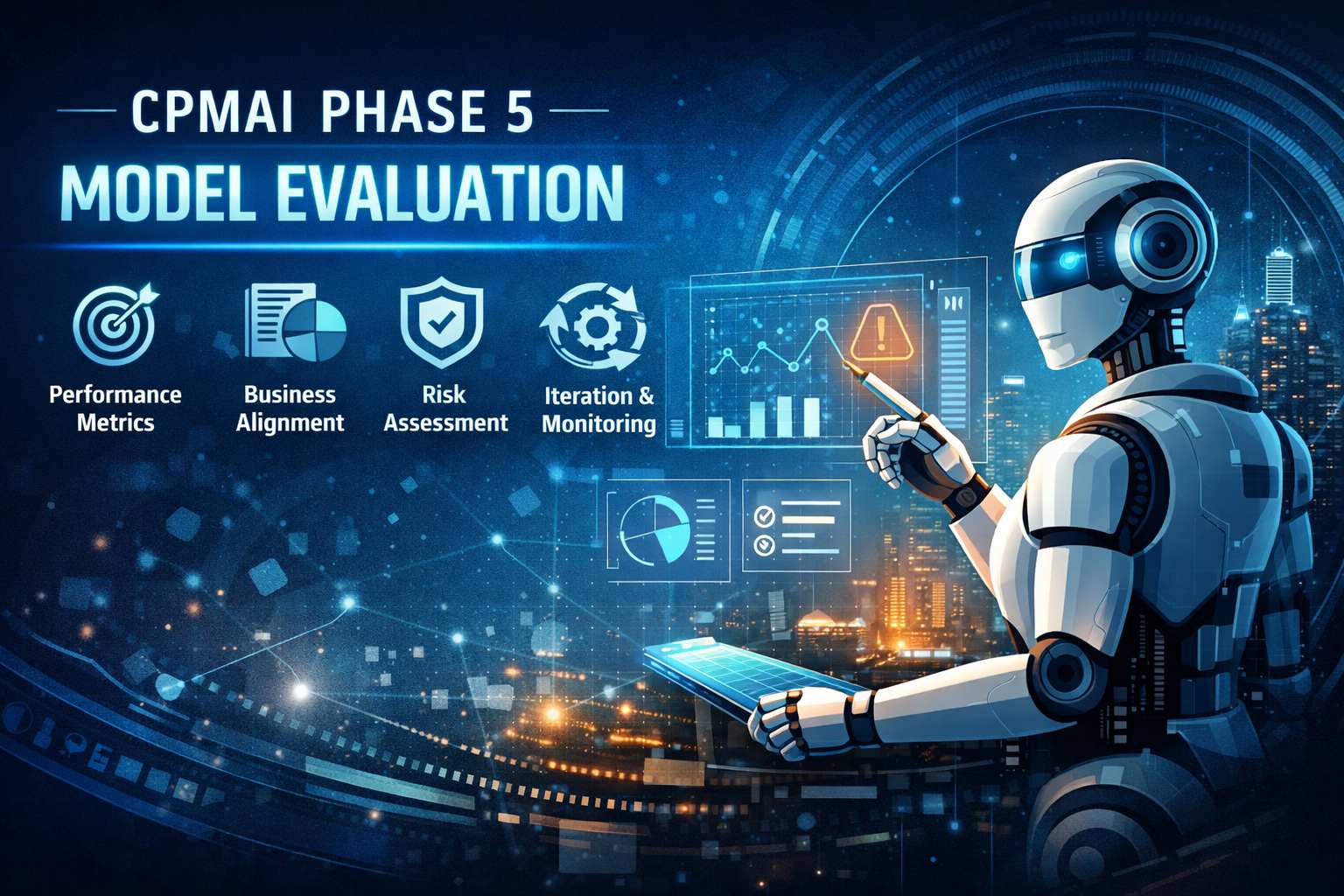
    Model Evaluation: A Critical Phase 5 of CPMAI

    In Phase 5: Model Evaluation, we go beyond asking, “Does the AI system work?”
    We ask, “Is the AI consistently delivering the value it was designed to create?”

    Building a model that performs well once is not enough—you must ensure it continues to perform reliably over time.
    While many teams focus primarily on technical metrics and functional requirements, this phase demands more.

    Those metrics matter, but Phase 5 requires evaluating how the AI solution performs in the real world and how well it continues to meet the objectives defined in CPMAI Phase I: Business Understanding.

     Model Evaluation A Critical Phase 5

    Model Evaluation – Repeatedly Questions to ask

    • Are we saving the money we thought we would?
    • Are we speeding up internal processes, improving compliance, or reducing risk?

    If the model isn’t meeting those key performance indicators, it’s not truly successful.

    An AI solution may look impressive on paper or perform well in controlled tests, yet still fail in the real world if it isn’t adopted by users or doesn’t integrate smoothly into existing workflows.

    That’s why Model Evaluation – CPMAI Phase 5 focuses on a thorough evaluation of whether the model truly meets both technical expectations and real business needs.

    It’s also important to recognize that AI is not a set-and-forget solution. Data evolves, user behavior changes, and operating environments shift over time. Models that perform strongly at launch can gradually drift and produce less reliable outcomes as input data changes in unexpected ways.

    Moreover, AI systems are inherently probabilistic. While they may deliver accurate results most of the time, they can also generate incorrect or misleading outputs in certain situations.

    For these reasons, continuous monitoring is essential—and a human-in-the-loop remains a critical part of responsible AI operation.

    The Rise of MLOps

    Model Evaluation requires a continuous monitoring approach, often referred to as Machine Learning Operations or MLOps.

    By using these approaches, if you notice the model’s performance slipping, or if the costs start to outweigh the benefits, you can revisit earlier phases to retrain or adjust your model.

    One lesson we learned in building iterative and highly reliable software systems is that we should be constantly testing our systems as we’re pushing them out to deployment.

    Adopting DevOps & MLOps Practices

    To sustain AI performance over time, teams must adopt core DevOps principles:

    • Continuous Integration (CI) to ensure that code and model updates are frequently merged, validated, and tested.
    • Continuous Deployment (CD) to automatically release new model versions into production once they pass defined quality and compliance checks.
    • Continuous monitoring and version control to track which model is active, how it is performing, and to enable fast rollback if issues arise.

    However, MLOps extends beyond traditional DevOps to address challenges unique to AI systems.

    AI-Specific MLOps Considerations

    • Data Drift
      Over time, changes in incoming data can cause models to behave differently, leading to degraded performance if not detected and managed.
    • Model Drift
      As real-world conditions evolve, a model’s predictions may become less accurate, even if the data pipeline remains unchanged.
    • Data Provenance
      Maintaining a clear record of exactly which data sources and datasets were used to train each model version.
    • Model Governance
      Defining who can access models, how changes are approved, and how risks such as bias, misuse, or compliance violations are handled. This may involve access controls, audit logs, and formal review processes.
      Key questions include:
      Who approves model updates?
      What rules govern versioning and deployment?
      – How do we ensure compliance with organizational and regulatory requirements?
    • Model Versioning
      Supporting multiple models in parallel—such as a production model and a candidate model under evaluation—while ensuring the ability to safely roll back if performance degrades.

    Developing a robust MLOps strategy ensures these technical, operational, and governance needs are addressed, enabling AI systems to remain reliable, compliant, and valuable over time.

    Iterate Models

    Model Evaluation Phase is also where you define a clear model iteration strategy.

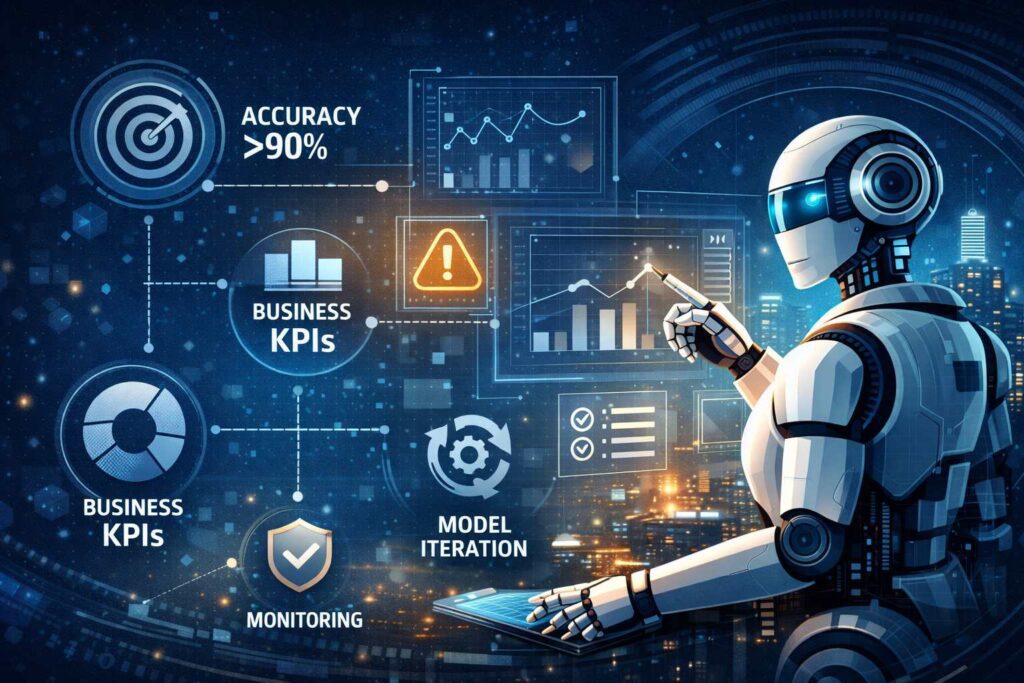
    This may include setting performance thresholds—such as retraining the model whenever accuracy drops below 90%—or establishing scheduled retraining cycles, like monthly or quarterly updates.

    At this stage, you also need to clarify:

    • Ownership: Who is responsible for monitoring model performance and triggering action
    • Data strategy: How new data will be collected, validated, and used for retraining or feature refinement
    • Monitoring tools: Which dashboards and metrics will be used for ongoing performance tracking

    A well-defined model governance plan ensures that all stakeholders understand when, why, and how changes to the model will occur.

    This structured approach helps ensure the AI system continues to deliver the business value originally defined in Phase I: Business Understanding.

    Adoption

    No matter how strong the model’s performance metrics are, an AI solution delivers no value if users don’t adopt it.

    As part of Phase V evaluation, it’s essential to confirm that end users not only understand how to use the system but also trust the insights and recommendations it provides.

    Adoption is supported by:

    • Targeted training sessions that build confidence and competence
    • User-friendly design that minimizes complexity
    • Clear, accessible documentation that explains both usage and intent

    If users are not engaging with the AI solution – perhaps because it’s too complex or poorly integrated into their daily workflows – that feedback is a strong signal to revisit the approach. This may involve adjusting the scope, simplifying the experience, or refining how the solution fits into real-world operations.

    Key Questions to Address in Model Evaluation Phase

    In Phase 5, you should be able to confidently answer the following questions:

    • Does the model meet the required accuracy, precision, and performance thresholds?
    • Are risks related to overfitting or underfitting adequately addressed?
    • Do the training, validation, and test performance curves indicate stable and reliable learning?
    • Does the model support and align with defined business KPIs?
    • Is the model appropriate for the selected operational and deployment approach?
    • How will the model’s performance be continuously monitored?
    • How will model updates, iteration, and versioning be managed over time?

    If these questions can be answered with confidence, the AI initiative is well-positioned for long-term success and sustainability.

    With an AI solution that not only delivers value today but is designed to sustain that value over time, we are now ready to move into CPMAI Phase VI: Operationalization.

    Connect with us if you have any questions. In case you haven’t read about phase 4, do read. And you need to hire freelancers to help you build or manage your AI projects. Reach out to our team of freelancers.

  • Good Data Preparation with perfect consideration- Phase 3 in CPMAI

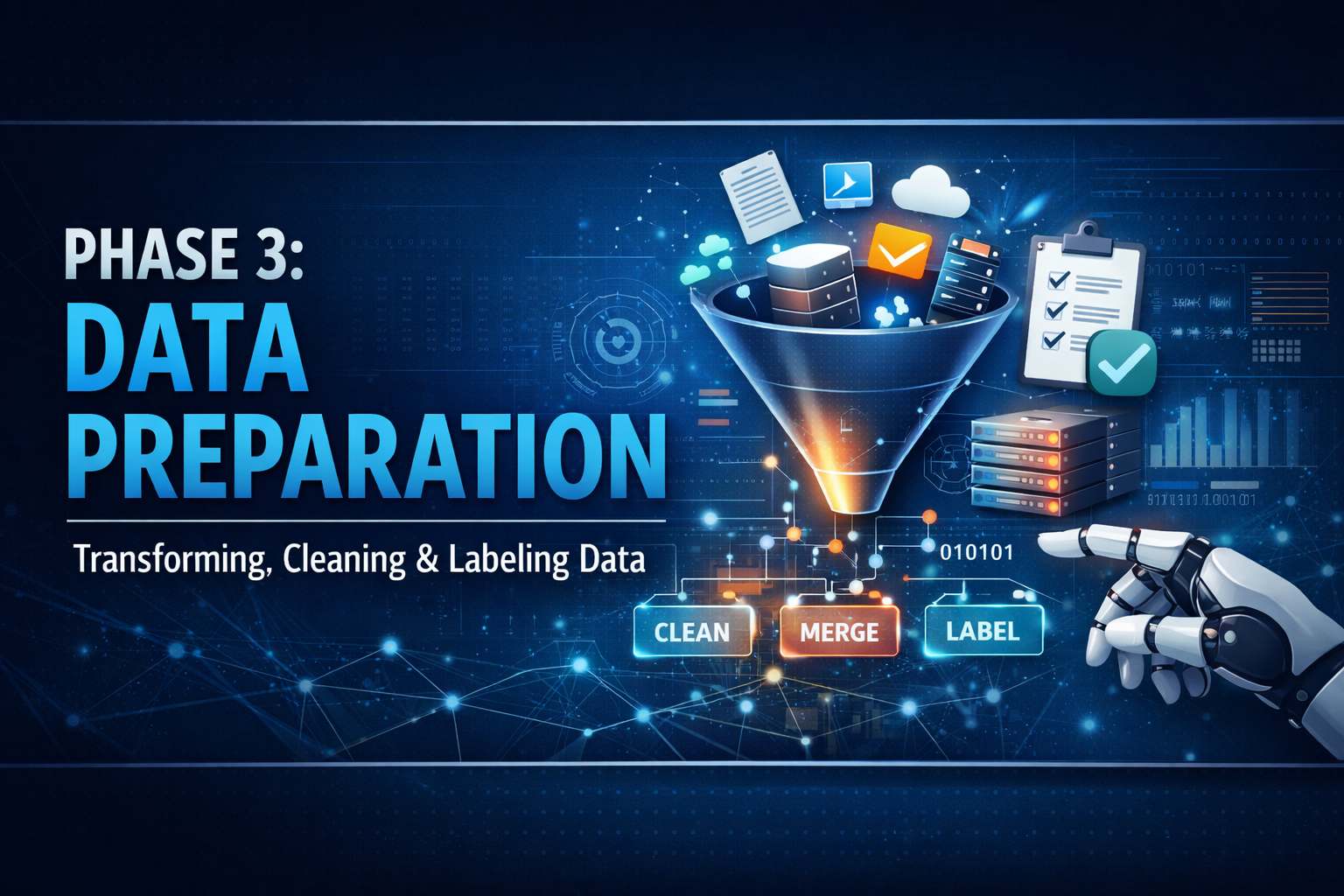
    Good Data Preparation with perfect consideration- Phase 3 in CPMAI

    Data Preparation is the third phase of CPMAI—and it’s where the real work begins. In most AI initiatives, the majority of effort is not spent on training models, but on getting the data ready.

    In fact, nearly 80% of the time in each AI project iteration is typically dedicated to collecting, cleaning, integrating, labeling, and otherwise preparing data for use.

    Messy or incomplete data is like a car without fuel. No matter how advanced the engine, it won’t take you anywhere.

    If you discover midway through the project that the data is overly complex, unmanageable, or misaligned with the objective, it often signals that the problem scope should have been tighter from the start.

    Fortunately, CPMAI is designed to be iterative. If new insights reveal the need to refine the scope or switch to a more appropriate dataset, the framework allows you to revisit earlier phases and course-correct before moving forward.

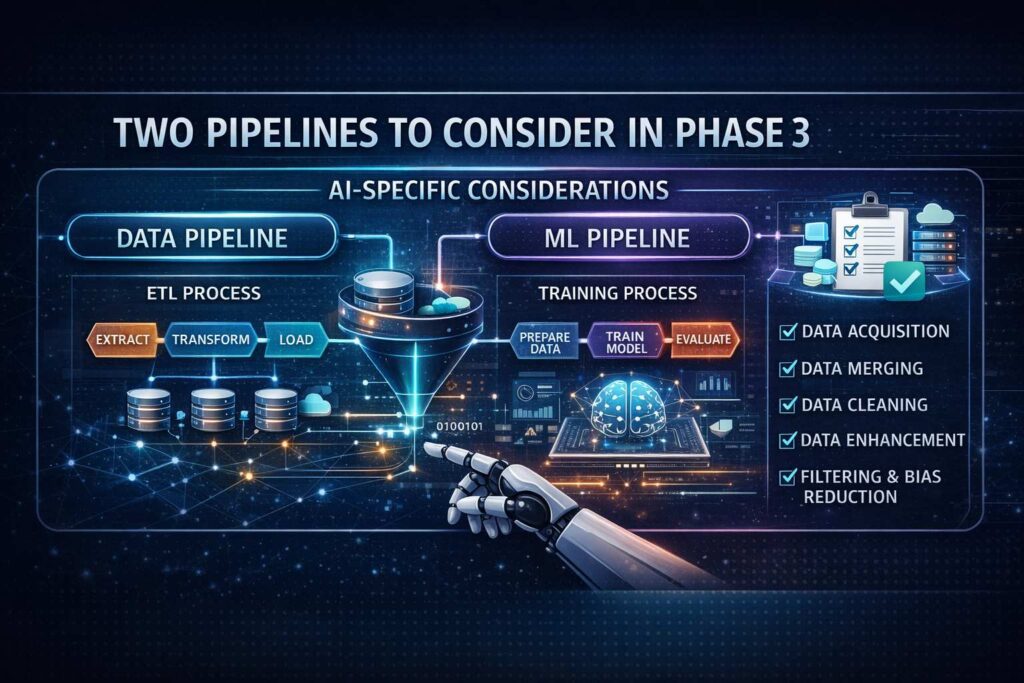
    Phase 3 - 2 Pipelines to consider in the phase of Data Preparation

    The Data Pipeline

    The first crucial step in phase three is to design and build your data pipeline.

    This pipeline is simply the route your data takes from its original source to the AI system.

    TWO PIPELINES TO CONSIDER for Data Preparation:

    Training Data Pipeline: The training data pipeline is where you gather, clean, and format historical or existing data to teach your model before it’s built and in use.

    Inference Data Pipeline: The inference data pipeline handles the real-time ongoing flow of new and production data that the model will process once it’s deployed.

    At this point in the process, you haven’t yet built your AI system. So by planning these pipelines before you start building, you can spot potential issues early.

    Maybe you have multiple data sources that each require different cleaning steps or transformations, or perhaps some data is in a format you can’t process efficiently.

    Addressing this before you’re deep into building and delivering your AI solution will save a lot of time and trouble down the road.

    Data preparation isn’t the glamorous part of AI, but it’s one of the most critical parts.

    Building efficient, well-planned data pipelines and thoroughly cleaning and labeling your data will give your AI project the best chance for success.

    AI-Specific Considerations for Data Preparation

    Data Acquisition in Data Preparation
    Define how data will be collected. This may include internal databases, APIs, streaming sources, or third-party providers.
    Ensure data ownership is clear and that you have the appropriate permissions and usage rights.

    Data Merging in Data Preparation
    When data originates from multiple sources, careful integration is required. Differences in naming conventions, schemas, or data types must be reconciled.
    Identify and eliminate duplicate records that could distort results or disrupt data pipelines.

    Data Cleaning in Data Preparation
    Address data quality issues by removing corrupted records, resolving inconsistencies, and managing missing values.
    Standardize formats where necessary—for example, aligning date formats or ensuring numeric values use consistent units.

    Data Enhancement in Data Preparation
    Enhance the dataset by deriving additional features that improve model performance. For instance, timestamps can be transformed into features such as day of the week or time of day.
    Consider data enrichment or augmentation techniques, such as generating additional samples or synthetic variations, to improve robustness.

    Filtering and Bias Reduction in Data Preparation
    Identify and correct data that may introduce bias. This may involve balancing category representation, removing misleading outliers, or excluding data that does not reflect real-world conditions.

    Critically important—consideration is data labeling.

    In supervised learning, one of the three core machine learning paradigms, models learn from labeled examples. This means the training data must be accurately and consistently labeled.

    For example, if you are building an image recognition system to identify cats, your dataset must clearly label images of cats—and exclude or correctly distinguish dogs, rabbits, or unrelated objects.

    Data labeling is both time- and resource-intensive. Attempting to label massive datasets all at once can quickly become unmanageable. A more effective approach is to begin with a smaller, well-defined subset to validate your assumptions and methodology before scaling.

    Large challenges are best tackled incrementally—by breaking them into smaller, manageable pieces.

    Ensure you have both the budget and the right expertise in place to perform data labeling accurately and consistently.

    If labeling proves to be too costly or time-consuming, that’s a strong signal to reassess the project scope. In some cases, a semi-supervised or unsupervised approach may be more practical. Alternatively, an off-the-shelf model that can be aligned to your business requirements may offer a faster and more economical path.

    The iterative nature of CPMAI provides this flexibility.

    You may discover that your data supports only a portion of the original problem—or that time and budget constraints limit how much data can realistically be prepared. That’s not a failure. It’s the strength of an iterative framework: you can return to Phase 1 or 2, refine your objectives, and continue moving forward with clarity.

    Finally, if nearly 80% of AI effort is spent on data engineering, it’s essential to staff accordingly.

    This often includes data engineers, data analysts, and domain experts who understand where the data resides and how it should be interpreted. Cutting corners on these roles almost always leads to delays, rework, and frustration later in the project.

    By the end of Data Preparation CPMAI Phase 3, you should be able to answer these questions.

    • How should data be cleaned and prepared to meet project requirements?
    • How can we create repeatable steps for data engineering?
    • How can we continuously monitor and evaluate data quality?
    • How can we effectively use or modify third-party data?
    • When and how should humans be involved with data labeling?
    • What additional steps can we take to augment data?

    If you can confidently address these areas, you’ll be well-positioned to move into Phase IV: Model Development—where the focus shifts to selecting and applying the AI tools best suited to solving the problem at hand.

    Connect with us if you have any questions. In case you haven’t read about phase 2, do read. And you need to hire freelancers to help you build or manage your AI projects. Reach out to our team of freelancers.

  • Data Understanding – Phase 2 Of A Good AI Project In CPMAI

    Data Understanding – Phase 2 Of A Good AI Project In CPMAI

    Data Understanding is about exploring how to inventory, assess, and plan for the data you need to power your AI solution.

    AI projects are like a car, and you can’t drive anywhere if your car doesn’t have any gas. Which means without the right data, your AI project simply won’t move forward.

    In many cases, we see that teams either don’t have the data they need or they don’t know what data they need in the first place.

    This phase focuses on pinpointing exactly which data matters and whether you have enough of it, both in quantity and quality.

    In CPMAI phase 1 (Business Understanding), we ask why we need AI to solve this problem, and in phase 2, we ask what data is needed to support those AI business requirements. Figuring out the type, quantity, and quality of data required for an AI solution ensures you’re on solid ground as you move on to preparing and modeling that data.

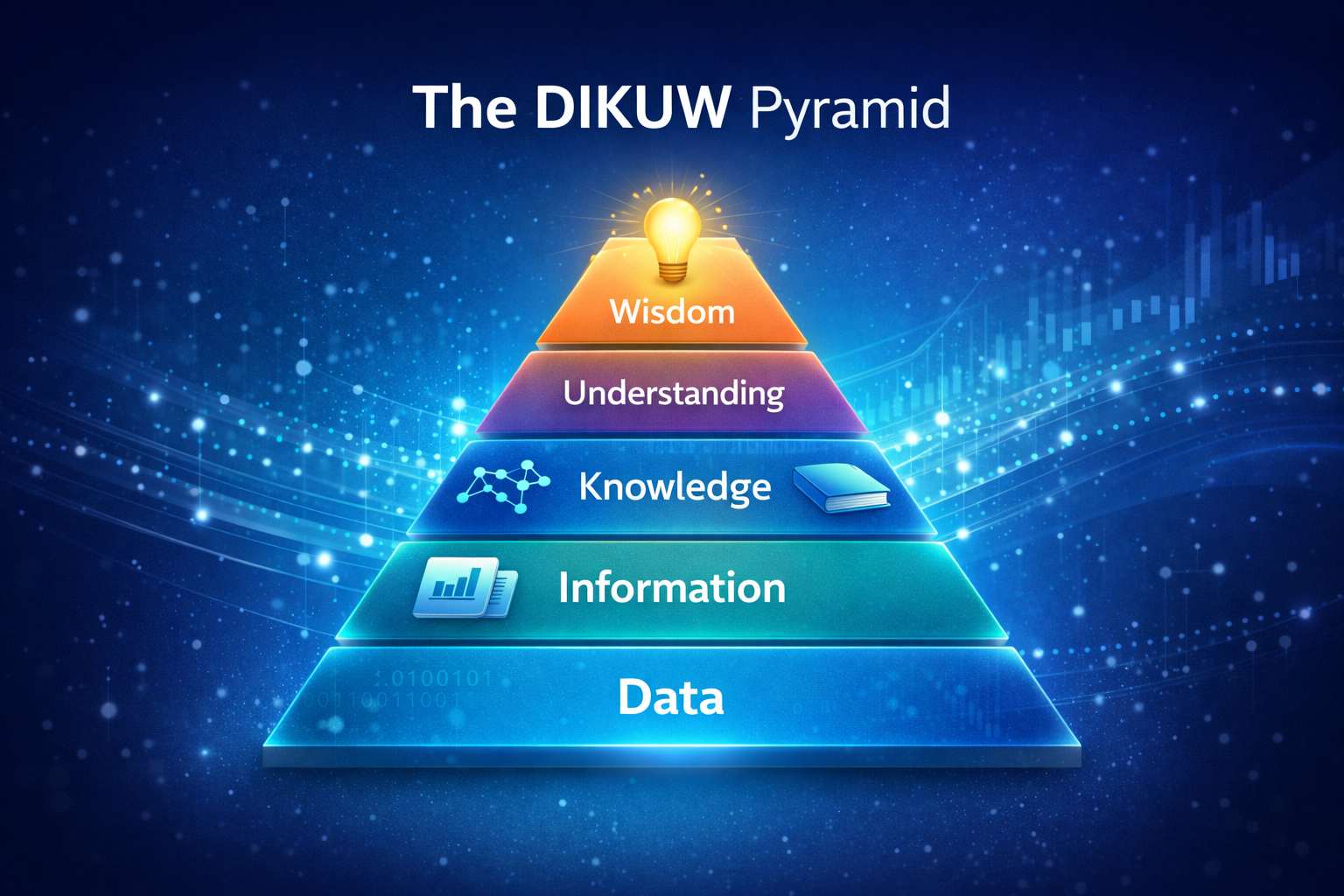
    The DIKUW Pyramid – Data Understanding

    Helps visualize the role of data in AI.

    DATA, INFORMATION, KNOWLEDGE, UNDERSTANDING, WISDOM

    Data Understanding - DIKUW Pyramid

    This shows the increasing value of intelligence with data.

    Data

    At this level of value, we’re dealing with raw facts at the foundational layer. Our primary needs here are storing and processing data. So we get some value from the data, but by itself, simply storing and retrieving that data doesn’t tell you much.

    Information

    By organizing, analyzing, and summarizing data, we can get more value from our data. We can answer not just basic facts of data, but also some questions, such as “Who did what? Where did this happen? When? Or how much?”

    At this level, we apply analytics and reporting solutions, but we can get even more value from our data.

    Knowledge

    We can identify patterns and gain deeper insights, like predicting future outcomes or grouping similar items.

    As we move up the pyramid, we also need to apply more sophisticated technology to get more value from data, whereas we only need databases and data stores at the D level and reporting and analytics tools at the I level.

    At the K level, machine learning enters the picture. The K level gives us the power to spot patterns in the data, such as conversational patterns or recognition patterns. It also allows us to predict outcomes and determine next steps.

    Sounds familiar, right? The seven patterns of AI. But we can get even more value from data.

    More than just knowing the patterns, understanding what those patterns represent is at the U level – a level that is often missing in similar diagrams.

    Understanding

    We need reasoning to understand why something is happening.

    Today’s AI often struggles here because it requires more than just pattern recognition. The lack of understanding is why many AI systems hallucinate or produce clearly incorrect results.

    We need something even more sophisticated than machine learning to give us the understanding we need for more complex reasoning.

    Wisdom

    At this level, human-like judgment and nuanced decision-making come into play.

    The W level is where we determine when and why certain things should be done instead of just recognizing or understanding the patterns to be able to make truly intelligent decisions, respond in environments of ambiguity, and handle all sorts of intelligent needs that our brains are capable of.

    In CPMAI, we use the DIKUW Pyramid to understand where AI can and cannot add value.

    If you’re trying to solve a data storage problem or a simple reporting problem at the Data or Information levels, you might just need databases and business intelligence tools.

    AI tools are really not the best fit for more basic aspects of data handling and reporting.

    Once you hit the Knowledge level and want to detect patterns or make predictions, that’s where AI or machine learning can really shine.

    Machines still struggle with reasoning and common sense.

    So while AI systems are starting to make progress with dealing with understanding-level problems, they still exhibit a lot of unpredictability and problems that can pose a risk.

    We haven’t yet been able to build machines with a sort of consciousness and higher-level understanding to address wisdom-level problems.

    Aiming for the right level for your AI project will help ensure that AI remains a good solution to your business problem.

    In CPMAI phase two, we need to understand how big data comes into play.

    The characteristics of big data are often described by the V’s of big data.

    VOLUME

    • How much data do we need?
    • Are we dealing with massive amounts of data that make traditional processing methods difficult to manage?

    VELOCITY

    • Is your data constantly changing?
    • Does your AI system need to deal with real-time changing data like social media feeds or sensor data from machinery?

    VARIETY

    Data can come in a variety of forms, such as images, text documents, audio recordings, and sensor data, each requiring different handling.

    VERACITY

    Veracity addresses data inconsistencies, missing values, or issues of poor data quality.

    Unstructured and Structured Data

    Structured Data

    • Can be displayed in rows, columns and relational databases
    • Numbers, dates and strings
    • Estimated 20% of enterprise data (Source: Gartner)
    • Requires less storage
    • Easier to manage and protect with legacy solutions

    Unstructured Data

    • Cannot be displayed in rows, columns, and relational databases
    • Images, audio, video, word processing files, e-mails, spreadsheets
    • Estimated 80% of enterprise data (Source: Gartner)
    • Requires more storage
    • More difficult to manage and protect with legacy solutions

    The majority of data in most organizations is unstructured…

    FOR EXAMPLE: EMAILS, PDFs, IMAGES, SOCIAL MEDIA POSTS

    Structured data is much easier to query and manipulate, but there’s a lot more of the unstructured type around. We need ways to get value from the unstructured data, just like we do from structured data.

    That’s where machine learning can shine, because it’s specifically designed to interpret and learn from these unstructured sources.

    If your data is already neatly stored in rows and columns, you may not even need AI.

    But if you have a mountain of emails or documents that need to be searched or categorized, that’s a prime opportunity for an AI project, so long as you have enough of the right data.

    In addition, we need to deal with the fact that not all data is equally reliable. This is where the data veracity questions that we just covered will be useful.

    Here are some key questions to ask.

    • What data is required to achieve our objectives? Clearly define the specific data needed to solve the business problem identified in Phase One.
    • Do we have enough data, and is it reliable? More data is not always better. The focus should be on clean, accurate, and representative datasets, free from significant errors or bias.
    • Which internal and external data sources are necessary? Identify all relevant data sources across the organization and from external partners or providers.
    • What additional data would strengthen our existing dataset? Determine any gaps and the data needed to improve coverage, accuracy, or insight.
    • What are the ongoing data collection and preparation requirements? If data changes frequently, establish a strategy for continuous collection, validation, and updates.
    • What technology is required for data processing and transformation? Assess the need for data pipelines, ETL processes, transformation tools, and labeling workflows.
    • Are there special considerations for unstructured data? Data such as text, documents, images, and audio may require specialized preprocessing techniques or machine learning models.

    If you don’t have the right data, or if it’s not in good shape, you could spend a lot of time and money building a model that never performs well.

    So here in Phase 2, you’re setting yourself up for success by mapping out your data sources, spotting potential problems early, and forming a plan to address them.

    There are several common pitfalls to address during CPMAI Phase 2: Data Understanding:

    • Data redundancy or gaps
      You may encounter duplicate datasets or discover that entire categories of required data are missing.
    • Poor-quality or noisy data
      Outdated records, inconsistent labeling, missing values, or biased data can significantly reduce the accuracy and reliability of AI systems.
    • Unsupported data formats
      Challenges arise when data exists in formats that your current tools, infrastructure, or team skills cannot effectively process.
    • Unclear data ownership or permission issues
      Risks emerge if you lack the legal rights, access permissions, or governance clarity to use certain datasets.

    Data-related issues are far easier and less costly to resolve when identified early.

    That is precisely the purpose of Phase 2: Data Understanding.

    By the end of Phases 1 and 2, you have clearly defined the business case for the AI initiative and developed a solid understanding of the data required. This foundation enables you to move confidently into the next phase, where data can be properly transformed, cleaned, and labeled for effective AI development.

    Connect with us if you have any questions. In case you haven’t read about phase 1, do read. And you need to hire freelancers to help you manage or execute your AI projects. Reach out to our team of freelancers.

  • First Phase Of Any AI Project In CPMAI – Business Understanding

    First Phase Of Any AI Project In CPMAI – Business Understanding

    Let’s first talk about return on investment (ROI) because that’s usually top of mind for anyone launching an AI project.

    Most of us think of ROI only in financial terms, but there are many ways to measure success…

    • Financial Savings: How much money a project will generate or save.
    • Time Savings: Reducing the hours a team needs to spend on repetitive tasks or reducing the errors in a previously manual process.
    • Resource Savings: Lowering operational costs or cutting down on manual processes.

    The key is to figure out what a positive return means for your specific organization and your specific project.

    Is it worthwhile to move forward with this AI project?
    AI GO/NO-GO DECISION.

    This phase is all about clarifying the business problem and the feasibility of solving it with AI.

    AI Project Business Feasibility

    An AI initiative can progress successfully only when three key feasibility dimensions are aligned.
    Explore each dimension to assess readiness.

    Business Feasibility of AI Project

    • Is the business problem clearly defined and well understood?
    • Is the organization prepared to invest in and support change?
    • Is there a meaningful return on investment or measurable business impact?

    If these questions cannot be confidently answered with “yes,” additional discovery and alignment may be required before moving forward.

    Data Feasibility

    • Does the available data truly represent what matters for the problem?
    • Is there sufficient, accessible data to train and validate AI models?
    • Is the data of adequate quality and reliability?

    If the required data is unavailable, difficult to access, or too costly to clean, the AI approach may need to be reconsidered.

    Implementation Feasibility

    • Do you have the necessary technology, infrastructure, and skills?
    • Can the solution be developed and deployed within acceptable timelines?
    • Can the model operate effectively in the intended production environment?

    Think of each question as a traffic signal:

    • Green means go
    • Yellow means proceed with caution
    • Red means stop

    The more yellow and red signals you encounter, the higher the overall project risk becomes.

    Some answers may fall into a “maybe” category – these are effectively yellow lights. A yellow does not mean the project must be abandoned, but it does signal uncertainty. Ideally, these uncertainties should be addressed and resolved before committing significant time, budget, or resources.

    If you choose to move forward without resolving them, you should do so with a clear understanding that you are operating in a high-risk environment.

    The goal is to answer all the key questions of feasibility and ensure that we have as many green lights as possible.

    A common pitfall in AI initiatives is investing significant time and effort in proofs of concept or prototypes that never progress to real-world deployment.

    AI tools can be exciting to experiment with, and it often feels like meaningful progress is being made with minimal effort. However, turning these early wins into solutions that consistently deliver real, measurable business value is far more challenging.

    Rather than focusing on a proof of concept—which is typically aimed at exploring tool capabilities—shift the emphasis to a pilot.

    A pilot is executed using real data, in a real environment, to address a real business problem.

    This approach helps teams validate not just what the technology can do, but whether it can succeed where it actually matters.

    If you find yourself in the proof-of-concept stage, challenge the team to shift toward a pilot as early as possible, using an agile or adaptive mindset.

    This pilot is often referred to as a Minimum Viable Product (MVP)—the smallest real-world solution that can be delivered while still providing meaningful value.

    CPMAI Phase One is where you define the success criteria for that MVP. This ensures the initiative is focused on solving a real business problem, rather than simply demonstrating that AI tools can be experimented with.

    Ask yourself:

    • What does success look like?
    • Which AI pattern best fits this problem?

    By focusing on an MVP, teams are encouraged to think big, start small, and iterate frequently, increasing the likelihood of delivering successful, value-driven AI solutions.

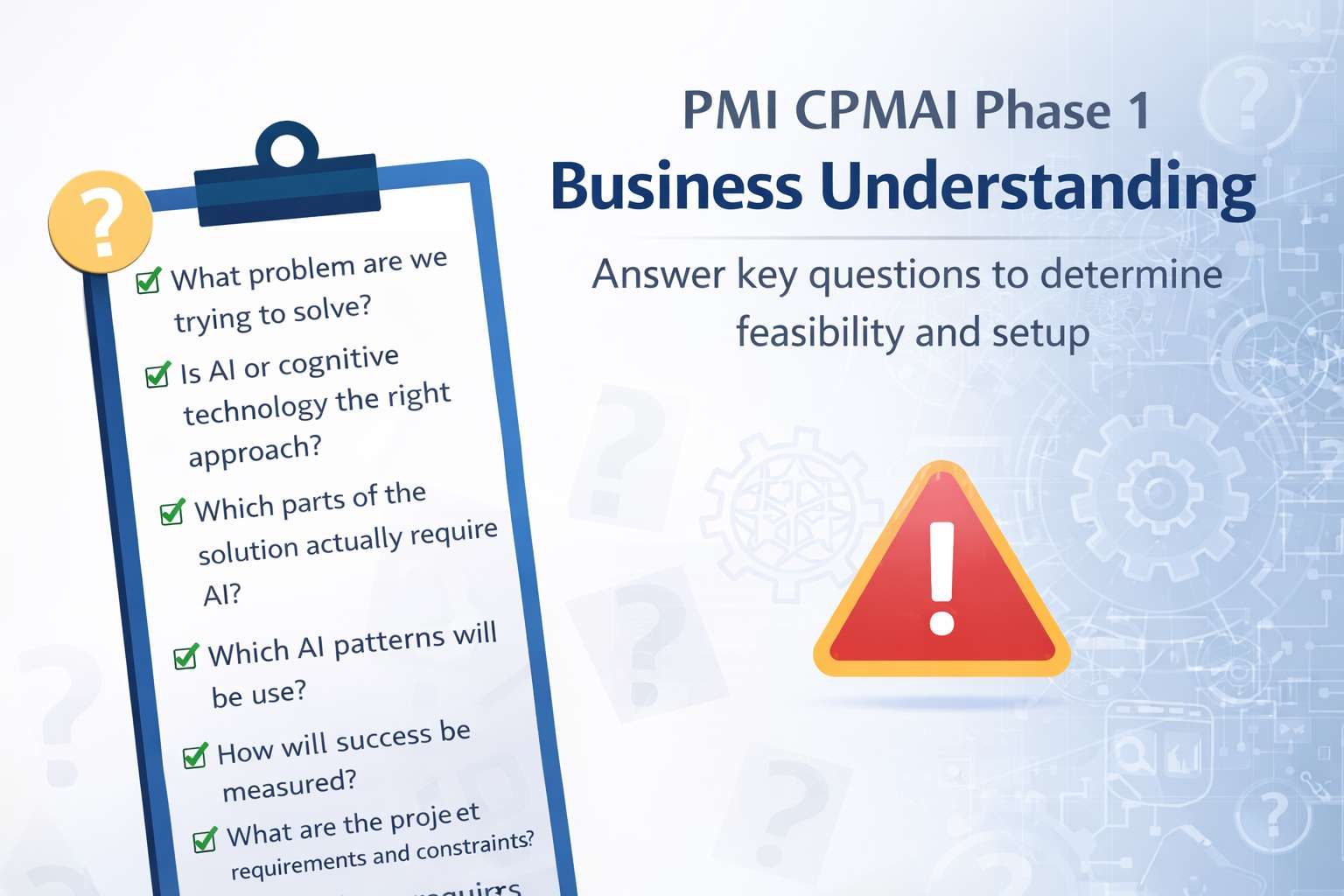
    Beyond the seven AI patterns and the AI Go / No-Go decision, CPMAI Phase I focuses on addressing a set of foundational questions that shape the entire initiative:

    1. What problem are we trying to solve?
    2. Is AI or cognitive technology the right approach?
    3. Which parts of the solution actually require AI?
    4. Which AI patterns should be applied?
    5. How will success be measured—financial impact, time savings, compliance, user satisfaction, or other outcomes?
    6. What are the project requirements and constraints?
    7. What additional considerations or risks exist?
    8. What skills, capabilities, or resources are required?

    The objective of CPMAI Phase I is to gather clear, aligned answers to these questions from key stakeholders, enabling the team to move forward confidently into the next phases of CPMAI.

    It’s important to remember that not every problem requires AI, and not every component of a project should use AI. If AI is not the right solution for a clearly defined problem, the initiative should pause until a more suitable approach is identified.

    Identifying feasibility issues early is far better than pushing ahead and uncovering them months later. This is precisely why CPMAI Phase I exists: to validate the business case, align expectations, and reduce risk—giving the rest of the AI journey the strongest possible foundation for success.

    Reach out to us if you have deeper questions about this phase of CPMAI. You can also talk to a freelance AI Project Manager and hire them if needed.

    Suggested Read: Next Phase – Data Understanding

  • About CPMAI Methodology 2026

    About CPMAI Methodology 2026

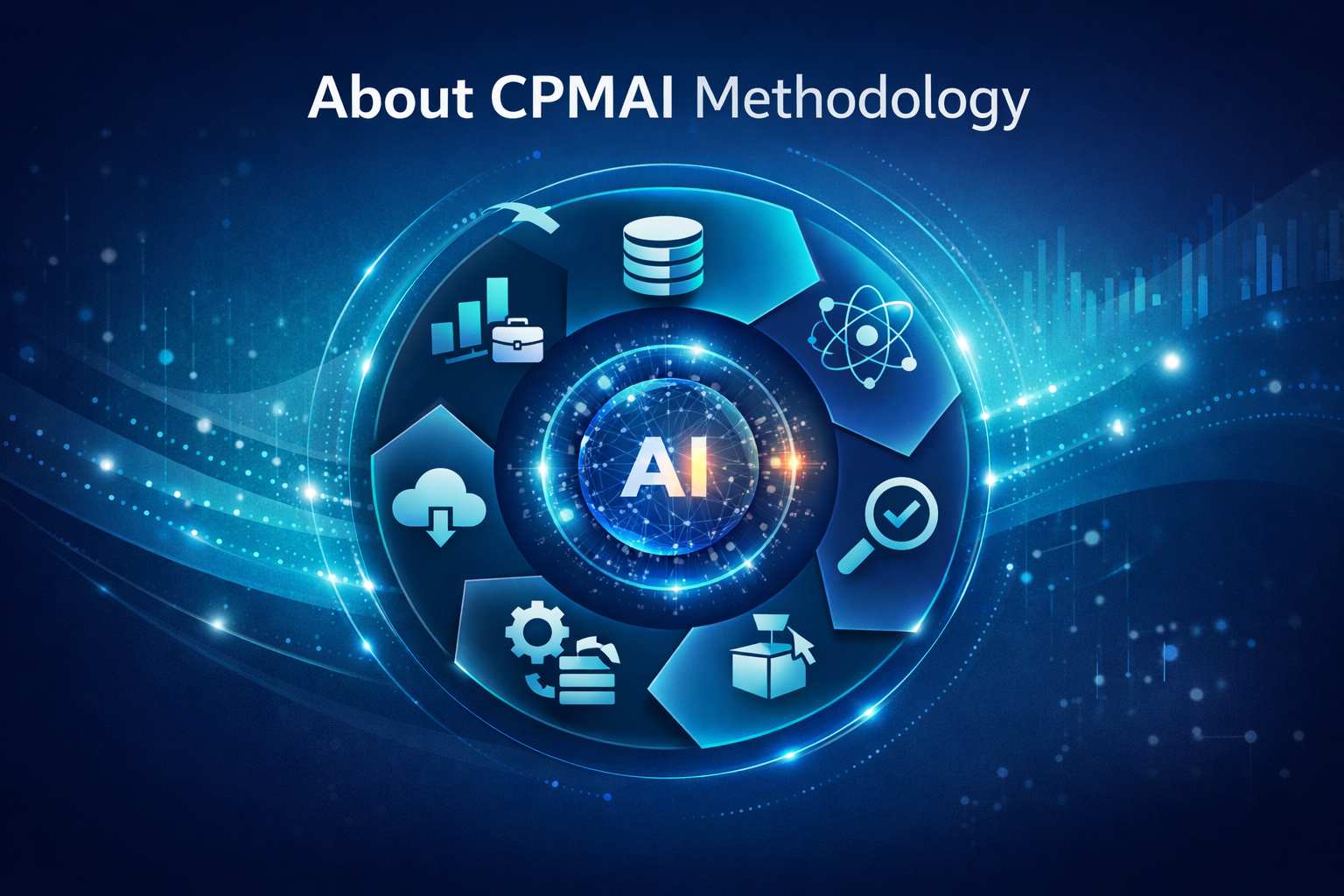
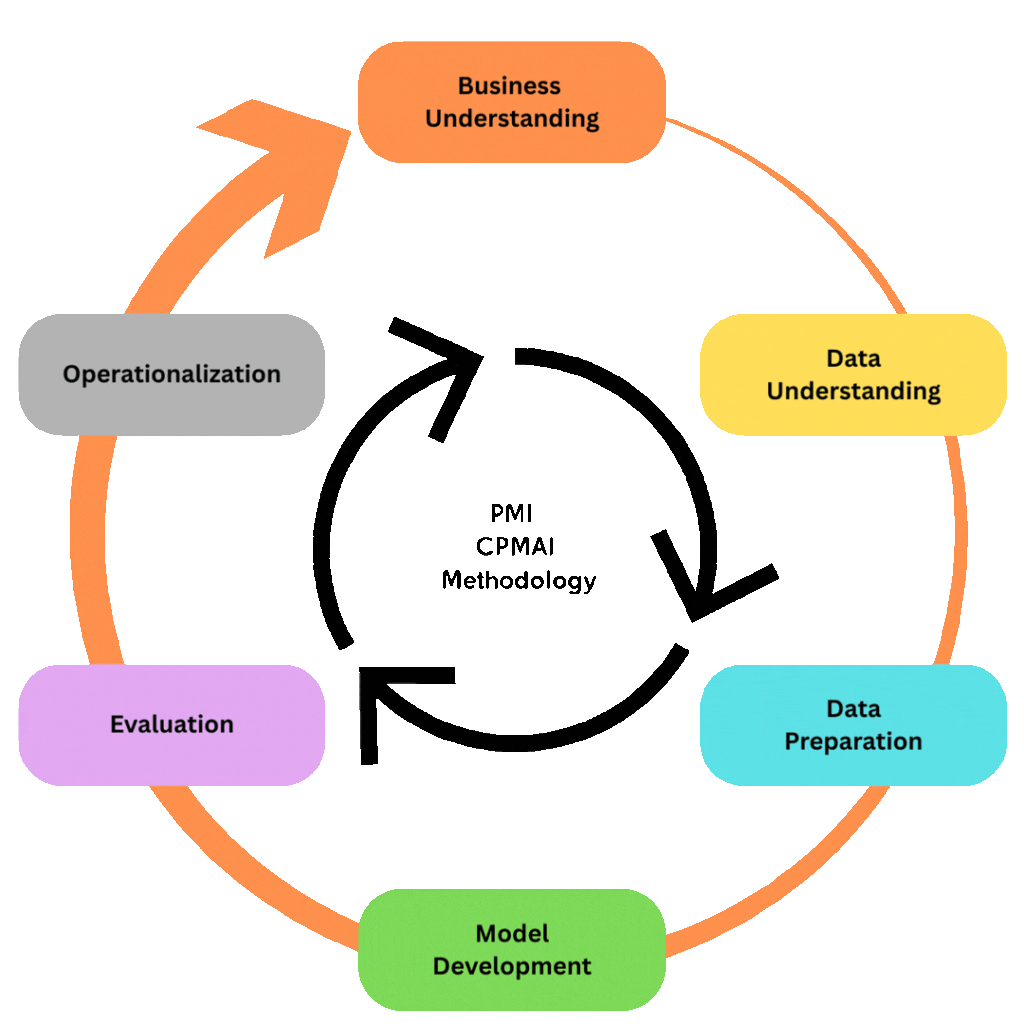
    In PMI’s CPMAI framework, the iterative and data-centric nature of AI initiatives is visualized as a circular, wheel-shaped lifecycle rather than a linear process.

    The lifecycle consists of six interconnected phases, each building on and informing the others:

    CPMAI Phase 1 – Business Understanding

    Clearly define business goals, success criteria, and requirements, and align them with what AI can realistically deliver.

    Read More

    CPMAI Phase 2 – Data Understanding

    With clear objectives in place, identify the data required to support the AI use case and assess its availability, relevance, and quality.

    Read More

    CPMAI Phase 3 – Data Preparation

    Prepare, clean, and transform data to ensure it is accurate, reliable, and suitable for producing trustworthy outcomes.

    Read More

    CPMAI Phase 4 – Model Development

    Develop AI models only after business context, data understanding, and data readiness are firmly established, ensuring alignment and reducing downstream risk.

    Read More

    CPMAI Phase 5 – Evaluation

    Validate the AI solution by testing it in real-world or near-real-world conditions to confirm it meets business and performance expectations.

    Read More

    CPMAI Phase 6 – Operationalization

    Deploy the AI system into production and establish processes to run, monitor, and maintain it so that it consistently delivers the intended business value.

    Read More

    Because CPMAI is an iterative loop, after each cycle of AI development, we come right back to the start of the CPMAI cycle at Business Understanding, iterating the AI system to continue to meet evolving requirements.

    AI is all about data, which means you need to manage AI projects like data projects, not as a typical IT or application development project. A software application can often stay the same even if the data changes. But in AI, you feed new data into the same model code, and it behaves differently.

    This need for data is both the power and challenge of AI, which is why traditional software development processes aren’t enough.

    You need a systematic way to handle data collection, cleaning, labeling, retraining, and continuous evaluation because a model can drift out of date fast if the underlying data shifts.

    The real complexity lies in how you shape and prepare the data.

    This requires a systematic approach to running AI projects to ensure consistent results. It’s not that we throw out all of our existing project management practices. Instead, we build on them, update them to address the unique needs of AI.

    CPMAI as an approach fits well with how organizations already manage projects, but it zeroes in on the data-centric aspects that can make or break AI initiatives.

    If we just say AI, we run the risk of talking about projects with vastly different scopes, risks, costs, data needs, and technology challenges.

    We need a way to get more specific with what we mean by AI.

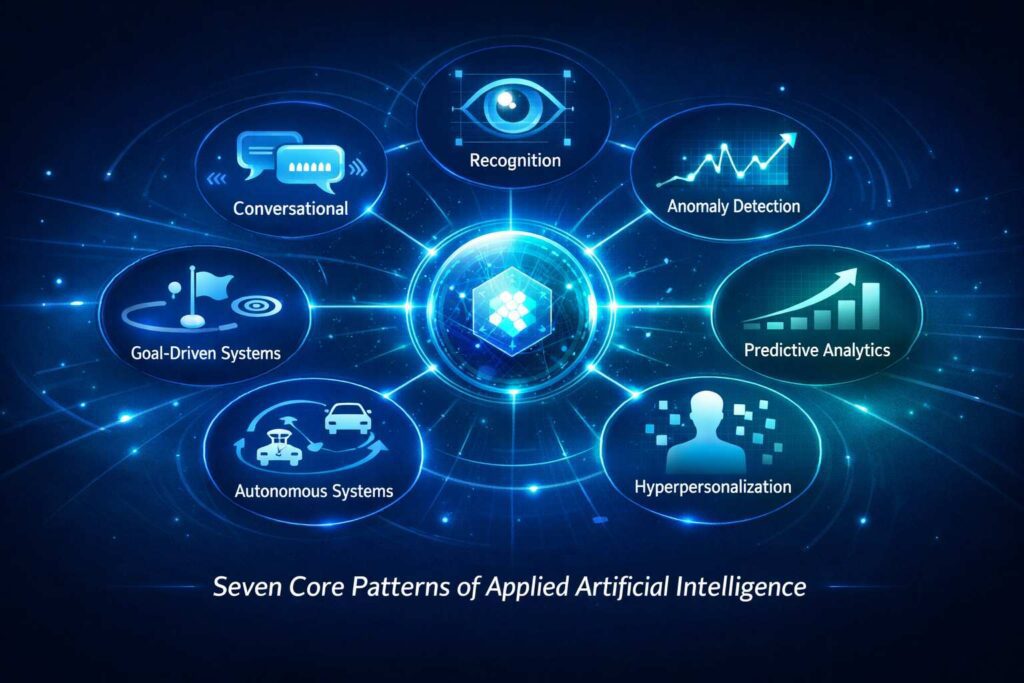
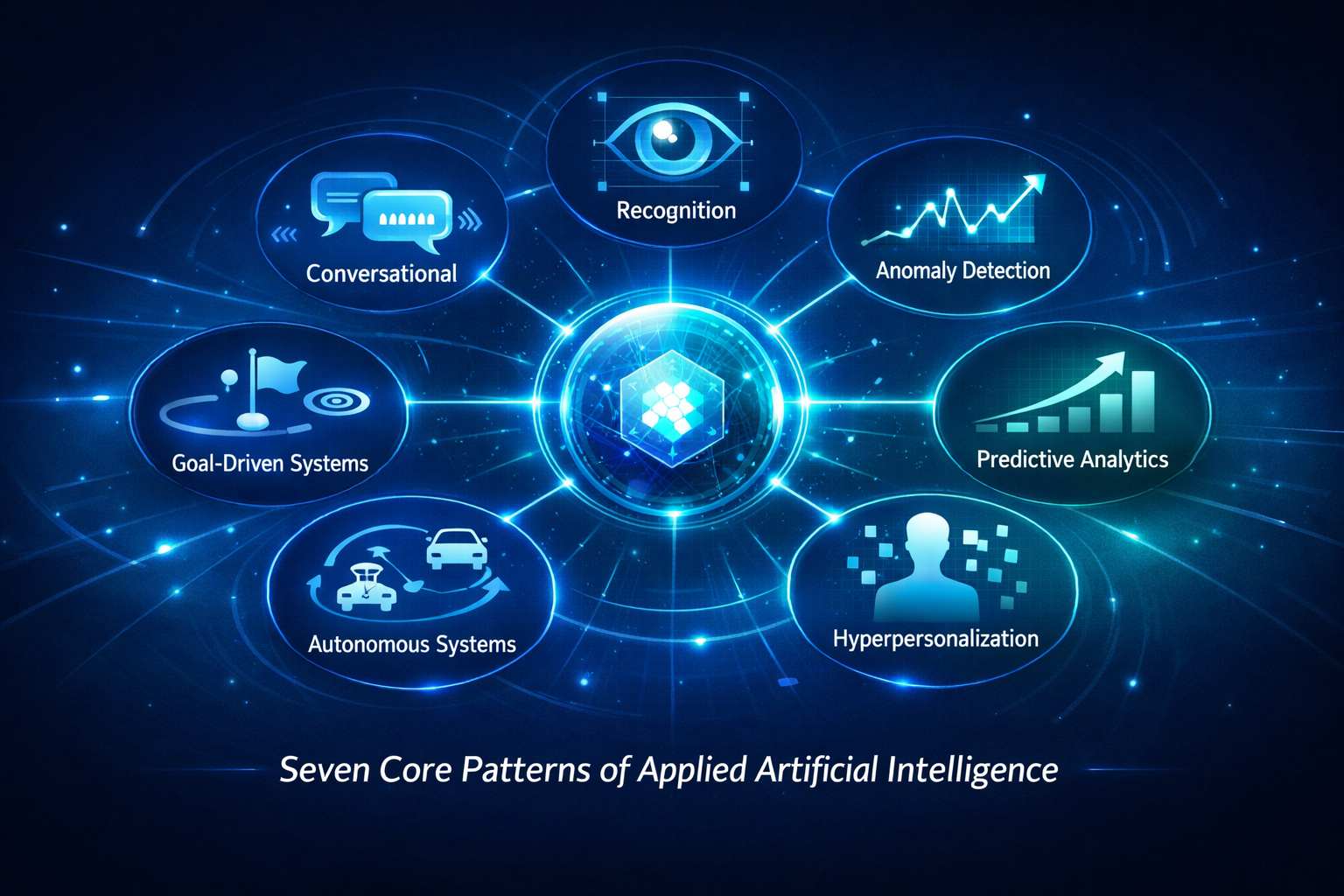
    A key approach is to break applications of AI down into seven main patterns – common categories in which people apply AI to meet their needs.

    1. Conversational Pattern
    2. Recognition Pattern
    3. Pattern and Anomaly Detection pattern
    4. Predictive Analytics and Decision Support Pattern
    5. Hyperpersonalization Pattern
    6. Autonomous Systems Pattern
    7. Goal-driven Systems Pattern
    CPMAI 7 AI Patterns

    CPMAI uses these seven patterns as shortcuts in AI Projects to identify the right data strategy, technology, and success metrics.

    These patterns help us figure out which AI approach makes sense for the problem we’re trying to solve.

    For instance, an AI-enabled chatbot like a virtual assistant or customer support bot would likely fall under the conversation and human interaction pattern.

    You’re far less likely to chase the wrong solution if you align your project with the right pattern from the start, because a project that involves AI to analyze medical radiology images is going to need a different approach than a customer support chatbot.


    The cost, scope, risks, and complexity of the solutions vary considerably as well. So when someone says I’m working on AI, you can ask, “Which pattern are you focusing on?”

    Connect with US to discuss more about AI in Project Management and CPMAI. Hire an AI Freelance Project Manager

  • 7 Fundamental AI Patterns To Apply To Meet Business Needs

    7 Fundamental AI Patterns To Apply To Meet Business Needs

    One effective way to understand AI is by organizing its use into seven fundamental application AI patterns that reflect how organizations apply AI to solve problems.

    1. Conversational AI Pattern

    The Conversational Pattern focuses on AI systems designed to understand and respond to human language in a natural, interactive manner. Common examples include chatbots and virtual assistants.

    Unlike traditional software interfaces that depend on rigid commands and structured inputs, conversational AI leverages Natural Language Processing (NLP) to interpret spoken or written language. These systems aim to understand user intent, context, and nuance, enabling them to generate relevant responses or take appropriate actions in a more human-like way.

    2. Recognition AI Patterns

    The Recognition Pattern centers on AI systems that identify, classify, or extract meaning from data such as images, audio, or text. Examples include facial recognition, handwriting recognition, and text extraction from documents.

    These systems are trained to detect features and match them against known patterns in real-world environments. Because real-world data is often noisy and inconsistent, recognition solutions require large volumes of training data, strong validation, and continuous refinement to ensure accuracy, reliability, and efficiency at scale.

    3. Patterns and Anomaly Detection

    This pattern focuses on discovering meaningful trends, regularities, or unusual deviations within complex datasets.

    Typical use cases include detecting fraudulent financial transactions, identifying abnormal network activity, or spotting early warning signs of equipment failure in manufacturing. By learning what “normal” behavior looks like, these AI systems can flag anomalies or emerging patterns that require attention or further investigation.

    4. Predictive Analytics and Decision Support

    Predictive Analytics and Decision Support systems analyze historical and real-time data to forecast future outcomes, such as predicting sales trends, demand fluctuations, or maintenance needs.

    These solutions rely on statistical techniques and machine learning models to uncover correlations and anticipate future states. The insights generated help organizations make informed decisions around planning, resource allocation, and risk management. A key challenge is ensuring the data is comprehensive and accurate, and that predictions remain aligned with real-world conditions so decision-makers can trust the results.

    5. Hyperpersonalization Pattern

    The Hyperpersonalization Pattern tailors content, recommendations, or experiences to individual users. Examples include product recommendations on e-commerce platforms or personalized content suggestions on streaming services.

    AI systems learn from user behavior, preferences, and feedback to continuously refine their recommendations. Key challenges in this pattern include protecting user privacy, managing incomplete or sparse data, and mitigating bias while still delivering highly relevant and engaging experiences.

    6. Autonomous Systems Pattern

    The Autonomous Systems Pattern involves AI solutions that operate with minimal human intervention. This includes physical systems like self-driving vehicles and robots, as well as autonomous software agents and process automation tools.

    These systems combine real-time data processing—often from sensors such as cameras or LiDAR—with decision-making algorithms that allow them to adapt to dynamic environments. Because autonomy carries a higher risk, these solutions demand rigorous testing, strong safety mechanisms, and often regulatory compliance. Continuous learning is essential to help autonomous systems improve performance and handle unexpected situations over time.

    7. Goal-Driven Systems Pattern

    Goal-Driven Systems focus on optimizing outcomes based on a clearly defined objective, such as scheduling resources, optimizing logistics, or playing strategy-based games.

    By defining goals, constraints, and rules, these AI systems evaluate possible actions and determine the most effective path forward. Success depends on accurately modeling real-world constraints, handling changing requirements, and ensuring that recommended actions are practical and executable. These systems often require extensive training, tuning, and iteration to perform reliably.

    Connect with US to discuss more about AI in Project Management and CPMAI.

  • How to Write a Project Plan: A 10 Step Guide for Project Managers

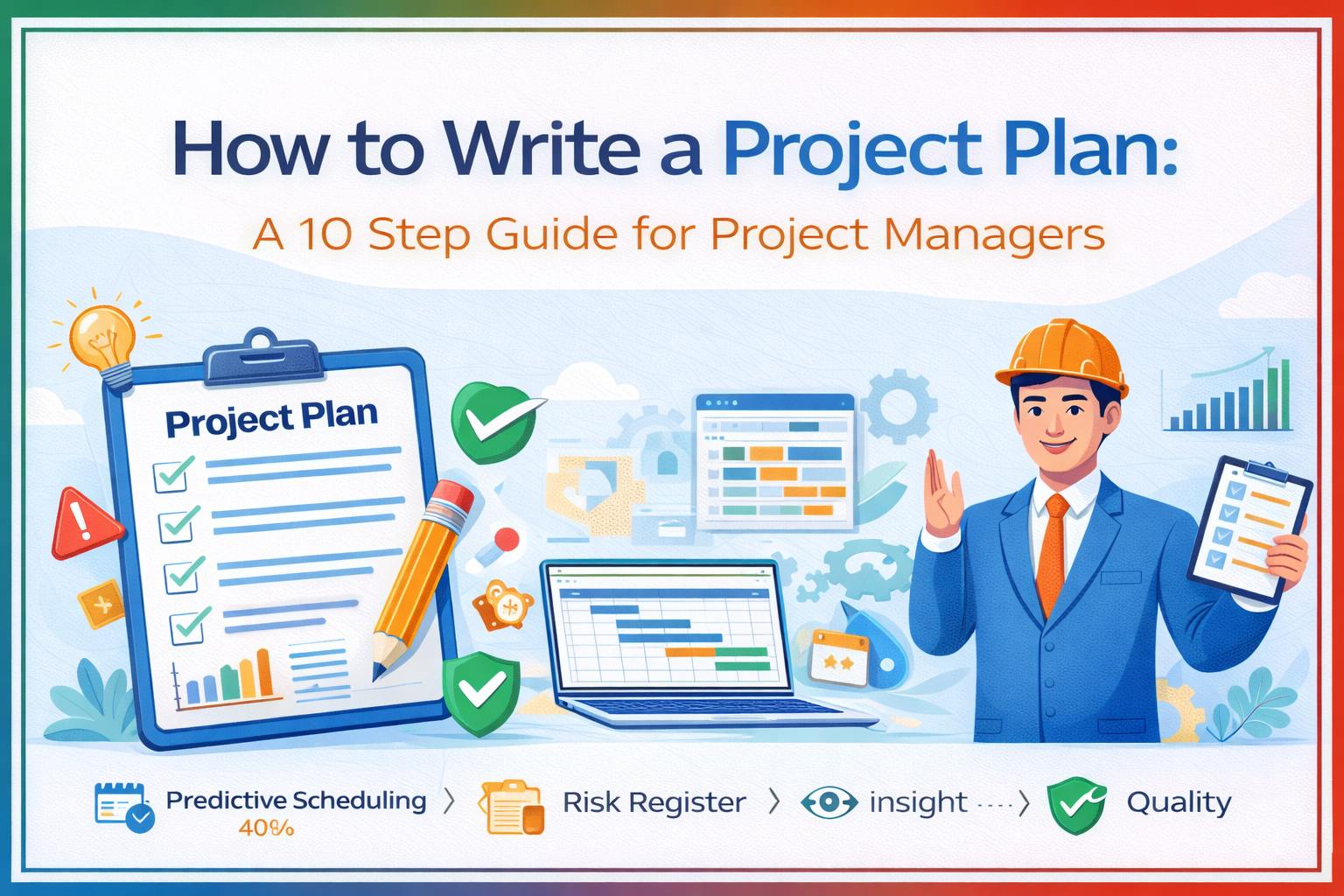
    How to Write a Project Plan: A 10 Step Guide for Project Managers

    Introduction

    A project plan is more than a document—it is a decision-making framework. While many projects fail due to execution challenges, research consistently shows that poor or rushed planning is the root cause.

    In this article, we’ll break down how to write an effective project plan using a 10-step structure that combines classic project management principles with modern, data-driven thinking.

    1. What Is a Project Plan?

    A project plan is a formal document that defines how a project will be executed, monitored, and controlled.

    Why it matters:

    • Organizations using formal planning improve success rates by ~28%
    • Nearly 70% of failed projects lacked structured planning
    • A plan aligns scope, schedule, cost, and expectations

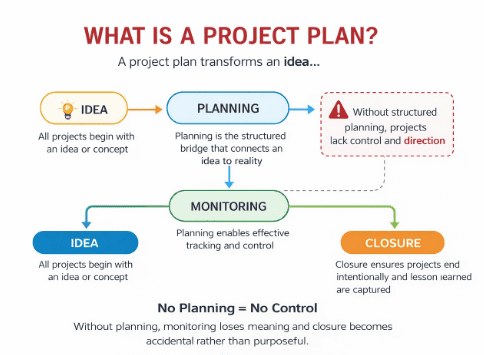
    At its core, a project plan transforms:

    Ideas → Structure → Execution

    What is a project plan

    So, a project plan is not a document created after work begins. It is the structural bridge that transforms an idea into a controlled, monitorable, and closable initiative. The flow diagram emphasizes that without planning, monitoring loses meaning, and closure becomes accidental rather than intentional.

    2. Project Plan Success Statistics

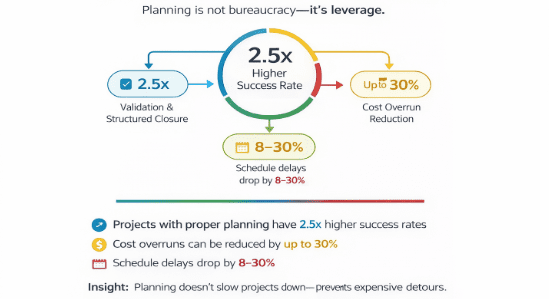
    Planning is not bureaucracy—it’s leverage.

    Key insights:

    • Projects with proper planning have 2.5× higher success rates
    • Validation and structured closure reduce rework
    • Cost overruns can be reduced by up to 30%
    • Schedule delays can drop by 8–30%
    Impact of project planning

    📌 Insight: Planning doesn’t slow projects down—it prevents expensive detours.

    3. Step-by-Step Project Plan Framework

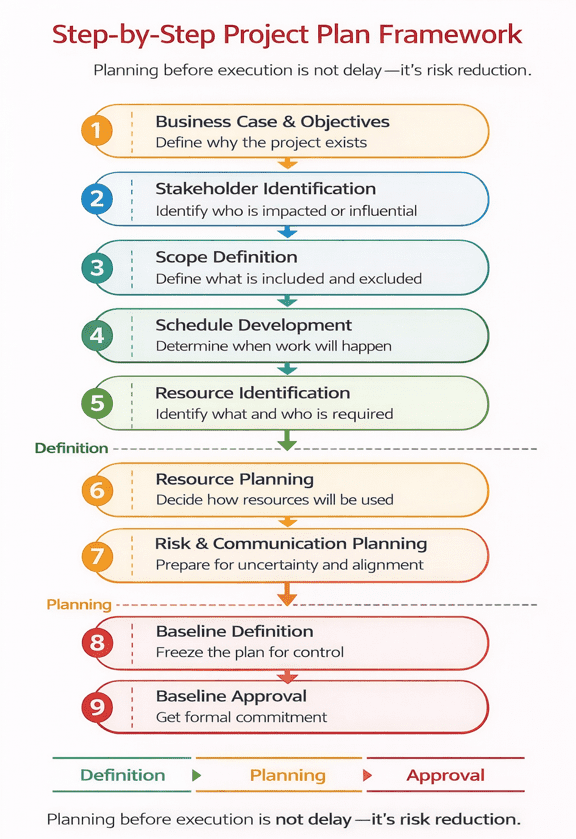
    A solid project plan follows a logical sequence:

    Step-by-Step Project Plan Framework
    1. Business Case & Objectives
      • Purpose: Define why the project exists.
      • Includes:
        • Business problem or opportunity
        • Measurable objectives
        • Success criteria
        • High-level benefits
      • 📌 If this is weak, the entire plan collapses later.
    2. Stakeholder Identification
      • Purpose: Identify who is impacted or influential.
      • Includes:
        • Sponsors
        • Customers/users
        • Internal teams
        • Vendors & external partners
      • 📌 Stakeholders define requirements, risks, and approvals.
    3. Scope Identification
      • Purpose: Define what is included and excluded.
      • Includes:
        • Deliverables
        • Boundaries
        • Assumptions
        • Constraints
      • 📌 Poor scope definition causes 52%+ rework (as noted later in the image).
    4. Schedule Development
      • Purpose: Define when work will happen.
      • Includes:
        • Work Breakdown Structure (WBS)
        • Task sequencing
        • Dependencies
        • Milestones
      • 📌 A schedule without scope is guesswork. A scope without a schedule is theory.
    5. Resource Identification
      • Purpose: Identify what and who is required.
      • Includes:
        • Human resources
        • Tools & technology
        • Infrastructure
        • Budgetary inputs
      • 📌 This answers: “What do we need to execute?”
    6. Resource Planning
      • Purpose: Decide how resources will be used.
      • Includes:
        • Allocation
        • Availability
        • Utilization
        • Skill mapping
      • 📌 This prevents overloading and hidden delays.
    7. Risk and Communication Planning
      • Purpose: Prepare for uncertainty and alignment.
      • Includes:
        • Risk register
        • Mitigation strategies
        • Communication matrix
        • Reporting cadence
      • 📌 Most project failures happen here — not in execution.
    8. Baseline Definition
      • Purpose: Freeze the control plan.
      • Includes:
        • Scope baseline
        • Schedule baseline
        • Cost baseline
      • 📌 Without baselines, monitoring is meaningless.
    9. Baseline Approval
      • Purpose: Get formal commitment.
      • Includes:
        • Stakeholder sign-off
        • Sponsor approval
        • Change control activation
      • 📌 This is where planning officially ends, and execution begins.

    Each step builds clarity before commitment.

    4. Core Project Plan Components

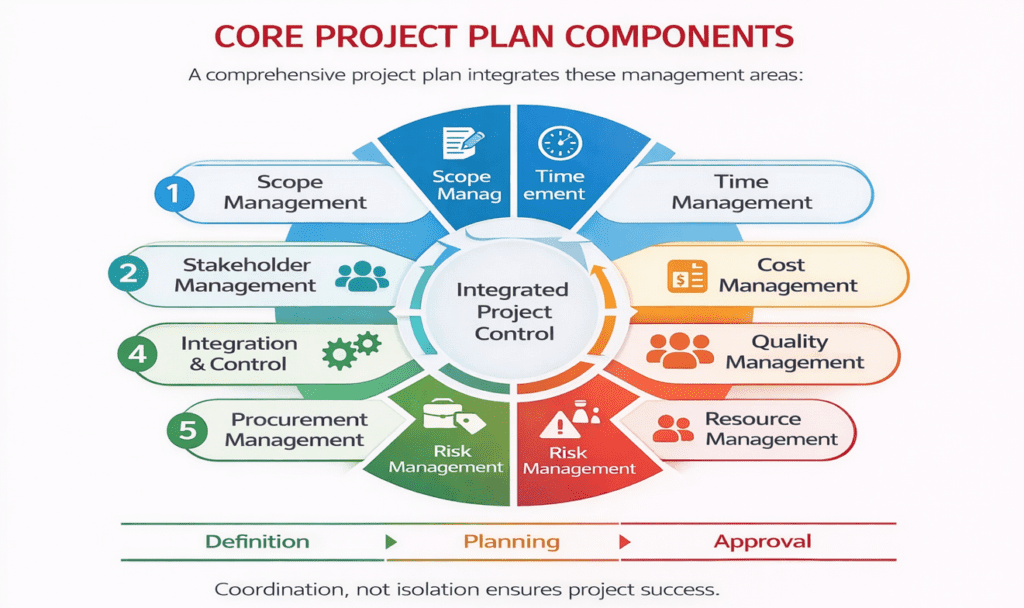
    A project plan is not a collection of independent documents. It is an integrated system where scope, time, cost, quality, resources, risk, and stakeholders are continuously balanced through coordinated planning and control.

    An effective project plan integrates multiple management areas:

    Core Project Plan Components
    • Scope Management
      • Defines what is included and excluded in the project.
      • Weak scope leads to rework, scope creep, and stakeholder dissatisfaction.
    • Time Management
      • Converts scope into a realistic timeline with dependencies and milestones.
      • Unplanned schedules create invisible delays that surface late.
    • Cost Management
      • Ensures the project stays financially viable.
      • Without cost tracking, overruns are discovered too late to correct.
    • Quality Management
      • Quality management defines how “good” is measured, not just when work is completed.
      • It sets standards, acceptance criteria, and review mechanisms to ensure deliverables meet expectations.
      • Without quality planning, teams deliver fast — but fail acceptance.
      • Speed without quality creates rework disguised as progress.
    • Resource Management
      • Resource management ensures the right people, skills, tools, and capacity are available when needed.
      • It prevents overallocation, burnout, and dependency risks.
      • Projects often fail not due to lack of talent, but due to poor resource planning.
      • A plan that ignores capacity is a plan built on assumptions.
    • Risk Management
      • Risk management prepares the project for uncertainty.
      • It involves identifying potential risks, assessing impact, and planning responses.
      • Without risk planning, teams react emotionally under pressure instead of responding logically.
      • Risk ignored in planning becomes a crisis during execution.
    • Procurement Management
      • Procurement management governs external dependencies such as vendors, tools, licenses, and services.
      • It defines sourcing strategies, contracts, and delivery expectations.
      • Weak procurement planning often leads to delays that the project team cannot control.
      • External dependencies don’t follow your internal schedules.
    • Stakeholder Management
      • Stakeholder management identifies who has influence, interest, or impact on the project.
      • It defines engagement strategies, communication needs, and approval expectations.
      • Many project issues are not technical — they are stakeholder misalignment issues.
      • Projects fail quietly when stakeholders are not heard early.
    • Integration & Control
      • Integration is the glue that holds all components together.
      • It ensures that scope, time, cost, quality, resources, risks, and stakeholders are continuously aligned through monitoring and control.
      • This is where the project manager truly adds value — by balancing trade-offs, not just tracking tasks.
      • Coordination, not isolation, ensures project success.

    These components work together through Integrated Project Control, not in isolation.

    5. Essential Formulas & KPIs (EVM)

    Planning is only effective when progress can be measured objectively.

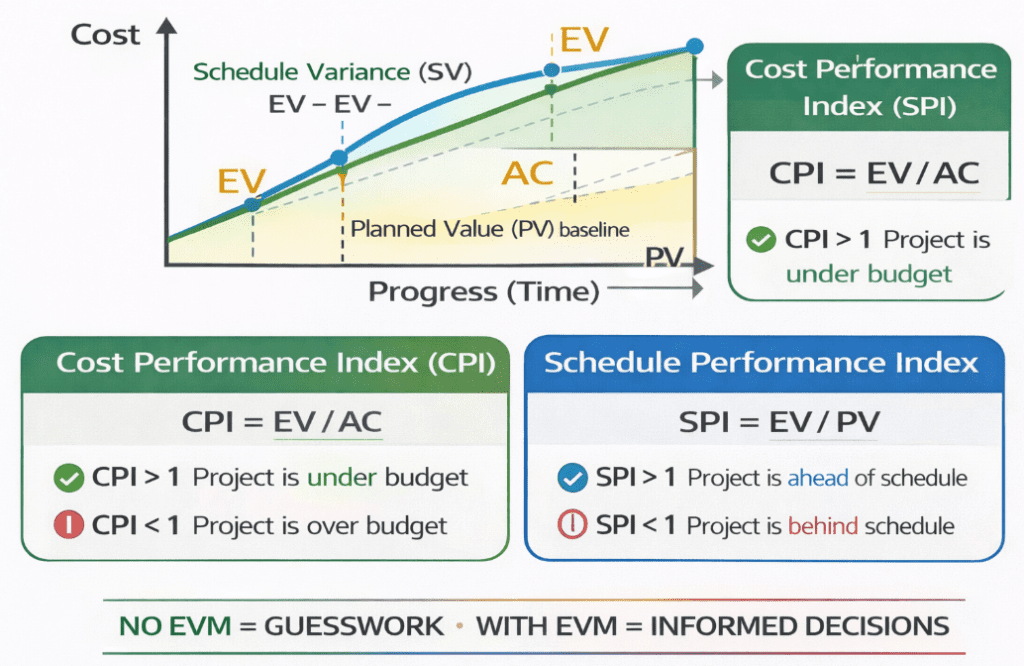
    Earned Value Management (EVM) provides a quantitative view of project health by combining scope, schedule, and cost into a single performance framework.

    Instead of relying on gut feeling, EVM answers one critical question:

    Are we getting the value we expected for the time and money spent?

    Earned Value Management (EVM) provides objective performance visibility.

    Key EVM Metrics Every Project Manager Should Know

    1. Earned Value (EV)

    What it means: The value of work actually completed, measured against the plan.

    📌 EV tells you how much work has truly been accomplished, not just how much time has passed.

    2. Actual Cost (AC)

    What it means: The actual cost incurred for the work completed so far.

    📌 AC reveals how much money you have spent to achieve the earned value.

    3. Planned Value (PV)

    What it means: The value of work that was planned to be completed by a specific time.

    📌 PV represents your baseline expectation.

    Core Performance Indicators

    🔹 Cost Performance Index (CPI)

    Formula: CPI = EV / AC

    What it tells you:

    • CPI > 1 → Project is under budget
    • CPI < 1 → Project is over budget

    📌 A declining CPI is an early warning of budget trouble.

    🔹 Schedule Performance Index (SPI)

    Formula: SPI = EV / PV

    What it tells you:

    • SPI > 1 → Project is ahead of schedule
    • SPI < 1 → Project is behind schedule

    📌 SPI shows schedule health based on delivered value, not time spent.

    🔹 Cost Variance (CV)

    Formula: CV = EV − AC

    📌 Shows how much budget variance exists at a given point in time.

    🔹 Schedule Variance (SV)

    Formula: SV = EV − PV

    📌 Indicates whether progress is ahead or behind the approved baseline.

    Why These KPIs Matter in Real Projects

    Organizations using EVM consistently report:

    • Better forecast accuracy (~35% improvement)
    • Earlier detection of cost and schedule risks
    • Fewer late-stage surprises

    Without EVM, problems surface late.
    With EVM, problems surface while they are still fixable.

    EVM is not about complex math.
    It is about early visibility and informed decisions.

    Earned Value Management

    If a project plan does not define how performance will be measured, it is not a plan — it is a guess.

    6. Essential Project Plan Document Outputs

    A well-defined project plan does not end with ideas or calculations.
    It produces formal documents that guide execution, enable control, and support decision-making throughout the project lifecycle.

    Essential Project Plan Document

    These documents are not just deliverables — they are reference points for alignment, accountability, and governance.

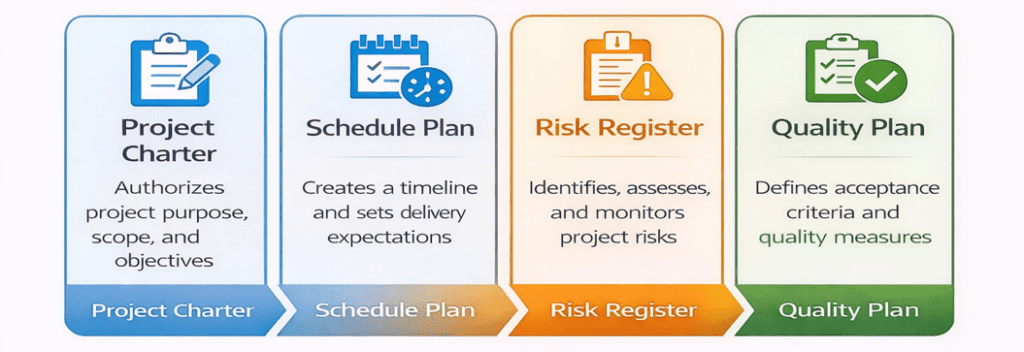
    A project plan typically produces:

    • 📄 Project Charter
      • The Project Charter formally authorizes the project and gives the project manager the authority to apply resources.
      • It defines the project’s purpose, objectives, high-level scope, key stakeholders, and success criteria. Without a clear charter, projects often suffer from unclear ownership and shifting expectations.
      • The charter answers one critical question: “Why does this project exist?”
    • 📅 Schedule Plan
      • The Schedule Plan translates scope into a time-bound execution roadmap.
      • It defines activities, dependencies, milestones, and delivery timelines.
      • This document becomes the baseline against which progress, delays, and corrective actions are measured.
      • A schedule plan turns intent into commitment.
    • ⚠️ Risk Register
      • The Risk Register captures identified risks, their impact, probability, and response strategies.
      • It ensures that risks are discussed early, tracked continuously, and managed proactively rather than reactively.
      • Projects without a risk register don’t avoid risks — they simply get surprised by them.
      • Risks ignored during planning appear as crises during execution.
    • Quality Plan
      • The Quality Plan defines how quality will be measured, reviewed, and accepted.
      • It establishes standards, acceptance criteria, review processes, and responsibility for quality assurance.
      • Without a quality plan, teams may deliver on time but fail acceptance.
      • Quality is not inspected at the end — it is planned from the start.

    These are not just deliverables—they are control instruments throughout execution. These documents are not created to satisfy process requirements.

    They exist to reduce ambiguity, support informed decisions, and protect the project under pressure.

    When project documentation is treated as a control mechanism rather than paperwork, execution becomes predictable and resilient.

    7. Common Project Planning Mistakes

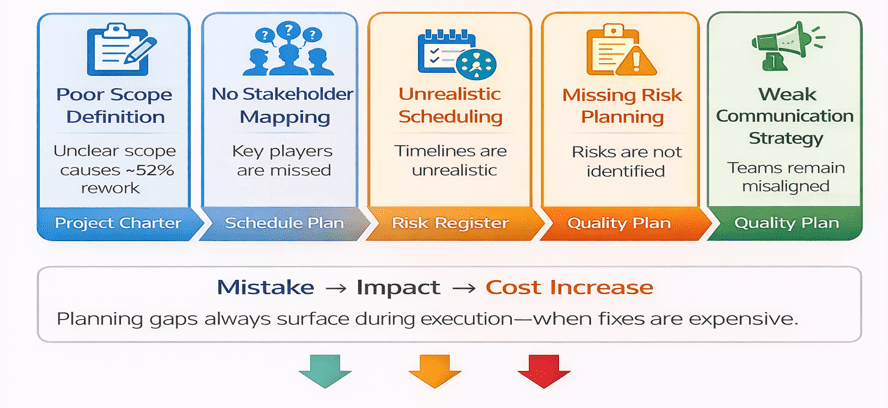
    The most frequent (and costly) planning mistakes include:

    • ❌ Poor scope definition (causes ~52% rework)
    • ❌ No stakeholder mapping
    • ❌ Unrealistic scheduling
    • ❌ Missing risk planning
    • ❌ Weak communication strategy

    Mistake → Impact → Cost Increase

    Common Project Planning Mistakes

    Planning gaps always surface during execution—when fixes are expensive.

    8. Modern Project Planning with Data & AI

    Project planning today is no longer based solely on experience, intuition, or static documents.
    It is increasingly data-assisted, enabling project managers to make faster, more informed decisions.

    AI Add Real Value in Project Planning

    Modern tools analyze historical project data, execution patterns, and real-time signals to surface insights that were previously invisible during planning.

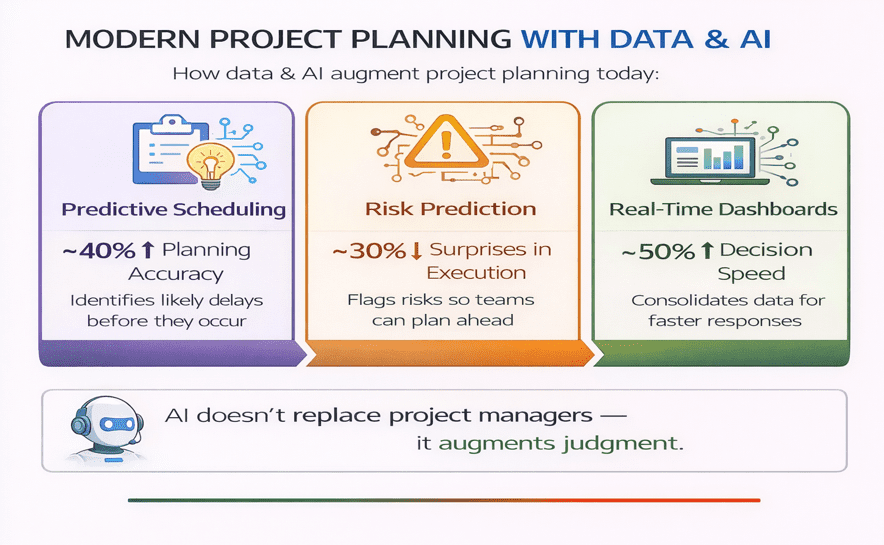
    Where Data & AI Add Real Value in Project Planning

    Predictive scheduling uses historical delivery data and dependency patterns to identify likely delays before they occur.
    This improves planning accuracy by ~40%, especially in complex or multi-team projects.

    Risk prediction models analyze past issues, scope changes, and dependency failures to highlight potential risk areas early.
    This reduces execution surprises by ~30% and allows teams to plan mitigations proactively.

    Real-time dashboards consolidate schedule, cost, resource, and risk data into a single view.
    This improves decision-making speed by ~50%, particularly for senior stakeholders and sponsors.

    AI as a Planning Assistant, Not a Replacement

    AI does not replace project managers.
    It augments judgment by:

    • Highlighting patterns humans may miss
    • Flagging early warning signals
    • Simulating “what-if” scenarios
    • Supporting faster trade-off decisions

    Final decisions still require context, stakeholder awareness, and leadership — areas where human judgment remains critical.

    The Shift in the Project Manager’s Role

    As data and AI handle more analysis and prediction, the project manager’s role evolves from:

    • Task tracking → Decision facilitation
    • Status reporting → Insight communication
    • Reactive problem-solving → Proactive risk management

    Projects still succeed because of people, but people succeed faster when supported by data.

    Modern project planning is not about choosing between experience and technology.
    It is about combining human judgment with data-driven insight to reduce uncertainty and improve outcomes.

    AI accelerates planning.
    Project managers provide direction.

    AI doesn’t replace project managers — it augments judgment.

    9. Project Plan Approval Flow

    A typical approval flow looks like this:

    Draft → Stakeholder Validation → Baseline → Execution

    This ensures:

    • Shared understanding
    • Formal commitment
    • Controlled change management

    📌 Skipping validation often leads to silent misalignment, where teams believe they are aligned—until execution exposes conflicting expectations.

    Approval is not a formality.
    It is the moment where assumptions are replaced with agreement.

    10. Final Success Message

    A strong project plan transforms uncertainty into structured execution.
    Teams that invest time in planning consistently deliver faster, cheaper, and with higher quality outcomes.

    Planning is not about predicting the future — it’s about being ready for it.

    ✅ Conclusion

    Writing a project plan is not a paperwork exercise. It is a leadership act that creates clarity, alignment, and confidence.

    Whether you manage traditional, agile, or hybrid projects, these 10 steps provide a practical blueprint for planning that actually works.

    To hire a Freelance Project Manager, you can connect with Team MumbaiFreelancer.com. If you want to discuss more about this topic, connect with us.

    I came across the following, which I think can help you, too.

  • When Leadership Lacks Empathy: How Project Managers Can Respond

    When Leadership Lacks Empathy: How Project Managers Can Respond

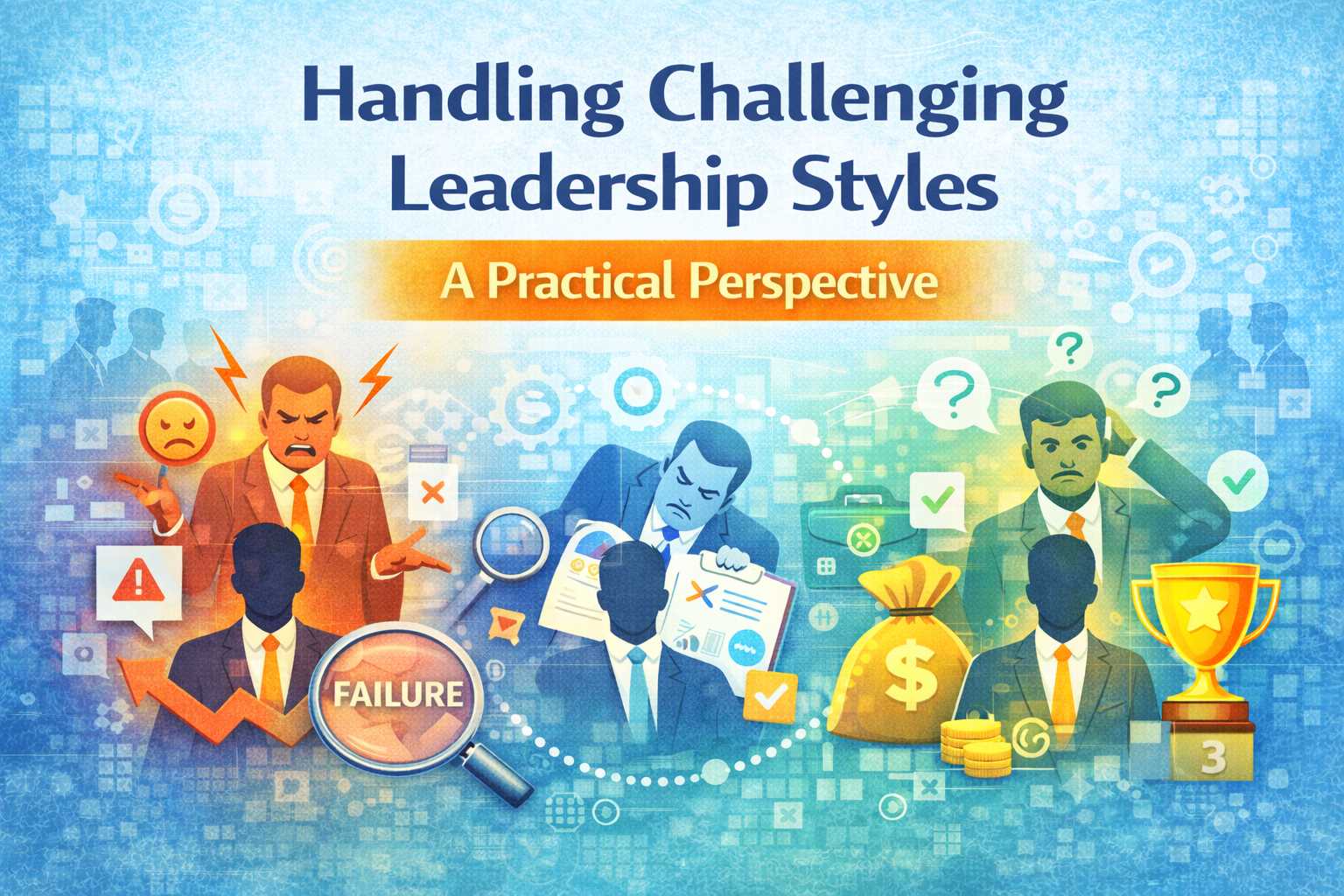
    Handling Challenging Leadership Styles: A Practical Perspective

    Introduction: The Reality Project Managers Rarely Talk About

    Project Management is often described through frameworks, processes, and certifications. But seasoned Project Managers know that projects don’t fail because of missing templates—they struggle because of people, power dynamics, and leadership behavior.

    In many organizations, Project Managers and Team Leads operate under leaders who may be technically competent but emotionally detached, ego-driven, or inconsistent in their respect and support. Empathy may be absent, yet expectations remain high. Deadlines don’t move. Accountability doesn’t soften.

    This creates a difficult reality:
    How do you lead, deliver, and protect your team when leadership lacks empathy?

    This article explores practical strategies Project Managers can use to:

    • Lead effectively when respect is inconsistent
    • Maintain professionalism under pressure
    • Recognize subtle manipulation tactics
    • Set expectations without triggering retaliation
    • Keep teams focused, motivated, and protected

    This is not about diagnosing personalities. It’s about operating professionally and strategically in challenging leadership environments.

    1. Leading Effectively When Respect Is Inconsistent

    Inconsistent respect is one of the most destabilizing leadership patterns Project Managers face. One week your judgment is trusted; the next, your decisions are questioned publicly. One sprint review ends with appreciation; the next becomes a blame exercise.

    For Project Managers, this inconsistency creates authority erosion—especially in front of teams and stakeholders.

    How Project Managers Can Respond

    The mistake many PMs make is seeking emotional validation or approval. That approach makes leadership effectiveness dependent on someone else’s behavior.

    Instead, anchor your leadership in structure and predictability:

    • Approved scope documents
    • Clearly defined milestones
    • RAID logs
    • Decision records
    • Agreed success metrics

    When respect fluctuates, process becomes your credibility.

    Lead through:

    • Clear agendas
    • Written summaries
    • Objective reporting
    • Outcome-focused discussions

    Your team will follow consistency, even if leadership behavior is unpredictable.

    Key Insight:
    Project authority doesn’t come from personal approval—it comes from clarity and structure.

    2. Maintaining Professionalism Under Pressure

    Projects are pressure environments by default. Add emotionally reactive or ego-driven leadership, and pressure can quickly turn toxic.

    Project Managers often face:

    • Public questioning of decisions
    • Escalations without warning
    • Emotionally charged meetings
    • Unrealistic demands framed as urgency

    The instinctive reaction is to defend yourself or push back emotionally. But experienced PMs know this rarely ends well.

    The Professional Response

    Professionalism under pressure means controlling tone, not surrendering authority.

    Effective Project Managers:

    • Separate issue ownership from personal emotion
    • Respond with facts, not feelings
    • Frame conversations around impact, risk, and trade-offs
    • Avoid emotional escalation, even when provoked

    Your calm becomes a stabilizing force. Teams notice. Stakeholders notice. Even difficult leaders notice—even if they never acknowledge it.

    Key Insight:
    Professional calm is not silence—it is controlled leadership.

    3. Recognizing Subtle Manipulation in Project Environments

    Manipulation in leadership is rarely dramatic. It’s subtle, plausible, and often disguised as “business pressure.”

    In project settings, it may appear as:

    • Verbal approvals later denied
    • Scope changes introduced informally
    • Praise given privately, blame assigned publicly
    • Escalations framed without full context
    • Shifting success criteria mid-project

    Left unrecognized, these behaviors create confusion, self-doubt, and delivery risk.

    What Project Managers Should Do

    The goal is not confrontation, but protection.

    Strong PMs respond with:

    • Written confirmations after meetings
    • Documented decisions and assumptions
    • Neutral meeting minutes
    • Transparent risk communication

    This is not bureaucracy. It’s risk mitigation.

    When narratives shift, documentation provides continuity. When accountability becomes selective, records provide fairness.

    Key Insight:
    Awareness creates distance. Documentation creates safety.

    4. Setting Expectations Without Triggering Retaliation

    Project Managers must constantly set boundaries—on scope, timelines, quality, and resources. In empathy-deficient leadership environments, boundary-setting can be misinterpreted as resistance or incompetence.

    This is where many PMs struggle.

    The Framing That Works

    The secret lies in how expectations are framed.

    Avoid:

    • “I can’t do this.”
    • “My team is overloaded.”
    • “This is unreasonable.”

    Instead, focus on:

    • Delivery impact
    • Risk exposure
    • Trade-offs
    • Business consequences

    For example:

    “If we accelerate this timeline, quality risk increases here. To mitigate that, we’ll need either additional resources or reduced scope.”

    Follow verbal conversations with written summaries. Keep language neutral and professional.

    Key Insight:
    Frame boundaries as project protection, not personal limitation.

    5. Keeping the Team Focused and Protected

    Teams sense leadership instability long before it’s acknowledged. When leadership lacks empathy, the impact trickles down as:

    • Anxiety
    • Confusion
    • Fear of blame
    • Reduced psychological safety

    A Project Manager’s role expands in such environments—from coordinator to buffer.

    How Project Managers Protect Their Teams

    Effective PMs:

    • Filter unnecessary noise from leadership
    • Translate vague or emotional directives into actionable tasks
    • Maintain clarity around priorities
    • Absorb pressure so teams can focus on delivery

    This doesn’t mean hiding reality. It means containing emotional volatility and protecting focus.

    Teams don’t need every leadership emotion—they need direction, safety, and predictability.

    Key Insight:
    When leadership is unpredictable, the team relies on the Project Manager for stability.

    6. Leading Without Losing Yourself

    One overlooked cost of working under empathy-deficient leadership is burnout. Project Managers are often expected to be endlessly resilient, neutral, and composed—without acknowledgment.

    Sustainable leadership requires:

    • Emotional boundaries
    • Peer support
    • Self-awareness
    • Periodic detachment from toxic dynamics

    Strong PMs know when to push, when to document, when to escalate—and when to disengage emotionally.

    Leadership effectiveness is not measured by how much pressure you absorb, but by how well you sustain delivery over time.

    Key Insight:
    Resilience is not endurance without limits—it’s endurance with awareness.

    Conclusion: Quiet Leadership That Sustains Projects

    Project Managers don’t always have the power to change leadership behavior. But they do have the responsibility to:

    • Protect delivery
    • Preserve team health
    • Maintain professionalism
    • Lead with clarity and restraint

    Handling leadership that lacks empathy is not about confrontation or ego battles. It’s about structure over emotion, facts over narratives, and consistency over approval.

    The Project Managers who master this skill become anchors in difficult organizations. Their leadership is not always loud—but it is lasting.

    Learn more about Project Managementconnect with us