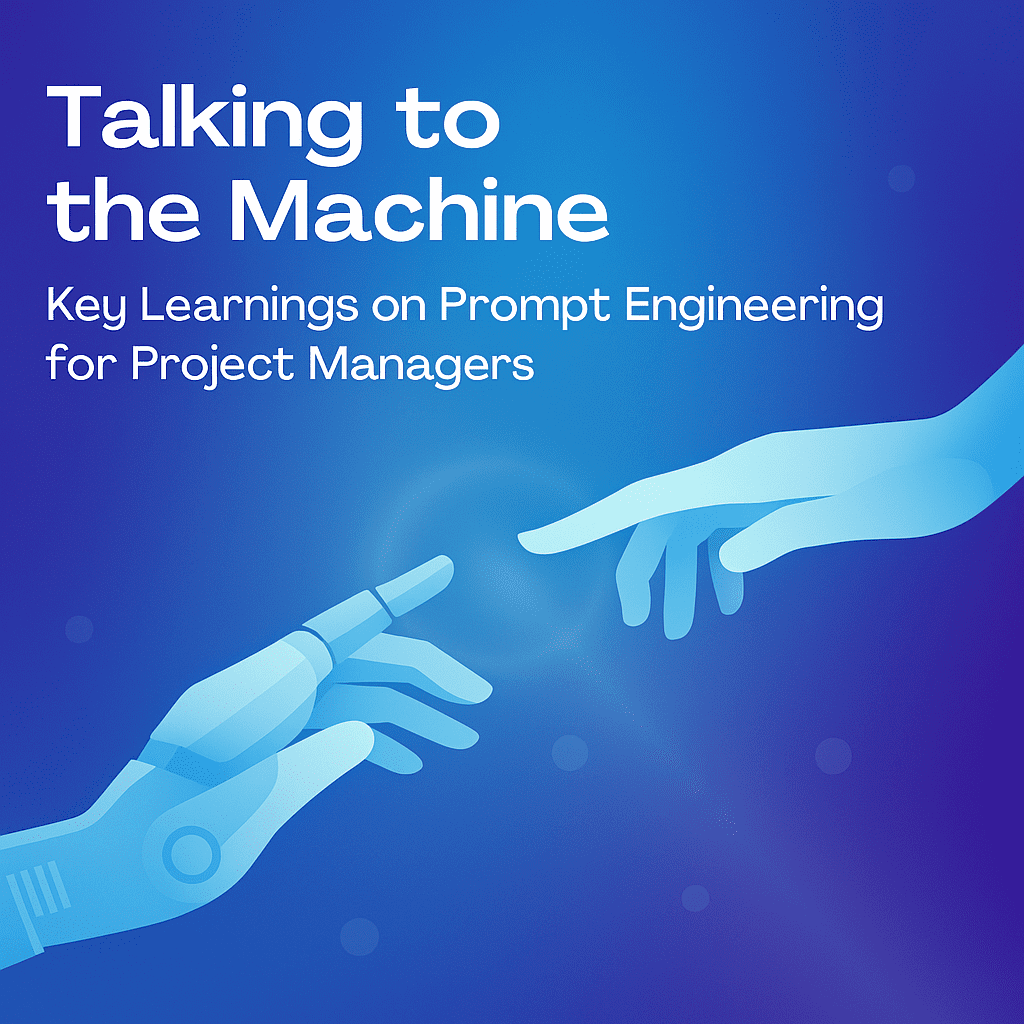
Artificial Intelligence is reshaping how project professionals plan, communicate, and deliver results. After studying PMI’s guide “Talking to the Machine – Prompt Engineering Essentials for Project Professionals,” I realized that prompt engineering is not just a technical skill — it is now a core competency for every project manager.
In this post, I am sharing the most practical and impactful insights from the guide, along with why they matter to all of us leading projects in the AI era.
1. Prompt Engineering: The New Power Skill for PMs
Generative AI tools like ChatGPT, Gemini, Claude, and Microsoft Copilot communicate using natural language.
That means the quality of output depends on the quality of our prompts.
Prompt engineering is the art of telling AI what you want, why you want it, and how you want it delivered — in a structured, contextual, and conversational manner.
For project managers, this skill directly improves:
- Clarity
- Productivity
- Decision-making
- Stakeholder alignment
- Speed of delivery
2. PM Skills Naturally Make You a Good Prompt Engineer
The guide highlights something powerful:
Project managers already possess the core skills needed for effective prompting.
These include:
- Communication skills: Explaining goals and constraints clearly
- Creativity and critical thinking: Asking better questions
- Logical reasoning: Breaking problems into smaller parts
- Problem-solving mindset: Iterating until you get a solid answer
Your existing PM strengths already set you up for success with GenAI.
3. AI Works Best When You Treat It as a Conversation
GenAI is not a search engine — it’s a “thinking partner.”
The best results come through dialogue, not one-shot queries.
The ideal workflow:
- Start with an open-ended question
- Let AI respond
- Narrow the scope
- Ask clarifying questions
- Request deeper insights, examples, or alternatives
This diverge → converge method helps you shape high-quality output.
4. Use Proven Prompt Patterns for Better Results
PMI introduces several prompt patterns that dramatically improve effectiveness.
The most useful ones:
✔ Persona Prompt
“Act as a senior project stakeholder…”
→ Good for expert-style output.
✔ Flipped Interaction
“Ask me questions until you understand the requirement.”
→ Great for requirement discovery and stakeholder simulation.
✔ Alternative Approaches
“Give me 3 ways to solve this problem and compare pros/cons.”
→ Ideal for brainstorming.
✔ Cognitive Verifier
Breaks down complex challenges into smaller, structured steps.
✔ Fact Checklist & Reflection
Helps identify claims and assumptions to check. Asking AI to review its own answer does not independently verify facts; confirm important claims against reliable sources.
These patterns turn vague ideas into clear, actionable insights.
5. How AI Enhances Project Work: The 3-Tier Model
PMI categorizes GenAI usage into three layers:
1️⃣ Automation (Speed & Efficiency)
AI can instantly generate:
- Meeting minutes
- Status reports
- Lesson-learned summaries
- Communication drafts
- Document formatting
It frees PMs from repetitive work.
2️⃣ Assistance (Filling Knowledge Gaps)
AI becomes a research and analysis partner.
Examples:
- Identifying risks for a risk matrix
- Listing stakeholder concerns
- Creating cost-benefit analysis
- Suggesting planning techniques
- Explaining new frameworks
Perfect for PMs entering new industries or domains.
3️⃣ Augmentation (Advanced Problem-Solving)
AI acts as a thought partner to navigate complex decisions.
Use it to:
- Frame a business case
- Develop decision options
- Unpack layered problems
- Analyze scenarios
- Develop mitigation strategies
AI does not replace project managers — it amplifies our thinking.
6. Context Is the Secret Ingredient
The more context you provide, the better the answer.
Good prompts include details about:
- Industry
- Project type
- Approaches (Agile, Hybrid, Predictive)
- Constraints
- Stakeholders
- Examples of desired output
Clear context can improve relevance, but it does not guarantee factual accuracy.
7. AI Still Needs Human Oversight
Even with powerful capabilities, GenAI is not perfect.
Project managers must:
- Validate facts
- Ensure ethical compliance
- Avoid inputting confidential information
- Exercise judgment on recommendations
AI is a tool — not a decision-maker.
Worked example: turn project notes into a reviewable status draft
A useful prompt gives AI enough evidence to work with and sets limits on what it may infer. The following is an illustrative website-project example, not a real client report or an excerpt from PMI’s guide. It shows how a project manager can separate recorded facts from decisions that still need human judgment.
A vague request would be: “Write a project status report.” It leaves the model to guess the reporting period, audience, evidence and tone. A more useful instruction supplies those details and makes unknowns visible:
Act as a project reporting assistant. Draft a short weekly update for the sponsor of a five-page service website, using only these fictional notes: three page designs are approved; two await client feedback; the developer cannot finish the booking integration until test credentials arrive; no revised estimate has been agreed. Use four sections: completed work, blockers, decisions needed and next actions. Do not invent dates, owners, completion percentages or an overall red/amber/green rating. Label missing information “not confirmed.” For each proposed action, identify what a human needs to confirm before it becomes a commitment. End with questions for the project manager.
A reviewable draft could state that three designs are approved and that the booking integration is blocked by missing test credentials. It should not claim the project is 60% complete: three of five approved designs is not a measure of completion across development, content, integration and testing.
Similarly, “the client will provide credentials tomorrow” would be an invented commitment. An appropriate next action is to confirm who can supply suitable test credentials and when. If the delivery date may be affected, ask the team to assess the impact rather than letting the model choose a new date.
Review the draft before sharing it
- Trace each fact: does it match the approved notes, task record or decision log?
- Check implied commitments: have any dates, owners, costs or approvals appeared without evidence?
- Separate facts from suggestions: proposed actions must remain proposals until the responsible person agrees.
- Check confidentiality: use information permitted by your organization’s policy for the chosen AI service; remove unnecessary client and personal data.
- Confirm the decision: the project manager and appropriate stakeholders approve the update and any escalation.
A follow-up prompt can ask, “Which statements in this draft are directly supported by the notes, and which are assumptions?” Use the answer to guide your review. It is not an independent fact check, and asking twice does not make an unsupported claim reliable.
Final Thought
Prompt engineering is no longer optional.
For project managers, it is becoming a career-defining skill — one that enhances leadership, sharpens decision-making, and unlocks new levels of productivity.

When we learn to “talk to the machine” effectively, we don’t just automate tasks…
we elevate the way we think, lead, and deliver projects.
Connect with Us to discuss more on this. or Reach me on my personal Blog and if you are serving as a freelance Project Manager or managing freelance projects then you may like my other blog AboutFreelancing.com
Apply these instructions to a specific task using the AI in project planning guide. When the task is building software, our vibe-coding article explains why requirements, review and iteration still matter.