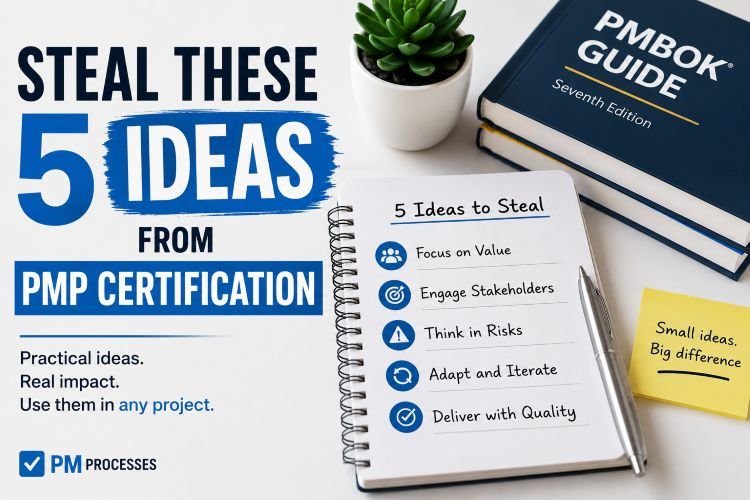
You can improve a small project before deciding whether to pursue certification. The useful starting point is a short set of decisions: what should improve, who needs to be involved, how to organise the work, what uncertainty matters and who accepts the result.
The five practices below draw on familiar project-management principles. They are a lightweight editorial interpretation, not an official PMP exam checklist or a claim that every project can be managed with five documents.
1. Define value as a change someone can observe
Illustrative project: a three-person team has four weeks to introduce a supplier-onboarding form. Completing the form is the output. Reducing incomplete submissions and avoidable follow-up is the intended outcome.
Write: “For the purchasing team, improve the completeness of incoming supplier information; compare with the baseline sample; keep a purchasing owner responsible for reviewing the outcome after launch.” Define the sample and measurement period before using a percentage target.
Keep delivery acceptance separate: required fields, access, validation and the approved handover can be tested before launch. The later benefit still needs evidence from real use.
2. Find the people who can accept or block the change
| Stakeholder | Why involve them? | Decision or contribution |
|---|---|---|
| Purchasing owner | Owns the working process | Accepts workflow and reviews outcomes |
| Finance reviewer | Needs consistent supplier details | Confirms fields and validation |
| Data/security owner | Controls sensitive information | Reviews access and retention |
| Representative user | Must complete or process the form | Tests usability and exceptions |
| Technical maintainer | Supports the live service | Accepts runbook and fault reporting |
Ask who else is affected rather than assuming this list is complete. Record when each person is needed. A late objection may reveal a missed requirement; address the substance instead of labelling the person difficult.
3. Tailor the work without losing control
Keep a fixed launch constraint visible, but use short feedback cycles for uncertain form wording and validation. Demonstrate an early version to purchasing and finance before building every field.
A small change record can be enough: requested change, reason, effort, effect on acceptance and decision owner. Tailoring reduces unnecessary ceremony; it does not remove security checks, obligations or agreed approval rights.
4. Distinguish risks, assumptions and issues
A risk is uncertainty that can affect objectives positively or negatively. An assumption is something used as a planning basis. An issue has already occurred. Unchecked assumptions can create risk, but the terms are not interchangeable.
| Type | Illustrative example | Useful action |
|---|---|---|
| Assumption | Finance can review the form next Tuesday | Confirm availability |
| Threat | If review is delayed, approval may miss the launch window | Book a delegate and set an escalation date |
| Opportunity | An existing approved form may meet most needs | Investigate reuse before building |
| Issue | The test account cannot access the form | Assign an owner and resolve or escalate |
For each important risk, name an owner and a response. Do not impose a rule to avoid escalation in every situation: urgent safety, security or authority-boundary issues may require immediate escalation through the agreed route.
5. Close with acceptance and operational ownership
The sponsor saying “looks good” is useful only if the agreed acceptance evidence is clear. Ask the authorised reviewer to confirm the required behaviour and record any exceptions. A form that works in a demonstration may still lack a support owner.
- Acceptance evidence and unresolved exceptions
- Final form/configuration location and access arrangements
- Named owner for support and future changes
- Instructions for failure reporting and the fallback process
- Outstanding actions with owners and dates
- Outcome review date and benefit owner
- One lesson worth carrying into the next project
Use the practices at your next review
Spend the meeting on decisions rather than reading the whole plan aloud: is the intended value still relevant, is anyone missing, what changed, which uncertainty needs action and is handover ready? Scale the detail to the consequences of getting the answer wrong.
For a fuller delivery plan, use our project-plan guide. If you are choosing a credential, read PMP vs CAPM separately; applying these practices does not establish certification eligibility.
Sources and further reading
Reviewed 5 November 2026. Independent editorial guidance; examples are illustrative and are not claimed client results.